Khlestkin V K, Lockachuk M N, Savkina O A, Kuznetsova L I, Pavlovskaya E N, Parakhina O I
All-Russian Research Institute of Genetics and Breeding of Farm Animals - Branch of L.K. Ernst Federal Research Center for Animal Husbandry, Pushkin, St. Petersburg, Russia.
Saint-Petersburg Brunch of the Scientific Research Institute for the Baking Industry, Pushkin, St. Petersburg, Russia.
Vavilovskii Zhurnal Genet Selektsii. 2022 Jul;26(4):385-393. doi: 10.18699/VJGB-22-47.
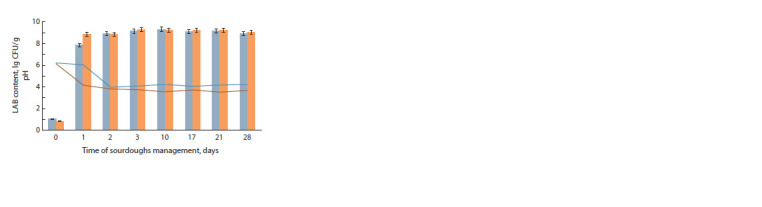
The article is devoted to the study of the microbiome of spontaneously fermented sourdoughs. The aim of the work was to study the inf luence of the technological parameters of sourdough propagations on the taxonomic structure of the microbiome of spontaneously fermented sourdoughs. Two spontaneously fermented sourdoughs were studied: dense rye sourdough and liquid rye sourdough, both prepared using the same batch of peeled rye f lour. To study the taxonomic structure of the sourdough microbiome in dynamics, the method of high-throughput sequencing of 16S rRNA gene fragments of microorganisms was used. It was shown that the technological parameters of sourdough (humidity, temperature) do not affect the taxonomic composition of the microbiome of dense rye or liquid rye sourdough at the phylum/class/genus level. It was found that during the f irst three days of propagations, bacteria from the phyla Proteobacteria and Firmicutes dominated in the microbial community. In the phylum Proteobacteria, microorganisms from the order Enterobacterales took a large share, which persisted for three days of backslopping. The phylum Firmicutes was represented by lactic acid bacteria of the genera Weissella, Lactobacillus, Leuconostoc, Pediococcus, Lactococcus. It was established by classical microbiological methods that after a day of fermentation, the number of lactic acid bacteria cells was signif icantly higher in liquid rye sourdough compared to dense one. However, with further propagation of sourdoughs, the number of cells was comparable, while signif icant changes occurred at the level of genera and species. It was shown that as the relative number of lactic acid bacteria of the genus Lactobacillus increased, a gradual displacement of the coccal forms of Lactococcus, Leuconostoc, Weissella, Pediococcus happened. With further propagation of sourdough after 10 days, the position of the dominant groups of bacteria was occupied by representatives of the phylum Firmicutes, lactic acid bacteria of the genus Lactobacillus. The inf luence of the mode and parameters of the sourdough on the species composition of lactobacilli, which demonstrated a low bacterial diversity, is shown. In the f irst three days of propagations, lactobacilli L. curvatus, L. brevis, and Lactiplantibacil- lus sp. dominated in both sourdoughs. After a month of backslopping, Fructilactobacillus sanfranciscensis and Companilactobacillus sp. dominated in dense rye sourdough, and L. pontis dominated in liquid rye sourdough.
本文致力于自发发酵酸面团微生物群的研究。该工作的目的是研究酸面团发酵工艺参数对自发发酵酸面团微生物群分类结构的影响。研究了两种自发发酵酸面团:致密黑麦酸面团和液体黑麦酸面团,二者均使用同一批次的去皮黑麦粉制备。为动态研究酸面团微生物群的分类结构,采用了微生物16S rRNA基因片段高通量测序方法。结果表明,酸面团的工艺参数(湿度、温度)在门/纲/属水平上不影响致密黑麦或液体黑麦酸面团微生物群的分类组成。研究发现,在发酵的前三天,变形菌门和厚壁菌门的细菌在微生物群落中占主导地位。在变形菌门中,肠杆菌目微生物占很大比例,这种情况在回接发酵的三天中持续存在。厚壁菌门由魏斯氏菌属、乳杆菌属、明串珠菌属、片球菌属、乳球菌属的乳酸菌代表。通过经典微生物学方法确定,发酵一天后,液体黑麦酸面团中乳酸菌细胞数量显著高于致密黑麦酸面团。然而,随着酸面团的进一步发酵,细胞数量相当,而在属和种水平上发生了显著变化。结果表明,随着乳杆菌属乳酸菌相对数量的增加,乳球菌属、明串珠菌属、魏斯氏菌属、片球菌属的球菌形式逐渐被取代。酸面团发酵10天后进一步发酵,细菌优势菌群的位置被厚壁菌门的代表、乳杆菌属的乳酸菌占据。研究显示了酸面团的发酵方式和参数对乳酸菌物种组成的影响,乳酸菌表现出较低的细菌多样性。在发酵的前三天,弯曲乳杆菌、短乳杆菌和植物乳杆菌在两种酸面团中占主导地位。回接发酵一个月后,旧金山果糖乳杆菌和 Companilactobacillus sp. 在致密黑麦酸面团中占主导地位,而 pontis 乳杆菌在液体黑麦酸面团中占主导地位。