Zhou Rong, Li Jiayu, Chen Meiling
The Second School of Clinical Medicine, Zhejiang Chinese Medical University, Hangzhou, China.
School of Humanities and Management, Zhejiang Chinese Medical University, Hangzhou, China.
Front Med (Lausanne). 2022 Jul 5;9:900488. doi: 10.3389/fmed.2022.900488. eCollection 2022.
Previous studies suggested that physical and cognitive function can be indicators to assess the risk of falls in the elderly. Various tests are widely used in geriatric clinical studies as assessment tools of physical and cognitive function. However, large sample studies comparing the fall predictive value of these tests are still sparse. This study was conducted to investigate the value of cognitive and physical function tests in predicting the risk of subsequent falls in the elderly, with the overarching goal of providing more evidence on fall-risk assessment.
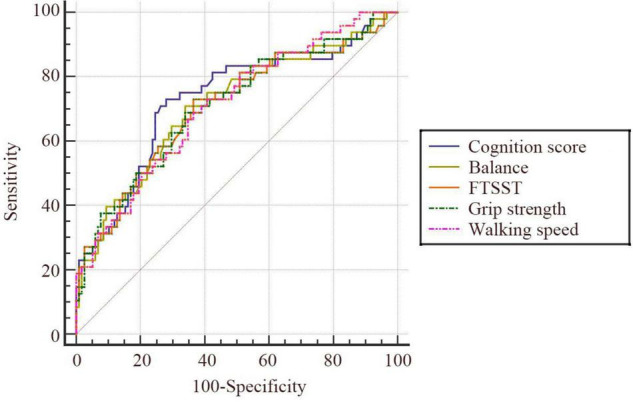
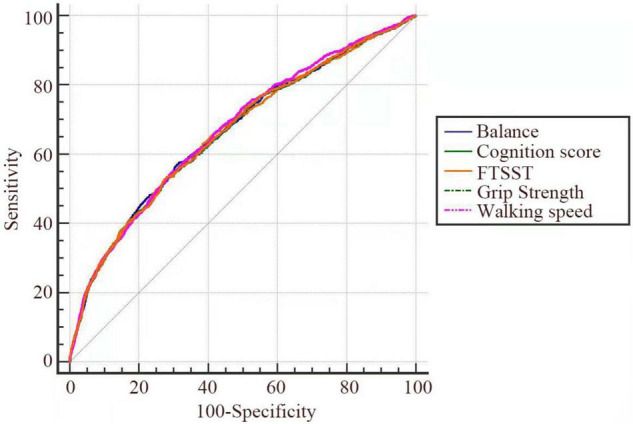
The current study was based on the data of respondents aged 60 and above from the China Health and Retirement Longitudinal Study (CHARLS). Data from the 2015 CHARLS national survey were used as the baseline data, and the fall data in 2018 were used as the follow-up data. Physical function tests included balance, walking speed, the five times sit-to-stand test (FTSST), and grip strength. The value of cognitive and physical function tests in predicting falls was evaluated by logistic regression analysis and receiver operating characteristic (ROC) curves.
The incidence of falls among the 4,857 subjects included in this study was 20.86%. Results showed that cognition (OR = 0.83, 95% CI: 0.70-0.98), the FTSST (OR = 3.51, 95% CI: 1.66-7.46), and grip strength (OR = 1.02, 95% CI: 1.01-1.03) were independent predictors of falls in the full sample after adjusting for various confounders. Notably, the above tests showed better predictive value for falls for the oldest-old (≥ 80 years) subjects.
Overall, results showed that grip strength, the FTSST, and cognition tests are simple and practicable tools for identifying individuals at higher risk of falls in the community. Moreover, the fall predictive performance of physical and cognitive function tests was age-dependent, with a higher predictive value in older adults aged 80 and above.
先前的研究表明,身体和认知功能可作为评估老年人跌倒风险的指标。各种测试在老年临床研究中被广泛用作身体和认知功能的评估工具。然而,比较这些测试跌倒预测价值的大样本研究仍然较少。本研究旨在探讨认知和身体功能测试在预测老年人随后跌倒风险中的价值,总体目标是为跌倒风险评估提供更多证据。
本研究基于中国健康与养老追踪调查(CHARLS)中60岁及以上受访者的数据。2015年CHARLS全国调查的数据用作基线数据,2018年的跌倒数据用作随访数据。身体功能测试包括平衡、步行速度、五次坐立试验(FTSST)和握力。通过逻辑回归分析和受试者工作特征(ROC)曲线评估认知和身体功能测试在预测跌倒方面的价值。
本研究纳入的4857名受试者中,跌倒发生率为20.86%。结果显示,在调整各种混杂因素后,认知(OR = 0.83,95%CI:0.70 - 0.98)、FTSST(OR = 3.51,95%CI:1.66 - 7.46)和握力(OR = 1.02,95%CI:1.01 - 1.03)是全样本跌倒的独立预测因素。值得注意的是,上述测试对年龄最大的(≥80岁)受试者的跌倒显示出更好的预测价值。
总体而言,结果表明握力、FTSST和认知测试是识别社区中跌倒风险较高个体的简单可行工具。此外,身体和认知功能测试的跌倒预测性能与年龄有关,在80岁及以上的老年人中预测价值更高。