Gad Hanem M, El Rayes S M, Abdelrahman Ehab A
Chemistry Department, Faculty of Science, Suez Canal University Ismailia 41522 Egypt.
Chemistry Department, Faculty of Science, Benha University Benha 13518 Egypt
RSC Adv. 2022 Jul 1;12(30):19209-19224. doi: 10.1039/d2ra03177a. eCollection 2022 Jun 29.
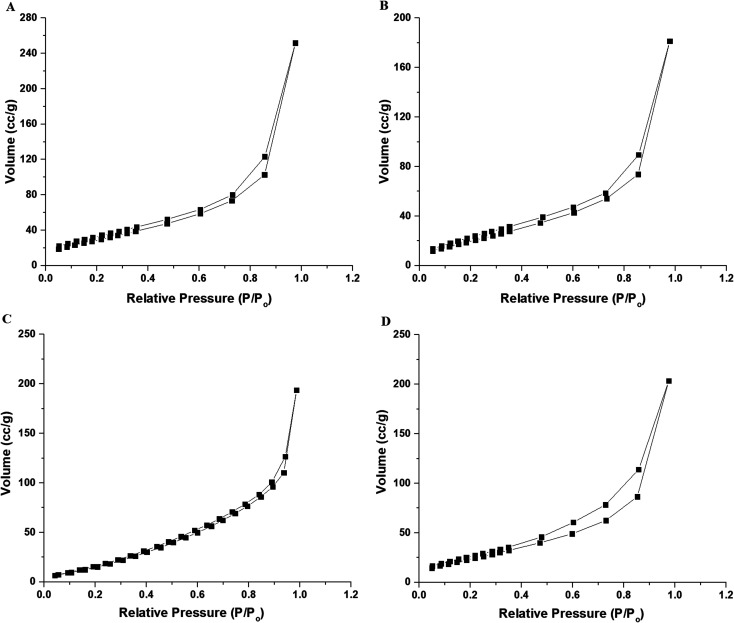
Herein, silica nanoparticles were modified by 2,4-dihydroxybenzaldehyde and 5-bromosalicylaldehyde to produce new nanocomposites which were abbreviated as N and N, respectively. The synthesized nanocomposites were used for efficient removal and preconcentration of Cu(ii) and Cd(ii) ions from water, blood, and fish muscles. FE-SEM, FT-IR, XRD, CHN elemental analysis, and nitrogen gas sorption analyzer were used to characterize the new nanocomposites. The XRD proved that the synthesized oxide is cristobalite with an average crystallite size of 54.80 nm. Due to the formation of the C[double bond, length as m-dash]N group, the intensity of the XRD peak at 2 = 21.9° in the N and N nanocomposites decreased significantly. The FT-IR bands, which appeared at 1603 and 1629 cm in the N and N nanocomposites, are attributable to the bending vibration of C[double bond, length as m-dash]N and/or OH, respectively. Also, the FE-SEM analysis shows the morphology of the silica nanoparticles which were identified as spherical and rod-like with slight agglomeration while the N and N nanocomposites have flaky surfaces due to the formation of C[double bond, length as m-dash]N groups. The maximum Cu(ii) ion adsorption capacities of the N and N nanocomposites are 64.81 and 40.93 mg g, respectively. The maximum Cd(ii) ion adsorption capacities of the N and N nanocomposites are 27.39 and 26.34 mg g, respectively. The adsorption of Cu(ii) or Cd(ii) ions using the synthesized nanocomposites is spontaneous, chemical, exothermic, and well-matched with the Langmuir equilibrium isotherm. The recovery findings demonstrate that the preconcentration process is accurate, adaptable, and resulted in quantitative separation because % Recovery is more than 95%. Furthermore, the % RSD was less than 3.5%, indicating good reproducibility.
在此,二氧化硅纳米颗粒用2,4 - 二羟基苯甲醛和5 - 溴水杨醛进行改性,以制备分别简称为N和N的新型纳米复合材料。合成的纳米复合材料用于从水、血液和鱼肌肉中高效去除和预富集铜(II)和镉(II)离子。使用场发射扫描电子显微镜(FE - SEM)、傅里叶变换红外光谱仪(FT - IR)、X射线衍射仪(XRD)、CHN元素分析仪和氮气吸附分析仪对新型纳米复合材料进行表征。XRD证明合成的氧化物是方石英,平均晶粒尺寸为54.80纳米。由于C═N基团的形成,N和N纳米复合材料中2θ = 21.9°处的XRD峰强度显著降低。在N和N纳米复合材料中分别出现在1603和1629 cm处的FT - IR谱带分别归因于C═N和/或OH的弯曲振动。此外,FE - SEM分析显示二氧化硅纳米颗粒的形态被鉴定为球形和棒状,有轻微团聚,而N和N纳米复合材料由于C═N基团的形成具有片状表面。N和N纳米复合材料对铜(II)离子的最大吸附容量分别为64.81和40.93 mg/g。N和N纳米复合材料对镉(II)离子的最大吸附容量分别为27.39和26.34 mg/g。使用合成的纳米复合材料吸附铜(II)或镉(II)离子是自发的、化学的、放热的,并且与朗缪尔平衡等温线匹配良好。回收率结果表明预富集过程准确、适应性强,并且实现了定量分离,因为回收率超过95%。此外,相对标准偏差(%RSD)小于3.5%,表明重现性良好。