Department of Electrical and Computer Engineering, Seoul National University, South Korea.
Department of Biochemistry and Molecular Biology, Seoul National University College of Medicine, South Korea.
FEBS Open Bio. 2022 Sep;12(9):1634-1643. doi: 10.1002/2211-5463.13467. Epub 2022 Aug 9.
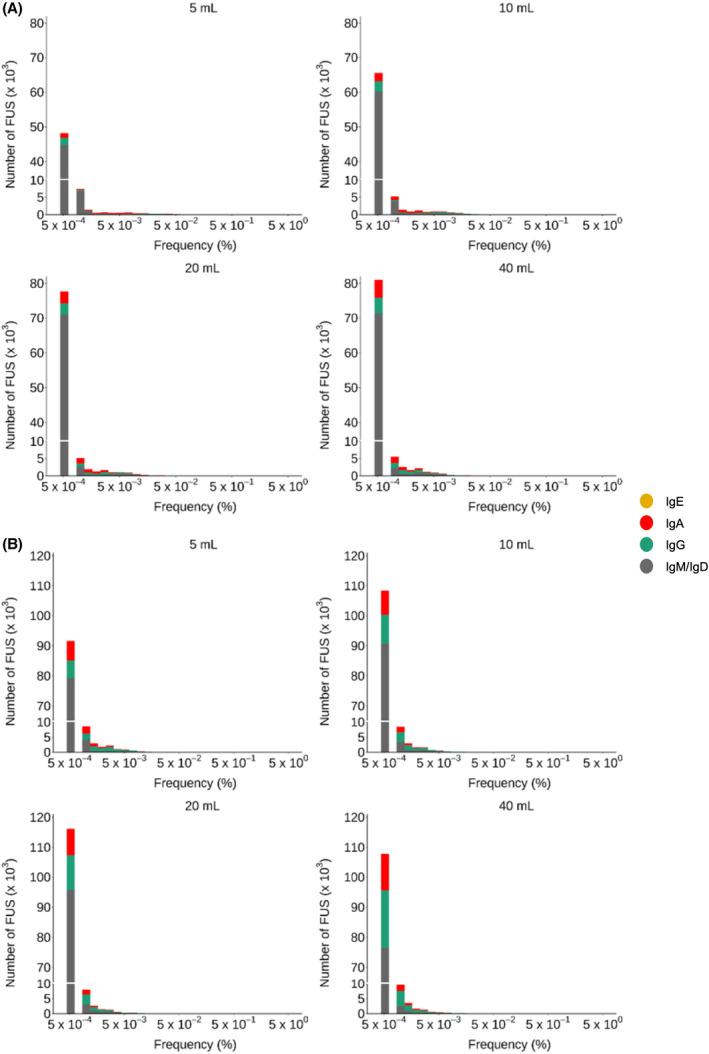
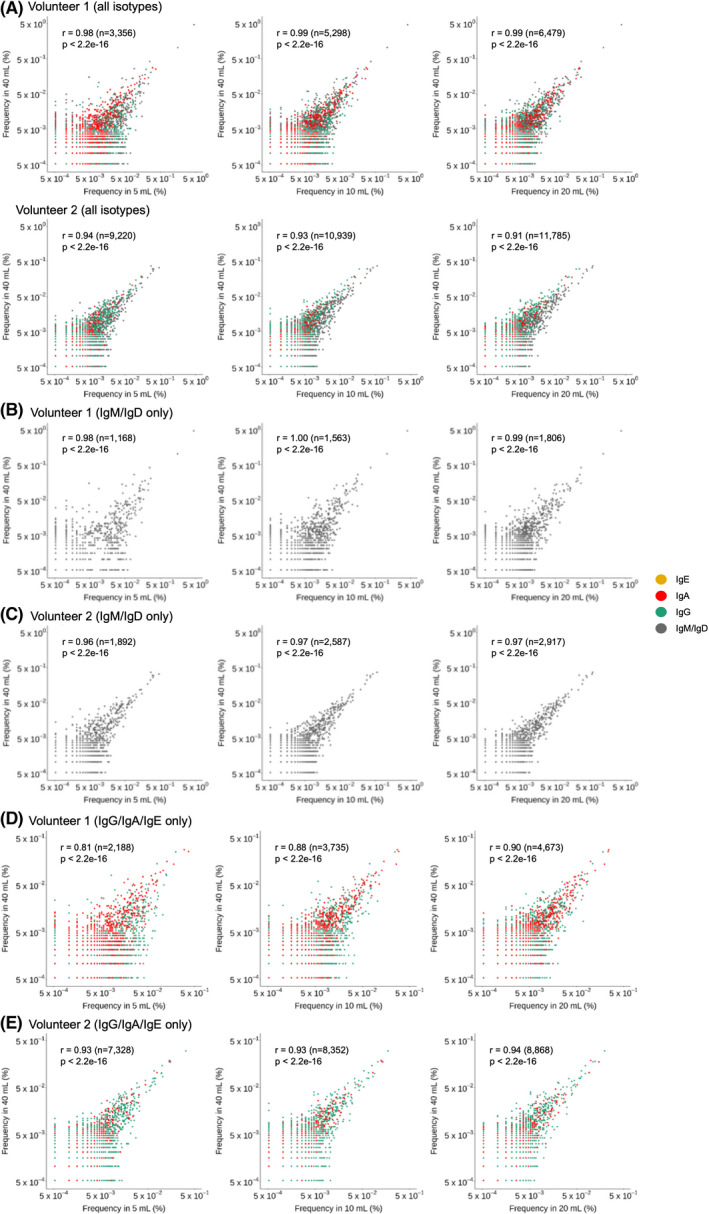
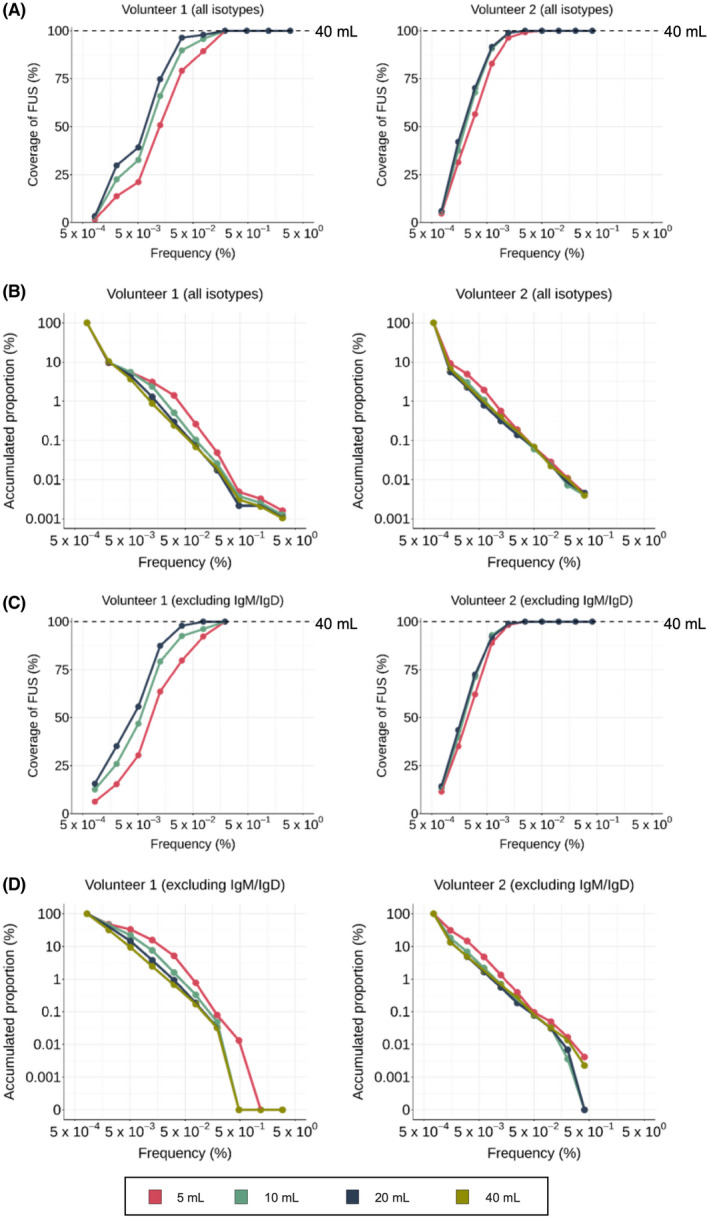
B cells recognize antigens via membrane-expressed B-cell receptors (BCR) and antibodies. Similar human BCR sequences are frequently found at a significantly higher frequency than that theoretically calculated. Patients infected with SARS-CoV2 and HIV or with autoimmune diseases share very similar BCRs. Therefore, in silico reconstitution of BCR repertoires and identification of stereotypical BCR sequences related to human pathology have diagnostic potential. Furthermore, monitoring changes of clinically significant BCR sequences and isotype conversion has prognostic potential. For BCR repertoire analysis, peripheral blood (PB) is the most convenient source. However, the optimal human PB volume for in silico reconstitution of the BCR repertoire has not been studied in detail. Here, we sampled 5, 10, and 20 mL PB from the left arm and 40 mL PB from the right arm of two volunteers, reconstituted in silico PB BCR repertoires, and compared their composition. In both volunteers, PB sampling over 20 mL resulted in slight increases in functional unique sequences (FUSs) or almost no increase in repertoire diversity. All FUSs with a frequency above 0.08% or 0.03% in the 40 mL PB BCR repertoire were detected even in the 5 mL PB BCR repertoire from each volunteer. FUSs with a higher frequency were more likely to be found in BCR repertoires from reduced PB volume, and those coexisting in two repertoires showed a statistically significant correlation in frequency irrespective of sampled anatomical site. The correlation was more significant in higher-frequency FUSs. These observations support the potential of BCR repertoire analysis for diagnosis.
B 细胞通过膜表达的 B 细胞受体(BCR)和抗体识别抗原。相似的人类 BCR 序列经常以远高于理论计算的频率出现。感染 SARS-CoV2 和 HIV 或患有自身免疫性疾病的患者共享非常相似的 BCR。因此,BCR 库的计算机重建和鉴定与人类病理学相关的典型 BCR 序列具有诊断潜力。此外,监测临床上有意义的 BCR 序列和同种型转换具有预后潜力。对于 BCR 库分析,外周血(PB)是最方便的来源。然而,尚未详细研究用于计算机重建 BCR 库的最佳人类 PB 体积。在这里,我们从两名志愿者的左臂采集 5、10 和 20mlPB,并从右臂采集 40mlPB,进行计算机重建 PB BCR 库,并比较它们的组成。在两名志愿者中,超过 20ml 的 PB 采样导致功能独特序列(FUS)略有增加或对库多样性几乎没有增加。志愿者的每个 5mlPBBCR 库中都检测到了频率高于 0.08%或 0.03%的所有 40mlPBBCR 库中的 FUS。频率较高的 FUS 更有可能在减少 PB 体积的 BCR 库中发现,并且即使在来自两个库的共存 FUS 中,它们的频率也存在统计学上的显著相关性,而与采样的解剖部位无关。在高频 FUS 中,这种相关性更为显著。这些观察结果支持 BCR 库分析用于诊断的潜力。