Department of Neurology, Qingdao Municipal Hospital, Qingdao University, Qingdao, Shandong 266071, China.
Department of Neurology, Institute of Neurology, Huashan Hospital, Shanghai Medical College, Fudan University, Shanghai 200040, China.
Chin Med J (Engl). 2022 Jun 20;135(12):1425-1431. doi: 10.1097/CM9.0000000000002228.
Previous studies have shown that inflammation plays an important role in intracranial atherosclerotic stenosis (ICAS). The platelet-to-lymphocyte ratio (PLR) has recently emerged as a potential inflammatory biomarker. This study aimed to explore the association of the PLR with ICAS in a Chinese Han population.
A total of 2134 participants (518 with ICAS, 1616 without ICAS) were enrolled in this study. ICAS was defined as atherosclerotic stenosis >50% or the occlusion of several main intracranial arteries. Multivariable logistic regression analyses were used to assess the association of the PLR with ICAS. Additional subgroup analyses were performed according to age (<60 vs. ≥60 years) and acute ischemic stroke.
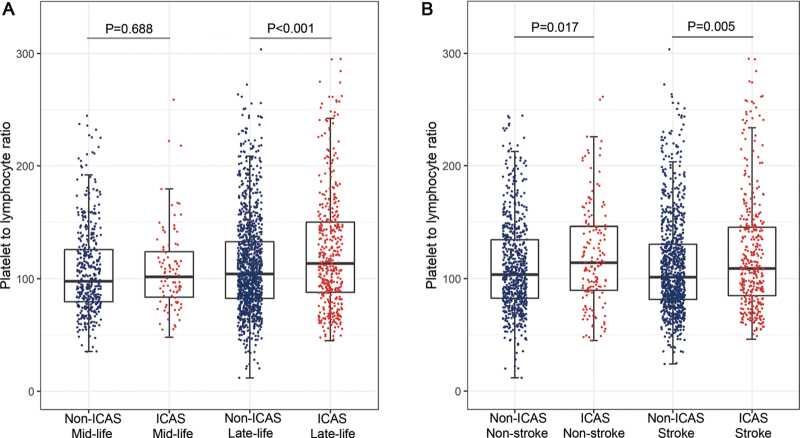
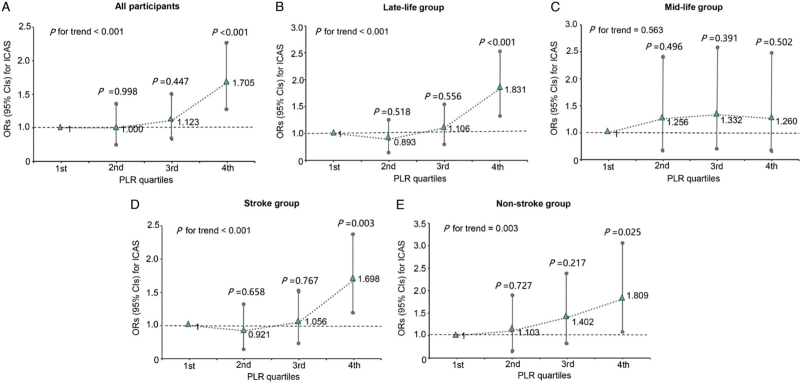
Multivariate regression analysis showed that a high PLR was associated with a higher risk of ICAS in all participants ( P < 0.001). Compared with the lowest quartile, the fourth PLR quartile was significantly associated with ICAS (OR 1.705, 95% confidence interval 1.278-2.275, P < 0.001). In the subgroups stratified by age, an association between the PLR and ICAS was found in the late-life group ( P < 0.001), but not in the mid-life group ( P = 0.650). In the subgroups stratified by acute ischemic stroke, the relationship between an elevated PLR and a higher risk of ICAS remained unchanged (stroke group, P < 0.001; non-stroke group, P = 0.027).
An elevated PLR was associated with a higher risk of ICAS in a Chinese Han population. The PLR might serve as a potential biomarker for ICAS in the elderly population.
先前的研究表明,炎症在颅内动脉粥样硬化性狭窄(ICAS)中起着重要作用。血小板与淋巴细胞比值(PLR)最近已成为一种有潜力的炎症生物标志物。本研究旨在探讨汉族人群中 PLR 与 ICAS 的相关性。
本研究共纳入 2134 名参与者(518 名患有 ICAS,1616 名无 ICAS)。ICAS 定义为动脉粥样硬化狭窄>50%或几条主要颅内动脉闭塞。多变量逻辑回归分析用于评估 PLR 与 ICAS 的相关性。根据年龄(<60 岁与≥60 岁)和急性缺血性脑卒中进行了额外的亚组分析。
多变量回归分析表明,高 PLR 与所有参与者的 ICAS 风险增加相关(P<0.001)。与最低四分位数相比,第四 PLR 四分位数与 ICAS 显著相关(OR 1.705,95%置信区间 1.278-2.275,P<0.001)。在按年龄分层的亚组中,PLR 与 ICAS 之间存在关联,尤其是在老年组(P<0.001),但在中年组中无此关联(P=0.650)。在按急性缺血性脑卒中分层的亚组中,高 PLR 与 ICAS 风险增加之间的关系保持不变(脑卒中组,P<0.001;非脑卒中组,P=0.027)。
在汉族人群中,PLR 升高与 ICAS 风险增加相关。PLR 可能是老年人群中 ICAS 的潜在生物标志物。