Angelo Bianchi Bonomi Hemophilia and Thrombosis Center, Fondazione IRCCS Ca' Granda Ospedale Maggiore Policlinico, Milan, Italy.
Department of Pathophysiology and Transplantation, Università degli Studi di Milanoo, Milan, Italy.
Haemophilia. 2022 Nov;28(6):950-961. doi: 10.1111/hae.14638. Epub 2022 Jul 22.
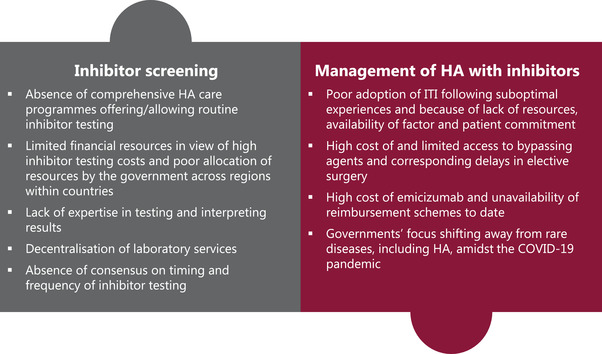
The development of inhibitors with factor VIII (FVIII) replacement therapy is one of the most common and challenging complications of haemophilia A (HA) treatment, jeopardising treatment efficacy and predisposing patients to high risks of morbidity and mortality. The management of patients with inhibitors is particularly challenging in countries where resources are limited.
To provide a comprehensive summary of the management of HA with inhibitors while focusing on differences in practice between Western and non-Western countries and how resource scarcity can impact HA management, leading to suboptimal outcomes in patients with inhibitors.
Summary of key evidence and regional expert opinion.
We address, particularly, the diagnosis of and testing for inhibitors, as well as the epidemiology of inhibitors, including incidence, prevalence and disease burden. Secondly, we provide an overview of the current treatment landscape in HA with inhibitors regarding the eradication of inhibitors with immune tolerance induction and the treatment and prevention of bleeding with bypassing agents, non-factor replacement agents and other experimental therapies. This is complemented with insights from the authors around the applicability of, and challenges associated with, such therapies in their settings of practice.
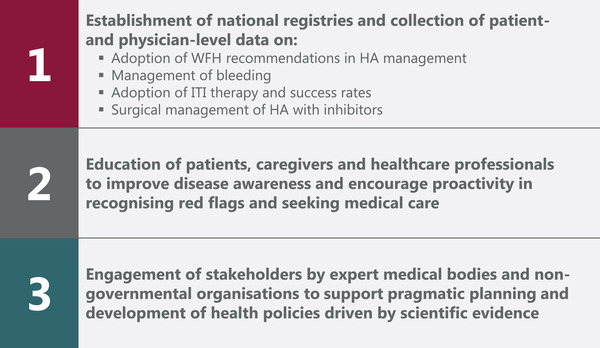
We conclude by proposing some key steps towards bridging the gaps in the management of HA with inhibitors in resource-limited countries, including: (1) the collection of quality data that can inform healthcare reforms and policies; (2) improving disease knowledge among healthcare practitioners and patients with the aim of standardising disease management across centres and (3) working towards promoting equal access to HA care and therapies for everyone.
因子 VIII(FVIII)替代疗法的抑制剂发展是血友病 A(HA)治疗中最常见和最具挑战性的并发症之一,危及治疗效果,并使患者面临高发病率和死亡率的风险。在资源有限的国家,管理具有抑制剂的患者尤其具有挑战性。
全面总结具有抑制剂的 HA 的管理,同时重点关注西方国家和非西方国家之间实践差异,以及资源匮乏如何影响 HA 管理,导致抑制剂患者的治疗效果不理想。
总结关键证据和区域专家意见。
我们特别讨论了抑制剂的诊断和检测,以及抑制剂的流行病学,包括发病率、患病率和疾病负担。其次,我们概述了目前具有抑制剂的 HA 的治疗现状,包括免疫耐受诱导消除抑制剂,以及使用旁路制剂、非因子替代制剂和其他实验性疗法治疗和预防出血。作者还围绕这些疗法在其实践环境中的适用性和相关挑战提供了一些见解。
我们最后提出了在资源有限的国家管理具有抑制剂的 HA 方面弥合差距的一些关键步骤,包括:(1)收集可用于医疗保健改革和政策的高质量数据;(2)提高医疗保健从业者和患者对疾病的认识,旨在标准化各中心的疾病管理;(3)努力促进所有人平等获得 HA 护理和治疗。