National Key Laboratory of Wheat and Maize Crop Science, College of Life Sciences, Henan Agricultural University, Zhengzhou, China.
BMC Plant Biol. 2022 Jul 22;22(1):359. doi: 10.1186/s12870-022-03751-1.
Currently, mechanical maize kernel harvesting has not been fully utilized in developing countries including China, partly due to the absence of suitable cultivars capable of rapid desiccation during seed maturation. The initiation of rapid desiccation during seed maturation is regulated by abscisic acid (ABA). For further characterization of ABA-regulated key genes and cellular events, it is necessary to perform transcriptome analysis of maize developing embryos. The ABA synthesis-deficient mutant (vp5) and normal maize (Vp5) seeds are suitable materials for such purpose.
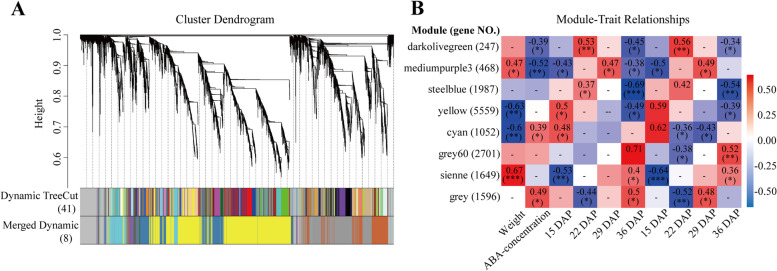
In the present work, developing vp5 and Vp5 embryos were compared by ABA content and transcriptome analyses. Quantitative analysis revealed the significant difference in ABA synthesis between both genotypes. From 29 days after pollination (DAP), ABA content increased rapidly in Vp5 embryos, but decreased gradually in vp5 embryos. At 36 DAP, ABA level in vp5 decreased to 1/4 that of Vp5, suggesting that the differential ABA levels would affect seed maturation. Comparative transcriptomic analysis has found 1019 differentially expressed genes (DEGs) between both genotypes, with the most DEGs (818) at 36 DAP. Further, weighted correlation network analysis (WGCNA) revealed eight DEGs co-expression modules. Particularly, a module was negatively correlated with ABA content in vp5 embryos. The module was mainly involved in metabolic and cellular processes, and its hub genes encoded thiamine, NPF proteins, calmodulin, metallothionein etc. Moreover, the expression of a set of key genes regulated by ABA was further verified by RT-qPCR. The results of the present work suggested that because of ABA deficiency, the vp5 seeds maintained strong metabolic activities and lacked dormancy initiation during seed maturation.
Transcriptome and WGCNA analyses revealed significant ABA-related changes in metabolic pathways and DEGs between vp5 and Vp5 during seed maturation. The results would provide insights for elucidating the molecular mechanism of ABA signaling and developing high dehydration tolerance maize suitable for mechanical harvesting.
目前,机械玉米籽粒收获在包括中国在内的发展中国家尚未得到充分利用,部分原因是缺乏能够在种子成熟过程中快速脱水的适宜品种。种子成熟过程中快速脱水的启动受脱落酸(ABA)的调节。为了进一步研究 ABA 调控的关键基因和细胞事件,有必要对玉米发育胚胎进行转录组分析。ABA 合成缺陷突变体(vp5)和正常玉米(Vp5)种子是用于此目的的合适材料。
在本工作中,通过 ABA 含量和转录组分析比较了 vp5 和 Vp5 发育中的胚胎。定量分析显示两种基因型之间 ABA 合成存在显著差异。从授粉后 29 天(DAP)开始,Vp5 胚胎中的 ABA 含量迅速增加,但 vp5 胚胎中的 ABA 含量逐渐减少。在 36 DAP 时,vp5 中的 ABA 水平下降到 Vp5 的 1/4,表明差异的 ABA 水平会影响种子成熟。比较转录组分析发现两种基因型之间有 1019 个差异表达基因(DEGs),其中 36 DAP 时最多有 818 个 DEGs。进一步的加权相关网络分析(WGCNA)显示了 8 个 DEGs 共表达模块。特别是,一个模块与 vp5 胚胎中 ABA 含量呈负相关。该模块主要参与代谢和细胞过程,其枢纽基因编码硫胺素、NPF 蛋白、钙调蛋白、金属硫蛋白等。此外,通过 RT-qPCR 进一步验证了一组受 ABA 调控的关键基因的表达。本工作的结果表明,由于 ABA 缺乏,vp5 种子在种子成熟过程中保持了较强的代谢活性,并且缺乏休眠启动。
转录组和 WGCNA 分析揭示了 vp5 和 Vp5 种子在成熟过程中代谢途径和 DEGs 中与 ABA 相关的显著变化。这些结果将为阐明 ABA 信号转导的分子机制和开发适合机械收获的高脱水耐性玉米提供新的思路。