Okorn Alexander, Jayaraman Arumugam, Englert Lukas, Arrowsmith Merle, Swoboda Theresa, Weigelt Jeanette, Brunecker Carina, Hess Merlin, Lamprecht Anna, Lenczyk Carsten, Rang Maximilian, Braunschweig Holger
Institute for Inorganic Chemistry, Julius-Maximilians-Universität Würzburg Am Hubland 97074 Würzburg Germany
Institute for Sustainable Chemistry & Catalysis with Boron, Julius-Maximilians-Universität Würzburg Am Hubland 97074 Würzburg Germany.
Chem Sci. 2022 Jun 14;13(25):7566-7574. doi: 10.1039/d2sc02515a. eCollection 2022 Jun 29.
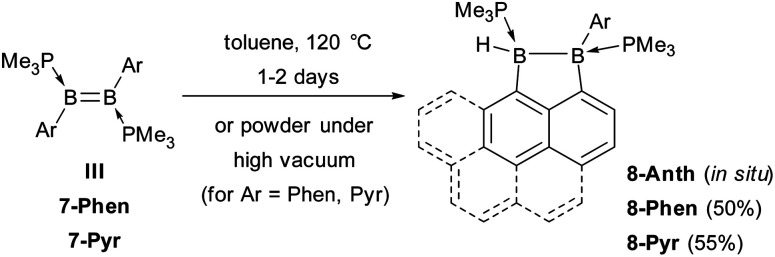
The classical route to the PMe-stabilised polycyclic aromatic hydrocarbon (PAH)-substituted diborenes BAr(PMe) (Ar = 9-phenanthryl 7-Phen; Ar = 1-pyrenyl 7-Pyr) the corresponding 1,2-diaryl-1,2-dimethoxydiborane(4) precursors, BAr(OMe), is marred by the systematic decomposition of the latter to BAr(OMe) during reaction workup. Calculations suggest this results from the absence of a second -substituent on the boron-bound aryl rings, which enables their free rotation and exposes the B-B bond to nucleophilic attack. 7-Phen and 7-Pyr are obtained by the reduction of the corresponding 1,2-diaryl-1,2-dichlorodiborane precursors, BArCl(PMe), obtained from the SMe adducts, which are synthesised by direct NMe-Cl exchange at BAr(NMe) with (MeS)BCl. The low-lying π* molecular orbitals (MOs) located on the PAH substituents of 7-Phen and 7-Pyr intercalate between the B-B-based π and π* MOs, leading to a relatively small HOMO-LUMO gap of 3.20 and 2.72 eV, respectively. Under vacuum or at high temperature 7-Phen and 7-Pyr undergo intramolecular hydroarylation of the B[double bond, length as m-dash]B bond to yield 1,2-dihydronaphtho[1,8-][1,2]diborole derivatives. Hydrogenation of 7-Phen, 7-Pyr and their 9-anthryl and mesityl analogues III and II, respectively, results in all cases in splitting of the B-B bond and isolation of the monoboranes (MeP)BArH. NMR-spectroscopic monitoring of the reactions, solid-state structures of isolated reaction intermediates and computational mechanistic analyses show that the hydrogenation of the three PAH-substituted diborenes proceeds a different pathway to that of the dimesityldiborene. Rather than occurring exclusively at the B-B bond, hydrogenation of 7-Ar and III proceeds a hydroarylated intermediate, which undergoes one B-B bond-centered H addition, followed by hydrogenation of the endocyclic B-C bond resulting from hydroarylation, making the latter effectively reversible.
制备甲基(PMe)稳定的多环芳烃(PAH)取代的二硼烯BAr(PMe)(Ar = 9 - 菲基,7 - Phen;Ar = 1 - 芘基,7 - Pyr)的经典路线是通过相应的1,2 - 二芳基 - 1,2 - 二甲氧基二硼烷(4)前体BAr(OMe),但在反应后处理过程中,后者会系统地分解为BAr(OMe),这影响了该路线。计算表明,这是由于硼连接的芳基环上缺少第二个取代基,这使得它们能够自由旋转,并使B - B键暴露于亲核攻击。7 - Phen和7 - Pyr是通过还原相应的1,2 - 二芳基 - 1,2 - 二氯二硼烷前体BArCl(PMe)得到的,这些前体由SMe加合物获得,而SMe加合物是通过在BAr(NMe)处用(MeS)BCl进行直接NMe - Cl交换合成的。位于7 - Phen和7 - Pyr的PAH取代基上的低能π分子轨道(MOs)插入基于B - B的π和π MOs之间,导致相对较小的HOMO - LUMO能隙,分别为3.20和2.72 eV。在真空或高温下,7 - Phen和7 - Pyr会发生B[双键,长度为m破折号]B键的分子内氢芳基化反应,生成1,2 - 二氢萘并[1,8 - ][1,2]二硼唑衍生物。7 - Phen、7 - Pyr及其9 - 蒽基和均三甲苯基类似物III和II的氢化反应,在所有情况下都会导致B - B键断裂并分离出单硼烷(MeP)BArH。对反应的核磁共振光谱监测、分离出的反应中间体的固态结构以及计算机理分析表明,这三种PAH取代的二硼烯的氢化反应与二均三甲苯基二硼烯的氢化反应途径不同。7 - Ar和III的氢化反应不是仅发生在B - B键上,而是通过一个氢芳基化中间体进行,该中间体经历一次以B - B键为中心的H加成,然后是氢芳基化产生的内环B - C键的氢化反应,使得后者实际上是可逆的。