Abd El-Lateef Hany M, Khalaf Mai M, Shalabi Kamal, Abdelhamid Antar A
Department of Chemistry, College of Science, King Faisal University, Al-Ahsa 31982, Saudi Arabia.
Department of Chemistry, Faculty of Science, Sohag University, Sohag 82524, Egypt.
ACS Omega. 2022 Jul 8;7(28):24727-24745. doi: 10.1021/acsomega.2c02639. eCollection 2022 Jul 19.
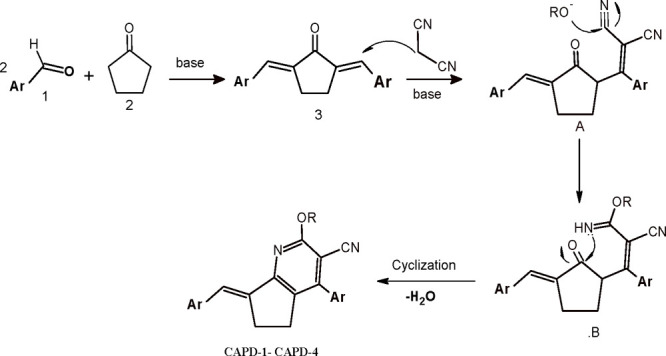
An effective method for designing new heterocyclic compounds of 6,7-dihydro-5H-cyclopenta[b]pyridine-3-carbonitrile derivatives (CAPDs) was presented through cyclocondensation reaction between 2,5-diarylidenecyclopentanone derivatives and propanedinitrile, and the cyclocondensation reaction succeeded using a sodium alkoxide solution (sodium ethoxide or sodium methoxide) as the reagent and the catalyst. The synthesized CAPD derivatives were employed as novel inhibitors for carbon steel (CS) corrosion in a molar HSO medium. The corrosion protection proficiency was investigated by electrochemical measurements (open circuit potential vs time ( vs ), potentiodynamic polarization plots (PDP), and electrochemical impedance spectroscopy (EIS)) and surface morphology (scanning electron microscopy (SEM)) examinations. The results show that the CAPD derivatives exhibit mixed type inhibitors and a superior inhibition efficiency of 97.7% in the presence of 1.0 mM . The adsorption of CAPD derivatives on the CS interface follows the Langmuir isotherm model, including physisorption and chemisorption. Scanning electron microscopy (SEM) exploration confirmed the adsorption of the CAPD derivatives on the CS substrate. Monte Carlo (MC) simulations and DFT calculations revealed that the efficacy of the CAPD molecules correlates well with their structures, and this protection was attributed to their adsorption on the CS surface.
通过2,5 - 二芳基亚甲基环戊酮衍生物与丙二腈之间的环缩合反应,提出了一种设计新型6,7 - 二氢 - 5H - 环戊并[b]吡啶 - 3 - 甲腈衍生物(CAPDs)杂环化合物的有效方法,并且使用醇钠溶液(乙醇钠或甲醇钠)作为试剂和催化剂,环缩合反应成功进行。合成的CAPD衍生物被用作在摩尔HSO介质中碳钢(CS)腐蚀的新型抑制剂。通过电化学测量(开路电位与时间( vs )、动电位极化曲线(PDP)和电化学阻抗谱(EIS))以及表面形态(扫描电子显微镜(SEM))检查来研究腐蚀防护能力。结果表明,CAPD衍生物表现为混合型抑制剂,在1.0 mM存在下具有97.7%的优异抑制效率。CAPD衍生物在CS界面上的吸附遵循朗缪尔等温线模型,包括物理吸附和化学吸附。扫描电子显微镜(SEM)探测证实了CAPD衍生物在CS基底上的吸附。蒙特卡罗(MC)模拟和密度泛函理论(DFT)计算表明,CAPD分子的效能与其结构密切相关,并且这种保护作用归因于它们在CS表面的吸附。