Zheng Qiuchen, Lee Bethany, Kebede Micheal T, Ivancic Valerie A, Kemeh Merc M, Brito Henrique Lemos, Spratt Donald E, Lazo Noel D
Gustaf H. Carlson School of Chemistry and Biochemistry, Clark University, Worcester, Massachusetts 01610, United States.
ACS Omega. 2022 Jul 7;7(28):24757-24765. doi: 10.1021/acsomega.2c02747. eCollection 2022 Jul 19.
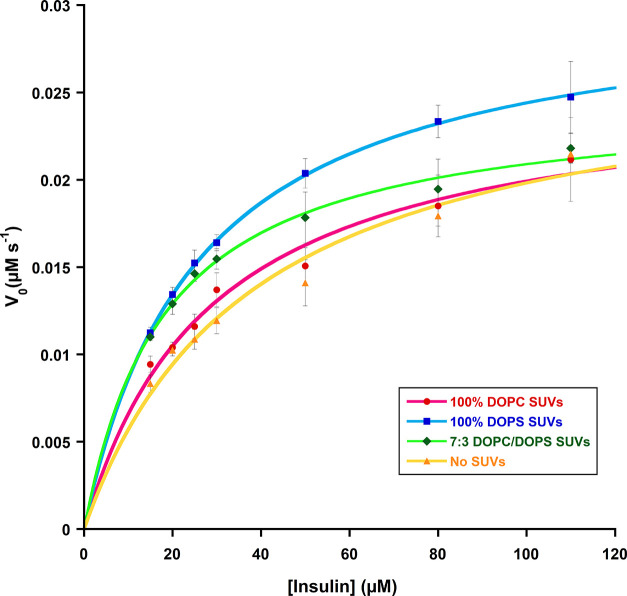
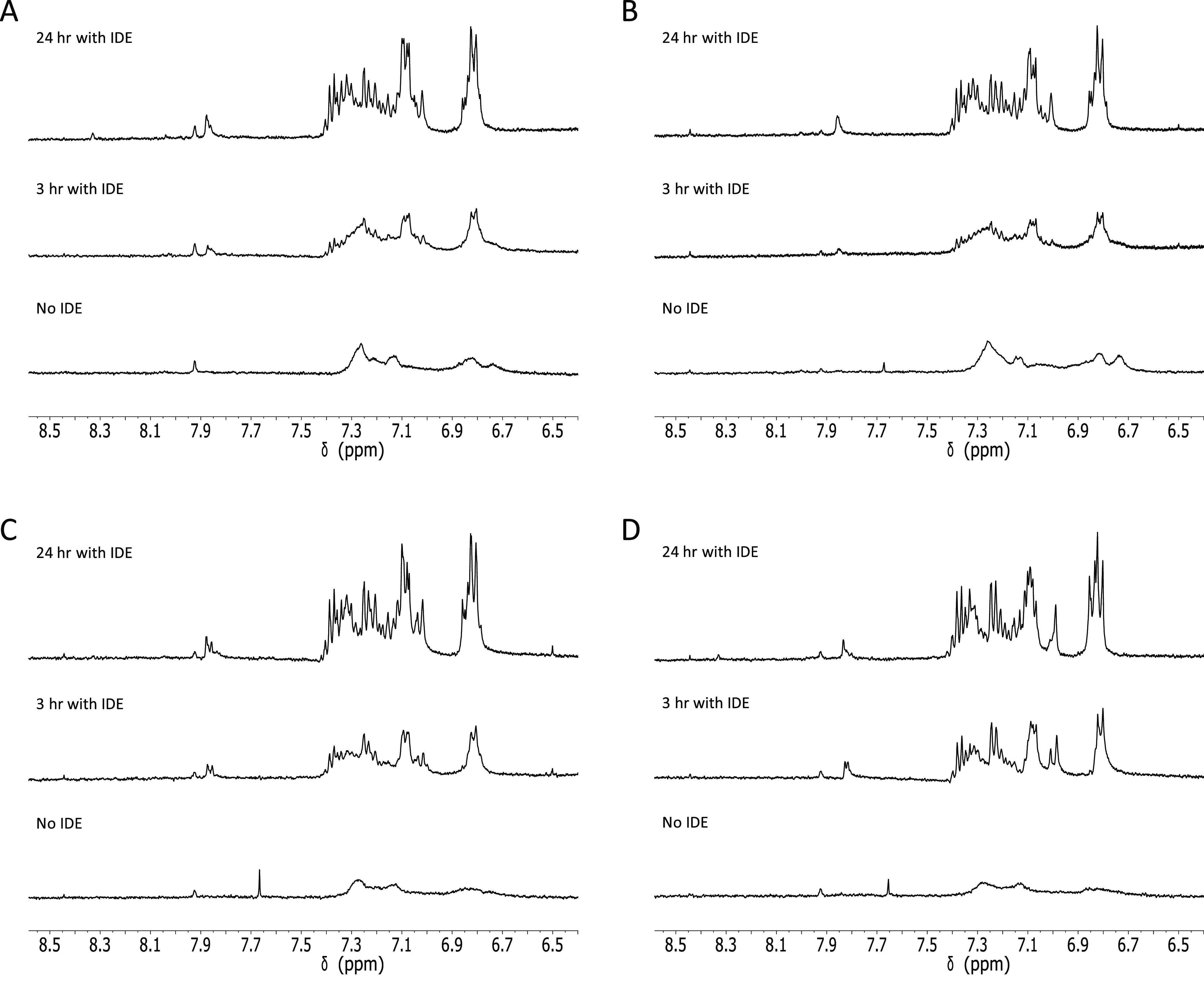
Insulin-degrading enzyme (IDE) is an evolutionarily conserved ubiquitous zinc metalloprotease implicated in the efficient degradation of insulin monomer. However, IDE also degrades monomers of amyloidogenic peptides associated with disease, complicating the development of IDE inhibitors. In this work, we investigated the effects of the lipid composition of membranes on the IDE-dependent degradation of insulin. Kinetic analysis based on chromatography and insulin's helical circular dichroic signal showed that the presence of anionic lipids in membranes enhances IDE's activity toward insulin. Using NMR spectroscopy, we discovered that exchange broadening underlies the enhancement of IDE's activity. These findings, together with the adverse effects of anionic membranes in the self-assembly of IDE's amyloidogenic substrates, suggest that the lipid composition of membranes is a key determinant of IDE's ability to balance the levels of its physiologically and pathologically relevant substrates and achieve proteostasis.
胰岛素降解酶(IDE)是一种在进化上保守的普遍存在的锌金属蛋白酶,参与胰岛素单体的有效降解。然而,IDE也会降解与疾病相关的淀粉样蛋白肽单体,这使得IDE抑制剂的开发变得复杂。在这项工作中,我们研究了膜的脂质组成对IDE依赖性胰岛素降解的影响。基于色谱法和胰岛素螺旋圆二色信号的动力学分析表明,膜中阴离子脂质的存在增强了IDE对胰岛素的活性。通过核磁共振光谱,我们发现交换加宽是IDE活性增强的基础。这些发现,连同阴离子膜对IDE淀粉样蛋白生成底物自组装的不利影响,表明膜的脂质组成是IDE平衡其生理和病理相关底物水平并实现蛋白质稳态能力的关键决定因素。