Biological Sciences, Sunnybrook Research Institute, Toronto, ON, Canada.
Department of Immunology, University of Toronto, Toronto, ON, Canada.
Front Immunol. 2022 Jul 8;13:926773. doi: 10.3389/fimmu.2022.926773. eCollection 2022.
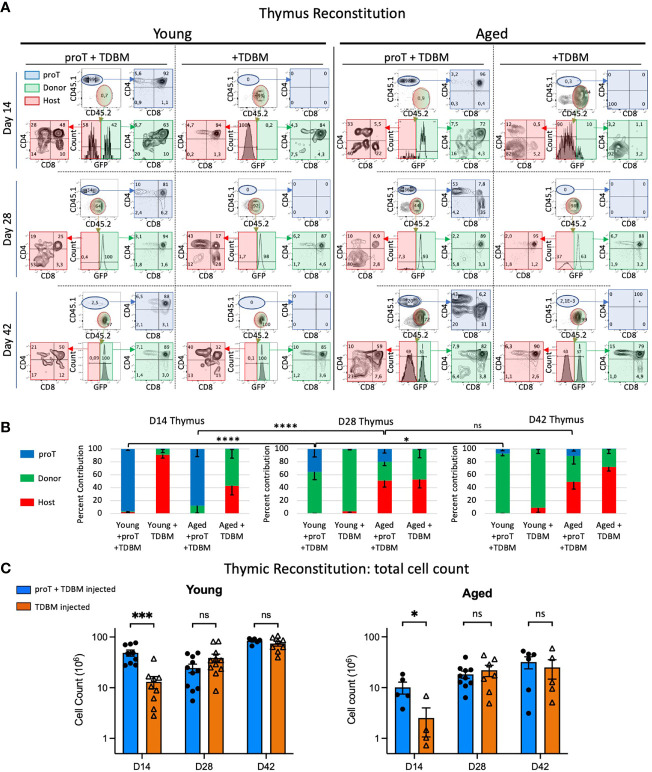
The prolonged lag in T cell recovery seen in older patients undergoing hematopoietic stem cell transplant (HSCT), after chemo-/radiotherapy, can lead to immune dysfunction. As a result, recovering patients may experience a relapse in malignancies and opportunistic infections, leading to high mortality rates. The delay in T cell recovery is partly due to thymic involution, a natural collapse in the size and function of the thymus, as individuals age, and partly due to the damage sustained by the thymic stromal cells through exposure to chemo-/radiotherapy. There is a clear need for new strategies to accelerate intrathymic T cell reconstitution when treating aged patients to counter the effects of involution and cancer therapy regimens. Adoptive transfer of human progenitor T (proT) cells has been shown to accelerate T cell regeneration in radiation-treated young mice and to restore thymic architecture in immunodeficient mice. Here, we demonstrate that the adoptive transfer of -generated proT cells in aged mice (18-24 months) accelerated thymic reconstitution after treatment with chemotherapy and gamma irradiation compared to HSCT alone. We noted that aged mice appeared to have a more limited expansion of CD4-CD8- thymocytes and slower temporal kinetics in the development of donor proT cells into mature T cells, when compared to younger mice, despite following the same chemo/radiation regimen. This suggests a greater resilience of the young thymus compared to the aged thymus. Nevertheless, newly generated T cells from proT cell engrafted aged and young mice were readily present in the periphery accelerating the reappearance of new naïve T cells. Accelerated T cell recovery was also observed in both aged and young mice receiving both proT cells and HSCT. The strategy of transferring proT cells can potentially be used as an effective cellular therapy in aged patients to improve immune recovery and reduce the risk of opportunistic infections post-HSCT.
在接受化疗/放疗后的造血干细胞移植 (HSCT) 后,老年患者的 T 细胞恢复出现长期延迟,可导致免疫功能障碍。结果,恢复的患者可能会经历恶性肿瘤和机会性感染的复发,导致高死亡率。T 细胞恢复的延迟部分是由于胸腺萎缩,即随着个体年龄的增长,胸腺的大小和功能自然衰退,部分是由于胸腺基质细胞暴露于化疗/放疗而受到的损伤。当治疗老年患者时,显然需要新的策略来加速胸腺内 T 细胞的重建,以抵消萎缩和癌症治疗方案的影响。已经证明,在接受辐射的年轻小鼠中,人祖 T(proT)细胞的过继转移可加速 T 细胞再生,并在免疫缺陷小鼠中恢复胸腺结构。在这里,我们证明与单独 HSCT 相比,在接受化疗和γ辐射治疗的老年小鼠(18-24 个月)中过继转移 proT 细胞可加速胸腺重建。我们注意到,与年轻小鼠相比,老年小鼠的 CD4-CD8-胸腺细胞扩增似乎更为有限,供体 proT 细胞向成熟 T 细胞的发育时间动力学也较慢,尽管接受了相同的化疗/放疗方案。这表明年轻的胸腺比老年的胸腺具有更大的弹性。尽管如此,来自 proT 细胞移植的老年和年轻小鼠的新生成 T 细胞在周围组织中很容易出现,从而加速了新的幼稚 T 细胞的再次出现。在接受 proT 细胞和 HSCT 的老年和年轻小鼠中均观察到 T 细胞恢复加速。过继转移 proT 细胞的策略可能作为一种有效的细胞疗法用于老年患者,以改善免疫恢复并降低 HSCT 后发生机会性感染的风险。