Department of Clinical and Experimental Medicine, Hepatobiliary Unit, Careggi University Hospital, University of Florence, Florence, Italy.
General Surgery 2U-Liver Transplant Unit, Department of Surgery, A.O.U. Città della Salute e della, Scienza di Torino, University of Turin, Turin, Italy.
Front Immunol. 2022 Jul 8;13:855263. doi: 10.3389/fimmu.2022.855263. eCollection 2022.
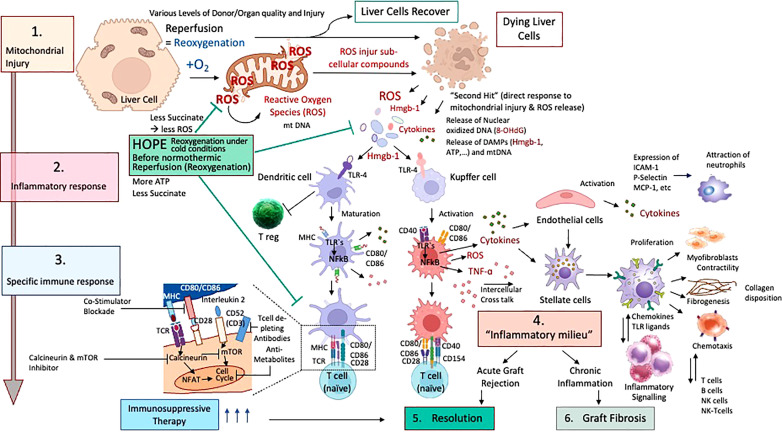
The frequent use of marginal livers forces transplant centres to explore novel technologies to improve organ quality and outcomes after implantation. Organ perfusion techniques are therefore frequently discussed with an ever-increasing number of experimental and clinical studies. Two main approaches, hypothermic and normothermic perfusion, are the leading strategies to be introduced in clinical practice in many western countries today. Despite this success, the number of studies, which provide robust data on the underlying mechanisms of protection conveyed through this technology remains scarce, particularly in context of different stages of ischemia-reperfusion-injury (IRI). Prior to a successful clinical implementation of machine perfusion, the concept of IRI and potential key molecules, which should be addressed to reduce IRI-associated inflammation, requires a better exploration. During ischemia, Krebs cycle metabolites, including succinate play a crucial role with their direct impact on the production of reactive oxygen species (ROS) at mitochondrial complex I upon reperfusion. Such features are even more pronounced under normothermic conditions and lead to even higher levels of downstream inflammation. The direct consequence appears with an activation of the innate immune system. The number of articles, which focus on the impact of machine perfusion with and without the use of specific perfusate additives to modulate the inflammatory cascade after transplantation is very small. This review describes first, the subcellular processes found in mitochondria, which instigate the IRI cascade together with proinflammatory downstream effects and their link to the innate immune system. Next, the impact of currently established machine perfusion strategies is described with a focus on protective mechanisms known for the different perfusion approaches. Finally, the role of such dynamic preservation techniques to deliver specific agents, which appear currently of interest to modulate this posttransplant inflammation, is discussed together with future aspects in this field.
边缘供肝的频繁使用迫使移植中心探索新的技术,以改善器官质量和植入后的效果。因此,器官灌注技术经常被讨论,越来越多的实验和临床研究也在进行。两种主要方法,即低温和常温灌注,是当今许多西方国家将引入临床实践的主要策略。尽管取得了这一成功,但提供关于该技术所传达的保护潜在机制的可靠数据的研究数量仍然很少,特别是在不同的缺血再灌注损伤 (IRI) 阶段。在成功将机器灌注应用于临床之前,IRI 的概念以及应该解决的潜在关键分子,以减少与 IRI 相关的炎症,需要更好地探索。在缺血期间,包括琥珀酸在内的克雷布斯循环代谢物在再灌注时直接影响线粒体复合物 I 中活性氧 (ROS) 的产生,起着至关重要的作用。在常温条件下,这些特征更为明显,导致下游炎症水平更高。直接后果是先天免疫系统的激活。关注机器灌注及其使用特定灌注添加剂对移植后炎症级联反应的调节作用的文章数量非常少。这篇综述首先描述了在线粒体中发现的引发 IRI 级联反应以及促炎下游效应的亚细胞过程,以及它们与先天免疫系统的联系。接下来,描述了目前已建立的机器灌注策略的影响,重点介绍了不同灌注方法已知的保护机制。最后,讨论了这些动态保存技术在输送目前看来有调节这种移植后炎症作用的特定药物方面的作用,以及该领域的未来方面。