Sheikdon Abdirizak Abdullahi, Mulepo Phillip, Waiswa Gonzaga, Bugeza Samuel, Sereke Senai Goitom, Mfaume Benjamin, Patrick Sali, Jada Swaka Amos, Emusugut Michael
Orthopedic Department, Makerere University, Kampala, Uganda.
Department of Radiology and Radiotherapy, Makerere University, Kampala, Uganda.
Orthop Res Rev. 2022 Jul 15;14:235-245. doi: 10.2147/ORR.S370357. eCollection 2022.
Supracondylar fractures (SCF) of the humerus is one of the commonest global health concerns among children and need a rigorous management process to obtain satisfactory outcomes. It is of paramount importance to use systematic guidelines to aid abate bad fracture outcomes. The study primarily sought to determine the functional and radiological management outcomes of SCF of the humerus in children at Mulago National Referral Hospital (MNRH) and associated factors to the outcomes.
We conducted a hospital-based, cross-sectional study among children managed for SCF of the humerus at MNRH. Using Flynn's criteria, current flexion and extension at the elbow joints, humeroulnar angle and the neurology were assessed and compared to the contralateral limb to get the functional outcomes. The pre-management digital radiographs of the elbow joint were compared with the current radiographs to assess radiological outcomes. Bivariate and multivariate analyses were used to determine the associated factors.
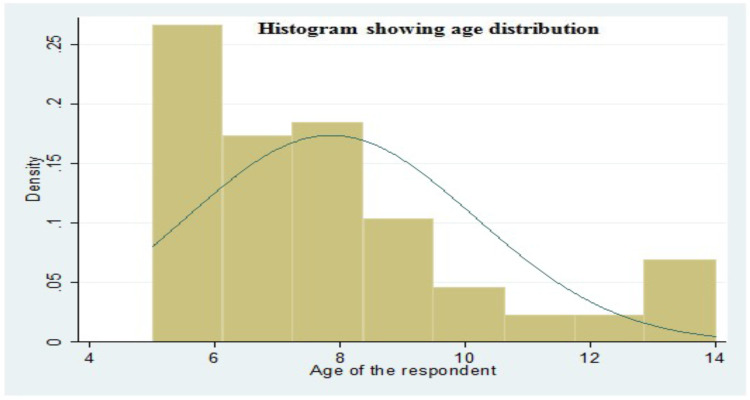
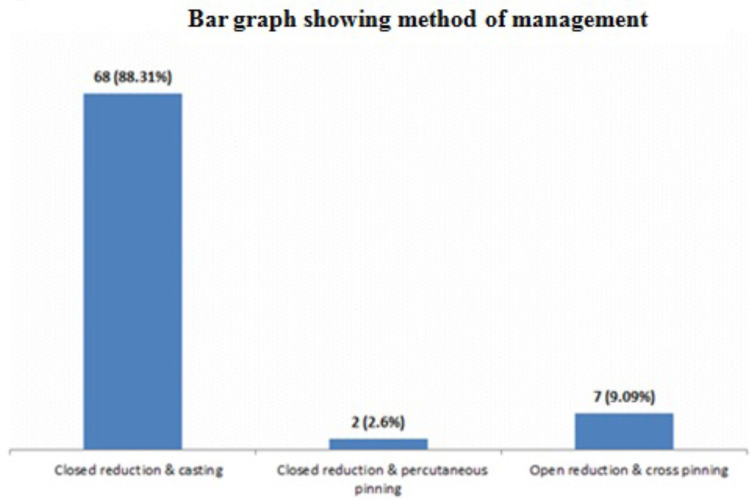
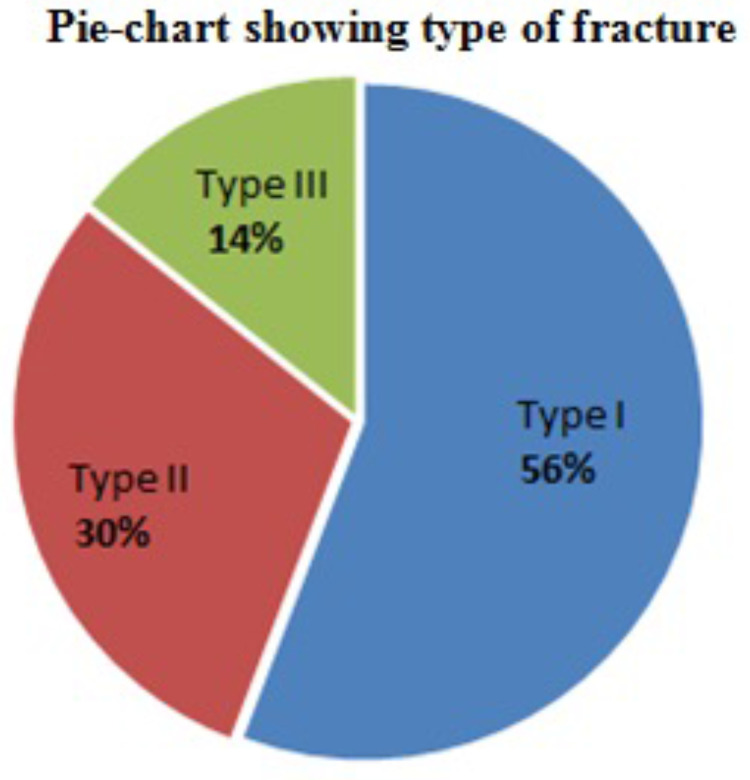
Of the 77 children, 46 (60%) were male with a mean age of 7.86±2.30 years. Gartland type I fracture constituted 55.8% (43), type II was 29.9% (23) and type III was 14.3% (11). About 88.3% of the patients were managed non-operatively and 11.7% were managed operatively. The overall satisfactory functional outcome was 46.7%, while 81.8% of the patients had a satisfactory radiological outcome at 6 months after the intervention. Delay in seeking treatment, type 1 fracture, and prolonged duration of immobilization were significantly associated with unsatisfactory functional management outcome. Type II fracture and prolonged duration of immobilization were significantly associated with unsatisfactory radiological management of SCF of the humerus.
The short-term functional outcome was unsatisfactory, while a satisfactory radiological outcome was found in most of the patients. Duration of immobilization, type of fracture, and seeking late medical care had a negative impact on the outcome of these fractures.
肱骨髁上骨折(SCF)是全球儿童中最常见的健康问题之一,需要严格的管理流程才能获得满意的结果。使用系统的指南来帮助减少不良骨折结局至关重要。该研究主要旨在确定穆拉戈国家转诊医院(MNRH)儿童肱骨髁上骨折的功能和放射学管理结果以及与这些结果相关的因素。
我们在MNRH对接受肱骨髁上骨折治疗的儿童进行了一项基于医院的横断面研究。使用弗林标准,评估肘关节当前的屈伸情况、肱尺角和神经功能,并与对侧肢体进行比较以获得功能结果。将肘关节管理前的数字X线片与当前的X线片进行比较以评估放射学结果。采用双变量和多变量分析来确定相关因素。
77名儿童中,46名(60%)为男性,平均年龄为7.86±2.30岁。加特兰I型骨折占55.8%(43例),II型占29.9%(23例),III型占14.3%(11例)。约88.3%的患者接受非手术治疗,11.7%的患者接受手术治疗。总体满意的功能结果为46.7%,而81.8%的患者在干预后6个月时放射学结果满意。寻求治疗延迟、I型骨折和固定时间延长与功能管理结果不满意显著相关。II型骨折和固定时间延长与肱骨髁上骨折放射学管理不满意显著相关。
短期功能结果不满意,而大多数患者的放射学结果满意。固定时间、骨折类型和就医延迟对这些骨折的结果有负面影响。