Department of Infectious Diseases, Ruijin Hospital, Shanghai Jiao Tong University School of Medicine, Shanghai 200025, China.
Department of Infectious Diseases, The Fifth People's Hospital of Suzhou, Suzhou 215131, China.
Can J Gastroenterol Hepatol. 2022 Jul 14;2022:8695196. doi: 10.1155/2022/8695196. eCollection 2022.
Noninvasive detection of histological abnormalities remains challenging in patients with HBeAg-negative chronic HBV infection with normal or mildly elevated levels of alanine aminotransferase (ALT). This study aimed to assess the utility of serum quantitative hepatitis B surface antigen (qHBsAg) in identifying significant histological lesions in this population.
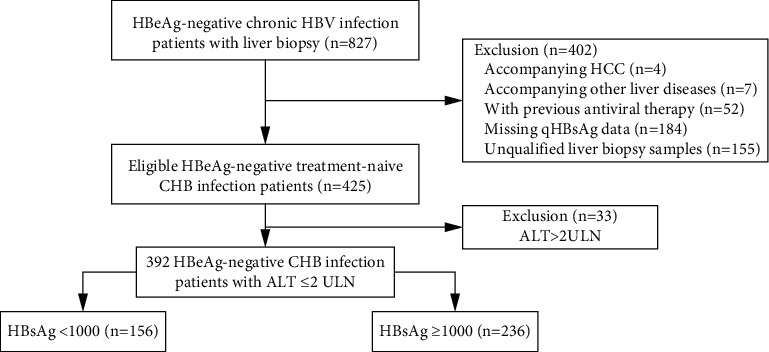
This is a single-center study with retrospective analysis of 392 treatment-naive patients of HBeAg-negative chronic HBV infection with normal or mildly elevated levels of ALT.
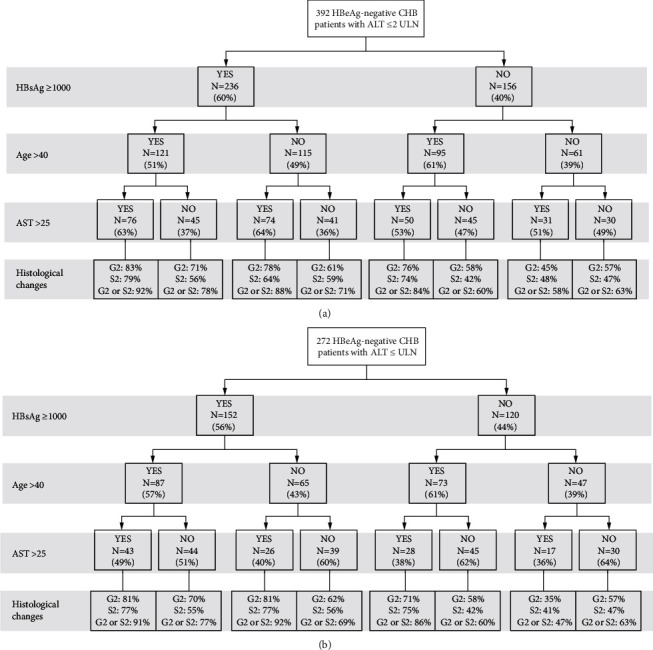
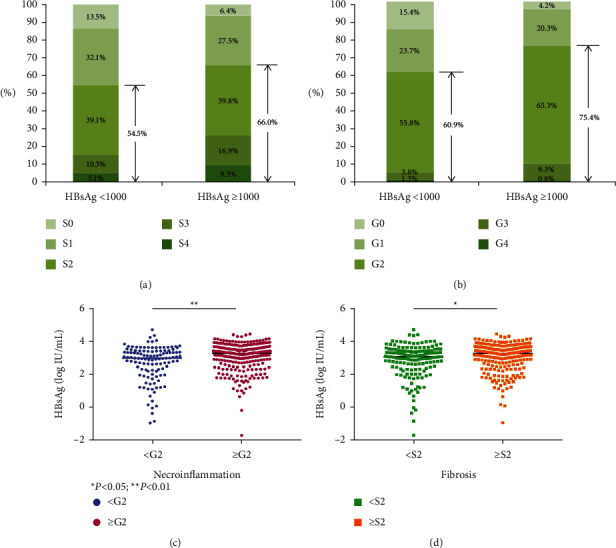
In this cohort, significant necroinflammation and fibrosis were found in 69.4% and 61.5% of patients, respectively. Patients with qHBsAg >1000 IU/mL ( = 236) had more hepatic inflammation of ≥2 (75.4% vs. 60.9%, < 0.01) or fibrosis ≥ 2 (66.1% vs. 54.5%, < 0.05) compared to those without ( = 156). Serum HBsAg (cutoff point = 1000 IU/mL), aspartate aminotransferase (AST) level (cutoff point = 25 IU/L), age (cutoff point = 40 years), and HBV family history were identified as independent predictors of significant histological abnormalities in multivariate logistic analysis.
A significantly higher proportion of patients with histological abnormalities were found in patients with qHBsAg >1000 IU/mL than those without. The qHBsAg level together with age, AST, and family history of HBV infection could be used as an algorithm to help noninvasive patient selection for antiviral therapy.
对于 HBeAg 阴性慢性乙型肝炎病毒感染且丙氨酸氨基转移酶(ALT)水平正常或轻度升高的患者,非侵入性检测组织学异常仍然具有挑战性。本研究旨在评估血清乙型肝炎表面抗原定量(qHBsAg)在识别该人群中显著组织学病变中的作用。
这是一项单中心研究,对 392 例未经治疗的 HBeAg 阴性慢性乙型肝炎病毒感染且 ALT 水平正常或轻度升高的患者进行回顾性分析。
在该队列中,分别有 69.4%和 61.5%的患者存在显著的坏死性炎症和纤维化。qHBsAg>1000IU/ml( = 236)的患者肝炎症≥2(75.4%比 60.9%,<0.01)或纤维化≥2(66.1%比 54.5%,<0.05)的比例高于 qHBsAg<1000IU/ml( = 156)的患者。多变量逻辑回归分析显示,血清 HBsAg(截断值 1000IU/ml)、天门冬氨酸氨基转移酶(AST)水平(截断值 25IU/L)、年龄(截断值 40 岁)和乙型肝炎病毒家族史是显著组织学异常的独立预测因素。
与 qHBsAg<1000IU/ml 的患者相比,qHBsAg>1000IU/ml 的患者中发现具有组织学异常的患者比例显著更高。qHBsAg 水平与年龄、AST 和乙型肝炎病毒感染家族史一起可作为一种算法,帮助非侵入性选择适合抗病毒治疗的患者。