Genetic Health Service New Zealand, Christchurch Hospital, Christchurch, New Zealand.
Department of Biochemistry, University of Otago, Dunedin, New Zealand.
Eur J Hum Genet. 2022 Oct;30(10):1178-1181. doi: 10.1038/s41431-022-01154-2. Epub 2022 Jul 25.
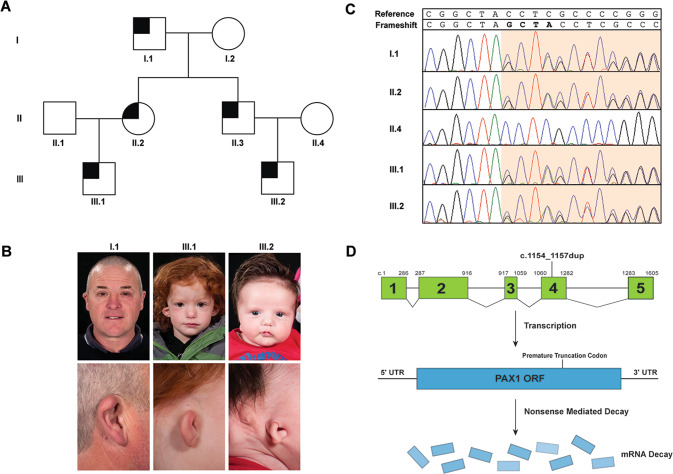
Oculo-auriculo-vertebral syndrome (OAVS) is a clinically heterogeneous disorder, with both genetic and environmental contributors. Multiple genes have been associated with OAVS and common molecular pathways, such as retinoic acid and the PAX-SIX-EYA-DACH (PSED) network, are being implicated in the disease pathophysiology. Biallelic homozygous nonsense or hypomorphic missense mutations in PAX1 cause otofaciocervical syndrome type 2 (OTFCS2), a similar but more severe multi-system disorder that can be accompanied by severe combined immunodeficiency due to thymic aplasia. Here we have identified a multi-generational family with mild features of OAVS segregating a heterozygous frameshift in PAX1. The four base duplication is expected to result in nonsense-mediated decay, and therefore cause a null allele. While there was full penetrance of the variant, expressivity of facial and ear features were variable. Our findings indicate there can be monoallelic and biallelic disorders associated with PAX1, and further implicate the PSED network in OAVS.
眼耳脊椎综合征(OAVS)是一种临床表现异质性疾病,具有遗传和环境因素的双重作用。多种基因与 OAVS 相关,常见的分子途径,如视黄酸和 PAX-SIX-EYA-DACH(PSED)网络,参与了疾病的病理生理学过程。PAX1 的双等位基因纯合无义或功能降低的错义突变导致耳面颈脊柱发育不良 2 型(OTFCS2),这是一种类似但更严重的多系统疾病,由于胸腺发育不全,可伴有严重联合免疫缺陷。在这里,我们鉴定了一个具有 OAVS 轻度特征的多代家族,该家族存在 PAX1 的杂合框移突变。预计四个碱基的重复会导致无义介导的衰变,从而导致无效等位基因。虽然该变体具有完全外显率,但面部和耳部特征的表现度存在差异。我们的研究结果表明,PAX1 相关疾病可能为单等位基因和双等位基因疾病,并进一步提示 PSED 网络在 OAVS 中发挥作用。