Schneck Emmanuel, Askevold Ingolf, Rath Ramona, Hecker Andreas, Reichert Martin, Guth Stefan, Koch Christian, Sander Michael, Seeger Werner, Mayer Konstantin, Padberg Winfried, Sommer Natascha, Kuhnert Stefan, Hecker Matthias
Department of Anesthesiology, Operative Intensive Care Medicine and Pain Therapy, Justus Liebig University of Giessen, 35392 Giessen, Germany.
Department of General and Thoracic Surgery, University Hospital Giessen, Justus Liebig University of Giessen, 35392 Giessen, Germany.
J Clin Med. 2022 Jul 16;11(14):4142. doi: 10.3390/jcm11144142.
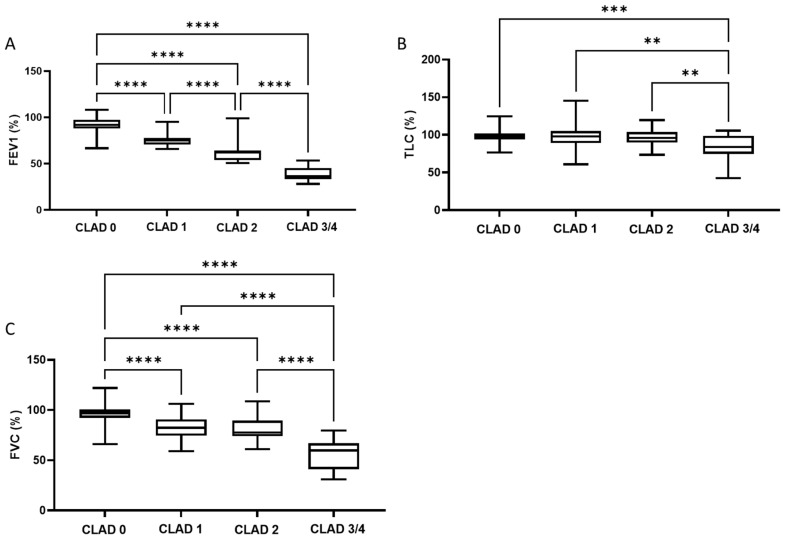
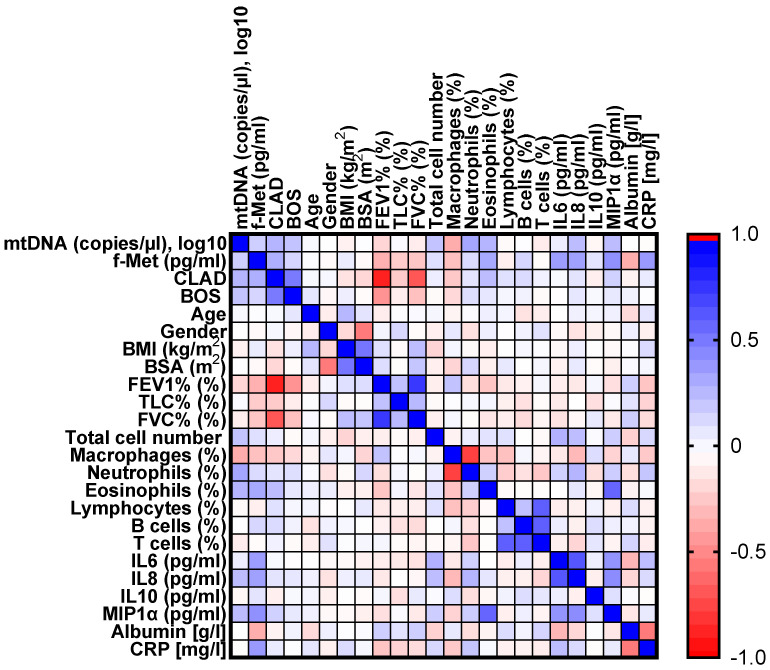
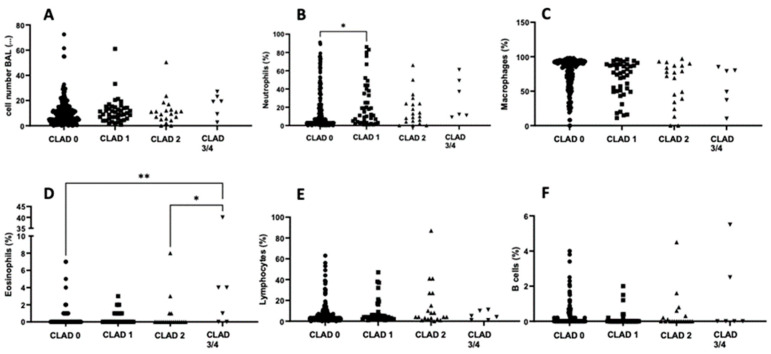
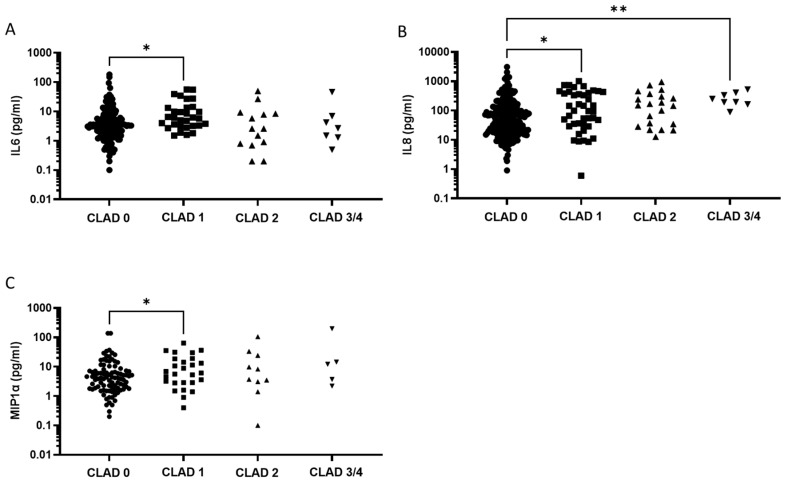
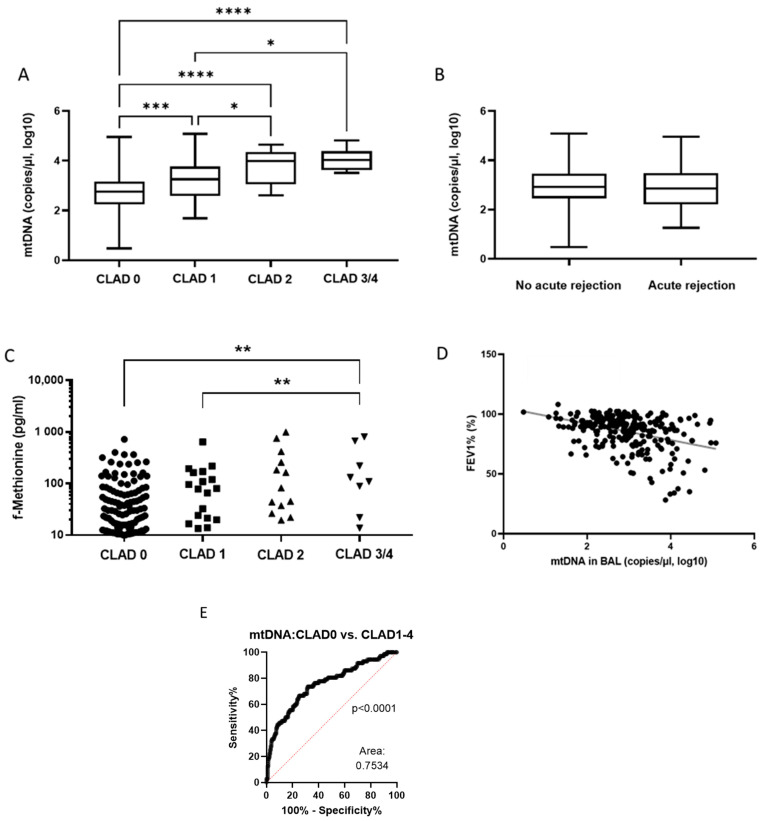
Chronic Lung Allograft Dysfunction (CLAD) is a life-threatening complication that limits the long-term survival of lung transplantation patients. Early diagnosis remains the basis of efficient management of CLAD, making the need for distinctive biomarkers critical. This explorative study aimed to investigate the predictive power of mitochondrial DNA (mtDNA) derived from bronchoalveolar lavages (BAL) to detect CLAD. The study included 106 lung transplant recipients and analyzed 286 BAL samples for cell count, cell differentiation, and inflammatory and mitochondrial biomarkers, including mtDNA. A receiver operating curve analysis of mtDNA levels was used to assess its ability to detect CLAD. The results revealed a discriminatory pro-inflammatory cytokine profile in the BAL fluid of CLAD patients. The concentration of mtDNA increased in step with each CLAD stage, reaching its highest concentration in stage 4, and correlated significantly with decreasing FEV1. The receiver operating curve analysis of mtDNA in BAL revealed a moderate prediction of CLAD when all stages were grouped together (AUROC 0.75, p-value < 0.0001). This study has found the concentration mtDNA in BAL to be a potential predictor for the early detection of CLAD and the differentiation of different CLAD stages, independent of the underlying pathology.
慢性肺移植功能障碍(CLAD)是一种危及生命的并发症,限制了肺移植患者的长期生存。早期诊断仍然是CLAD有效管理的基础,因此对独特生物标志物的需求至关重要。这项探索性研究旨在调查支气管肺泡灌洗(BAL)中提取的线粒体DNA(mtDNA)检测CLAD的预测能力。该研究纳入了106名肺移植受者,并分析了286份BAL样本的细胞计数、细胞分化以及炎症和线粒体生物标志物,包括mtDNA。通过对mtDNA水平进行受试者工作特征曲线分析,以评估其检测CLAD的能力。结果显示,CLAD患者的BAL液中存在具有鉴别意义的促炎细胞因子谱。mtDNA的浓度随着CLAD的每个阶段而逐步升高,在第4阶段达到最高浓度,并且与第一秒用力呼气容积(FEV1)的下降显著相关。对BAL中的mtDNA进行受试者工作特征曲线分析发现,当将所有阶段合并在一起时,mtDNA对CLAD具有中等程度的预测能力(曲线下面积为0.75,p值<0.0001)。本研究发现,BAL中mtDNA的浓度是早期检测CLAD以及区分不同CLAD阶段的潜在预测指标,与潜在病理状况无关。