Zhang Zhiren, He Qiaren, Zhao Wei, Li Yong, Yang Jiaming, Hu Zhenxiang, Chen Xi, Peng Hua, Fu Yang-Xin, Chen Long, Lu Ligong
Zhuhai Institute of Translational Medicine, Zhuhai People's Hospital, Zhuhai Hospital Affiliated with Jinan University, Zhuhai 519000, China.
The Outpatient Department, Shaoguan Hospital of Traditional Chinese Medicine, Shaoguan 512026, China.
J Clin Med. 2022 Jul 18;11(14):4164. doi: 10.3390/jcm11144164.
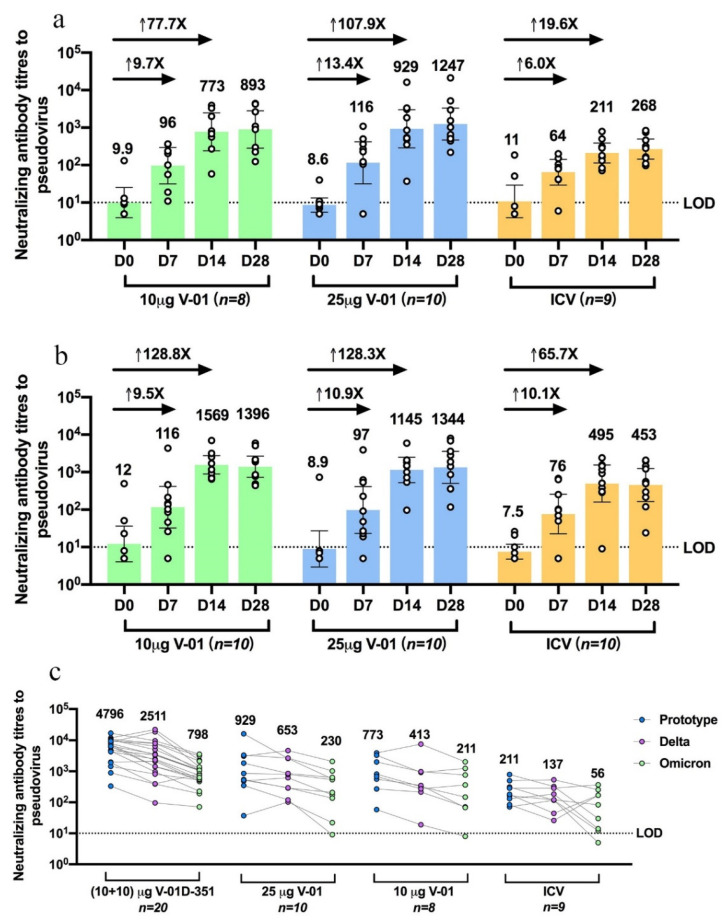
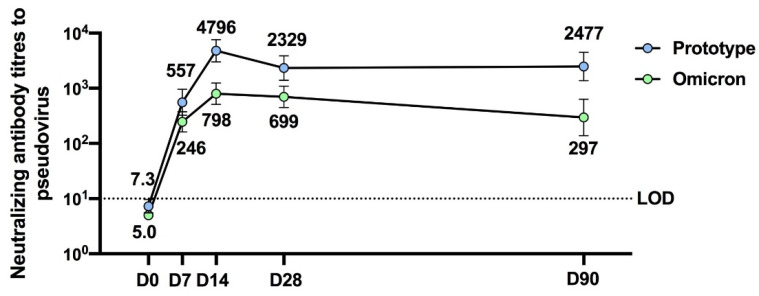
Immune escape of emerging SARS-CoV-2 variants of concern (VOCs) and waning immunity over time following the primary series suggest the importance and necessity of booster shot of COVID-19 vaccines. With the aim to preliminarily evaluate the potential of heterologous boosting, we conducted two pilot studies to evaluate the safety and immunogenicity of the V-01 or a bivalent V-01D-351 (targeting Delta and Beta strain) booster after 5-7 months of the primary series of inactivated COVID-9 vaccine (ICV). A total of 77 participants were enrolled, with 20 participants in the V-01D-351 booster study, and 27, 30 participants in the age stratified participants of V-01 booster study. The safety results showed that V-01 or V-01D-351 was safe and well-tolerated as a heterologous booster shot, with overall adverse reactions predominantly being absent or mild in severity. The immunogenicity results showed that the heterologous prime-boost immunization with V-01 or bivalent V-01D-351 booster induced stronger humoral immune response as compared with the homologous booster with ICV. In particular, V-01D-351 booster showed the highest pseudovirus neutralizing antibody titers against prototype SARS-CoV-2, Delta and Omicron BA.1 strains at day 14 post boosting, with GMTs 22.7, 18.3, 14.3 times higher than ICV booster, 6.2, 6.1, 3.8 times higher than V-01 booster (10 μg), and 5.2, 3.8, 3.5 times higher than V-01 booster (25 μg), respectively. The heterologous V-01 booster also achieved a favorable safety and immunogenicity profile in older participants. Our study has provided evidence for a flexible roll-out of heterologous boosters and referential approaches for variant-specific vaccine boosters, with rationally conserved but diversified epitopes relative to primary series, to build herd immunity against the ongoing pandemic.
新出现的严重急性呼吸综合征冠状病毒2(SARS-CoV-2)变异株(VOCs)的免疫逃逸以及初次接种疫苗后免疫力随时间减弱,提示了新冠疫苗加强针的重要性和必要性。为初步评估异源加强免疫的潜力,我们开展了两项试点研究,以评估在接种新冠灭活疫苗(ICV)初次系列5至7个月后,V-01或二价V-01D-351(针对德尔塔和贝塔毒株)加强针的安全性和免疫原性。共招募了77名参与者,其中20名参与V-01D-351加强针研究,27名、30名分别参与V-01加强针研究的年龄分层参与者。安全性结果显示,V-01或V-01D-351作为异源加强针是安全且耐受性良好的,总体不良反应主要为无或轻度。免疫原性结果显示,与ICV同源加强针相比,V-01或二价V-01D-351加强针的异源初免-加强免疫诱导了更强的体液免疫反应。特别是,V-01D-351加强针在加强接种后第14天显示出针对原型SARS-CoV-2、德尔塔和奥密克戎BA.1毒株的最高假病毒中和抗体滴度,其几何平均滴度(GMT)分别比ICV加强针高22.7、18.3、14.3倍,比V-01加强针(10μg)高6.2、6.1、3.8倍,比V-01加强针(25μg)高5.2、3.8、3.5倍。异源V-01加强针在老年参与者中也获得了良好的安全性和免疫原性。我们的研究为灵活推广异源加强针以及针对变异株特异性疫苗加强针的参考方法提供了证据,这些加强针相对于初次系列具有合理保守但多样化的表位,以建立针对当前大流行的群体免疫。