Volkova Tatyana V, Simonova Olga R, Perlovich German L
G. A. Krestov Institute of Solution Chemistry, The Russian Academy of Sciences, 153045 Ivanovo, Russia.
Pharmaceutics. 2022 Jul 15;14(7):1472. doi: 10.3390/pharmaceutics14071472.
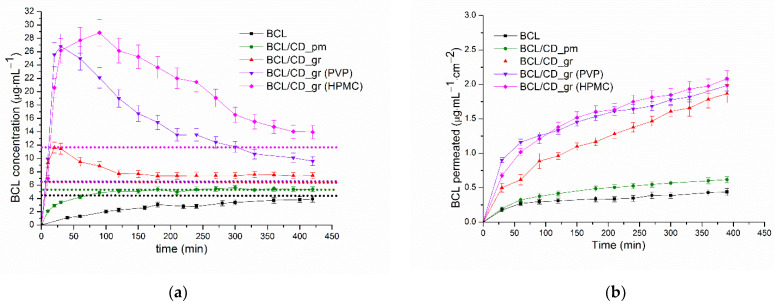
The complex formation of antiandrogen bicalutamide (BCL) with methylated (Me-β-CD) and acetylated (Ac-β-CD) β-cyclodextrins was investigated in buffer solution pH 6.8. A two-fold strongly binding of BCL to Ac-β-CD as compared to Me-β-CD was revealed. The solid dispersion of BCL with Ac-β-CD was prepared by the mechanical grinding procedure to obtain the complex in the solid state. The BCL/Ac-β-CD complex was characterized by DSC, XPRD, FTIR, and SEM techniques. The effect of Ac-β-CD in the BCL solid dispersions on the non-sink dissolution/permeation simultaneous processes was disclosed using the side-by-side diffusion cell with the help of the cellulose membrane. The elevated dissolution of the ground complex, as compared to the raw drug as well as the simple physical mixture, accompanied by the supersaturation was revealed. Two biopolymers-polyvinylpyrrolidone (PVP, M = 58,000) and hydroxypropylmethylcellulose (HPMC, M ~ 10,000)-were examined as the precipitation inhibitors and were shown to be useful in prolonging the supersaturation state. The BCL/Ac-β-CD complex has the fastest dissolution rate in the presence of HPMC. The maximal concentration of the complex was achieved at a time of 20, 30, and 90 min in the pure buffer, with PVP and with HPMC, respectively. The effectiveness of the BCL dissolution (release) processes (illustrated by the AUCC(t) parameter) was estimated to be 7.8-, 5.8-, 3.0-, and 1.8-fold higher for BCL/Ac-β-CD (HPMC), BCL/Ac-β-CD (PVP), BCL/Ac-β-CD (buffer), and the BCL/Ac-β-CD physical mixture, respectively, as compared to the BCL_raw sample. The excipient gain factor (EGF), calculated for the dissolution of the BCL complex, was shown to be 2.6 in the presence of HPMC, which is 1.3-fold greater as compared to PVP. From the experimental dissolution results, it can be concluded that the formation of BCL ground complex with Ac-β-CD enhances the dissolution rate of the compound. The permeation was also shown to be advantageous in the presence of the polymers, which was demonstrated by the elevated fluxes of BCL through the membrane. The comparison of the dissolution/permeation processes was illustrated and discussed. The conclusion was made that the presence of HPMC as a stabilizer of the supersaturation state is promising and seems to be a useful tool for the optimization of BCL pharmaceutical formulations manufacturing.
在pH 6.8的缓冲溶液中研究了抗雄激素比卡鲁胺(BCL)与甲基化(Me-β-CD)和乙酰化(Ac-β-CD)β-环糊精的复合物形成。结果表明,与Me-β-CD相比,BCL与Ac-β-CD的结合力强两倍。通过机械研磨法制备了BCL与Ac-β-CD的固体分散体,以获得固态复合物。采用差示扫描量热法(DSC)、X射线粉末衍射法(XPRD)、傅里叶变换红外光谱法(FTIR)和扫描电子显微镜法(SEM)对BCL/Ac-β-CD复合物进行了表征。借助纤维素膜,使用并排扩散池揭示了Ac-β-CD在BCL固体分散体中对非漏槽溶解/渗透同步过程的影响。与原料药以及简单物理混合物相比,研磨复合物的溶出度升高,并伴有过饱和现象。研究了两种生物聚合物——聚乙烯吡咯烷酮(PVP,分子量 = 58,000)和羟丙基甲基纤维素(HPMC,分子量约为10,000)作为沉淀抑制剂的效果,结果表明它们有助于延长过饱和状态。在HPMC存在下,BCL/Ac-β-CD复合物的溶出速率最快。在纯缓冲液、PVP和HPMC存在下,复合物分别在20、30和90分钟时达到最大浓度。与BCL原料药样品相比,BCL/Ac-β-CD(HPMC)、BCL/Ac-β-CD(PVP)、BCL/Ac-β-CD(缓冲液)和BCL/Ac-β-CD物理混合物的BCL溶解(释放)过程的有效性(以AUCC(t)参数表示)分别提高了7.8倍、5.8倍、3.0倍和1.8倍。计算得出,在HPMC存在下,BCL复合物溶解的辅料增益因子(EGF)为2.6,比PVP高1.3倍。从实验溶出结果可以得出结论,BCL与Ac-β-CD研磨复合物的形成提高了该化合物的溶出速率。聚合物的存在也有利于渗透,这通过BCL透过膜的通量增加得到证明。对溶解/渗透过程进行了比较和讨论。得出的结论是,HPMC作为过饱和状态的稳定剂具有前景,似乎是优化BCL药物制剂生产的有用工具。