Lage Daniela P, Vale Danniele L, Linhares Flávia P, Freitas Camila S, Machado Amanda S, Cardoso Jamille M O, de Oliveira Daysiane, Galvani Nathália C, de Oliveira Marcelo P, Oliveira-da-Silva João A, Ramos Fernanda F, Tavares Grasiele S V, Ludolf Fernanda, Bandeira Raquel S, Pereira Isabela A G, Chávez-Fumagalli Miguel A, Roatt Bruno M, Machado-de-Ávila Ricardo A, Christodoulides Myron, Coelho Eduardo A F, Martins Vívian T
Programa de Pós-Graduação em Ciências da Saúde: Infectologia e Medicina Tropical, Faculdade de Medicina, Universidade Federal de Minas Gerais, Av. Prof. Alfredo Balena, 190, Belo Horizonte 30130-100, MG, Brazil.
Laboratório de Imunopatologia, Núcleo de Pesquisas em Ciências Biológicas (NUPEB), Departamento de Ciências Biológicas, Insituto de Ciências Exatas e Biológicas, Universidade Federal de Ouro Preto, Ouro Preto CEP 35400-000, MG, Brazil.
Vaccines (Basel). 2022 Jul 19;10(7):1146. doi: 10.3390/vaccines10071146.
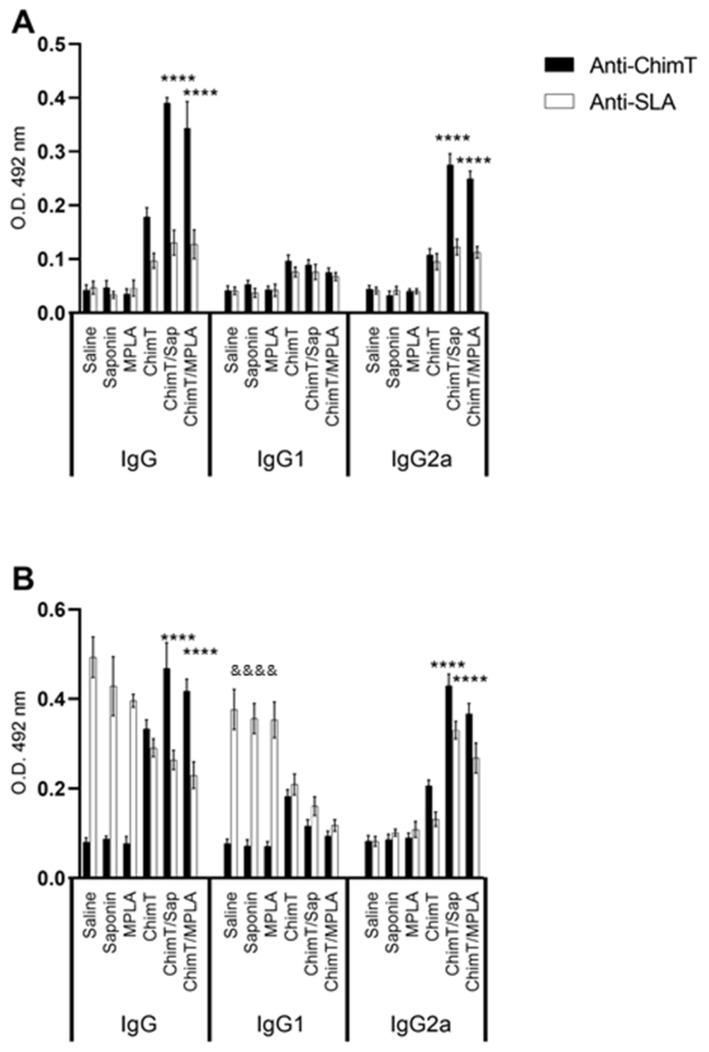
Currently, there is no licensed vaccine to protect against human visceral leishmaniasis (VL), a potentially fatal disease caused by infection with Leishmania parasites. In the current study, a recombinant chimeric protein ChimT was developed based on T-cell epitopes identified from the immunogenic Leishmania amastigote proteins LiHyp1, LiHyV, LiHyC and LiHyG. ChimT was associated with the adjuvants saponin (Sap) or monophosphoryl lipid A (MPLA) and used to immunize mice, and their immunogenicity and protective efficacy were evaluated. Both ChimT/Sap and ChimT/MPLA induced the development of a specific Th1-type immune response, with significantly high levels of IFN-γ, IL-2, IL-12, TNF-α and GM-CSF cytokines produced by CD4+ and CD8+ T cell subtypes (p < 0.05), with correspondingly low production of anti-leishmanial IL-4 and IL-10 cytokines. Significantly increased (p < 0.05) levels of nitrite, a proxy for nitric oxide, and IFN-γ expression (p < 0.05) were detected in stimulated spleen cell cultures from immunized and infected mice, as was significant production of parasite-specific IgG2a isotype antibodies. Significant reductions in the parasite load in the internal organs of the immunized and infected mice (p < 0.05) were quantified with a limiting dilution technique and quantitative PCR and correlated with the immunological findings. ChimT/MPLA showed marginally superior immunogenicity than ChimT/Sap, and although this was not statistically significant (p > 0.05), ChimT/MPLA was preferred since ChimT/Sap induced transient edema in the inoculation site. ChimT also induced high IFN-γ and low IL-10 levels from human PBMCs isolated from healthy individuals and from VL-treated patients. In conclusion, the experimental T-cell multi-epitope amastigote stage Leishmania vaccine administered with adjuvants appears to be a promising vaccine candidate to protect against VL.
目前,尚无获得许可的疫苗可预防人类内脏利什曼病(VL),这是一种由利什曼原虫寄生虫感染引起的潜在致命疾病。在当前的研究中,基于从具有免疫原性的利什曼无鞭毛体蛋白LiHyp1、LiHyV、LiHyC和LiHyG中鉴定出的T细胞表位,开发了一种重组嵌合蛋白ChimT。ChimT与佐剂皂苷(Sap)或单磷酰脂质A(MPLA)结合,并用于免疫小鼠,对其免疫原性和保护效果进行了评估。ChimT/Sap和ChimT/MPLA均诱导了特异性Th1型免疫反应的产生,CD4+和CD8+ T细胞亚群产生的IFN-γ、IL-2、IL-12、TNF-α和GM-CSF细胞因子水平显著升高(p<0.05),而抗利什曼原虫的IL-4和IL-10细胞因子产生相应较低。在免疫和感染小鼠的刺激脾细胞培养物中,检测到亚硝酸盐(一氧化氮的替代物)水平显著升高(p<0.05)以及IFN-γ表达显著升高(p<0.05),同时还检测到了寄生虫特异性IgG2a同种型抗体的显著产生。用有限稀释技术和定量PCR对免疫和感染小鼠内脏器官中的寄生虫载量进行了定量,发现其显著降低(p<0.05),且与免疫学结果相关。ChimT/MPLA的免疫原性略优于ChimT/Sap,尽管这在统计学上无显著差异(p>0.05),但由于ChimT/Sap在接种部位诱导了短暂性水肿,因此更倾向于选择ChimT/MPLA。ChimT还能诱导从健康个体和VL治疗患者中分离出的人外周血单核细胞产生高水平的IFN-γ和低水平的IL-10。总之,与佐剂联合使用的实验性T细胞多表位无鞭毛体阶段利什曼原虫疫苗似乎是一种有前景的预防VL的候选疫苗。