Pelletier Karyne, Côté Gabrielle, Madsen Kayla, Chen Shiyi, Kim S Joseph, Chan Christopher T, Mattsson Jonas, Pasic Ivan, Kitchlu Abhijat
Department of Medicine, Division of Nephrology, University Health Network, Toronto, Canada.
Hans Messner Allogeneic Blood and Marrow Transplantation Program, Division of Medical Oncology and Hematology, Princess Margaret Cancer Centre, University Health Network, Toronto, Canada.
Clin Kidney J. 2022 Apr 7;15(8):1583-1592. doi: 10.1093/ckj/sfac091. eCollection 2022 Aug.
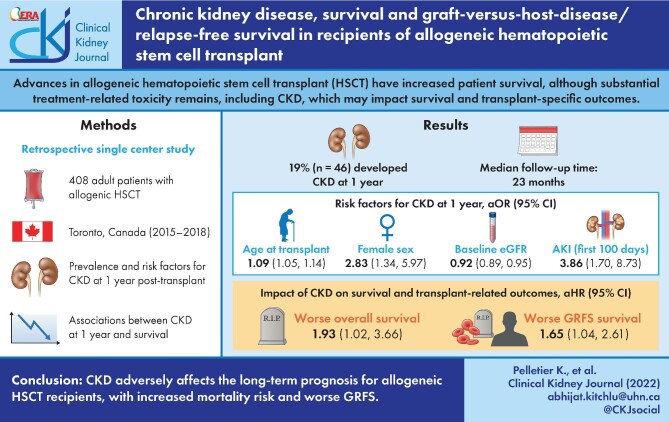
Advances in allogeneic hematopoietic stem cell transplant (HSCT) have increased patient survival, although substantial treatment-related toxicity remains, including chronic kidney disease (CKD). We assessed the association between CKD and survival and transplant-specific outcomes in HSCT recipients.
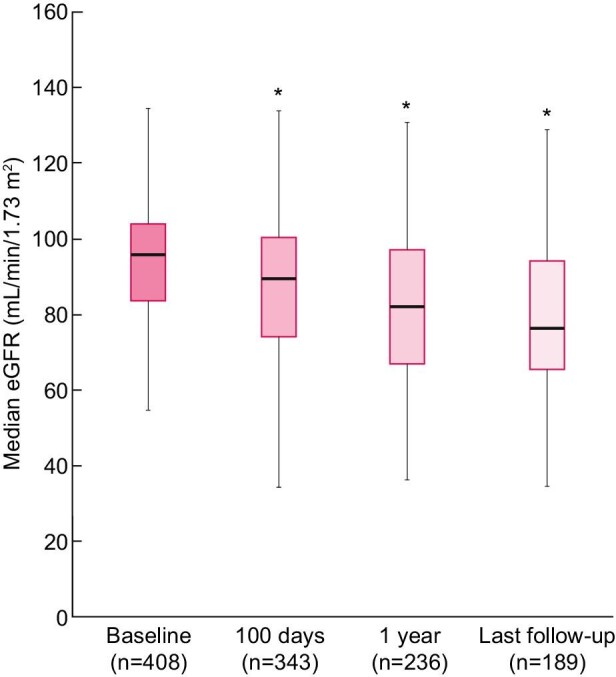
We conducted a retrospective study of all 408 adult patients with allogenic HSCT at Princess Margaret Cancer Centre (Toronto, Canada, 2015-18). We used logistic regression to identify risk factors for CKD at 1 year post-transplant. Associations between CKD at 1 year and overall survival, relapse-free survival, graft-versus-host-disease (GVHD)-free/relapse-free survival, relapse and transplant-related mortality were examined using extended time-varying Cox models. In a sensitivity analysis, we restricted the cohort to survivors at 1 year, using standard Cox proportional hazard models to examine associations between CKD and overall survival, relapse-free survival and GVHD-free/relapse-free survival, and Fine and Gray's competing risk models to determine associations between CKD and relapse/transplant-related mortality.
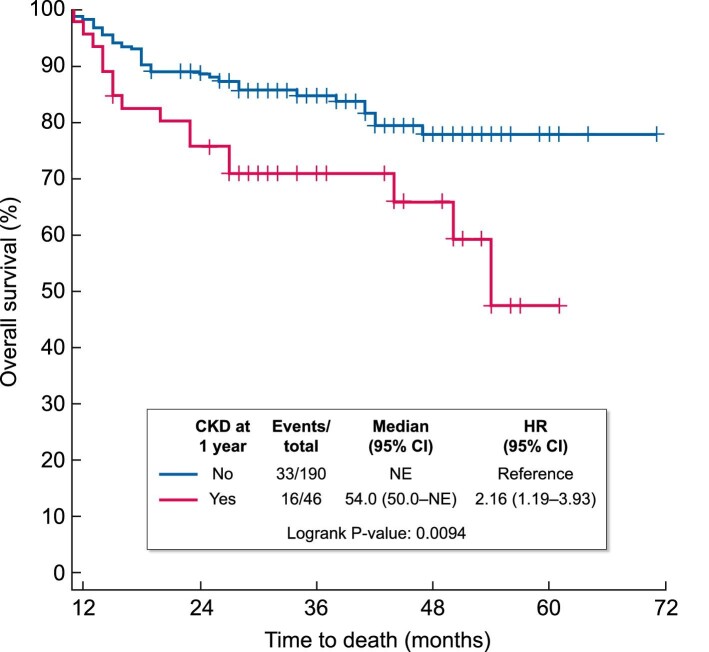
The prevalence of CKD at 1 year was 19% (46 patients) with median follow-up of 23 months. Multivariable regression identified age at transplant [adjusted OR (aOR) 1.09, 95% confidence interval (95% CI) = 1.05-1.14; P < 0.0001), female gender (aOR 2.83, 95% CI = 1.34-5.97; P = 0.006) and acute kidney injury during the first 100 days (aOR 3.86, 95% CI = 1.70-8.73; P = 0.001) as risk factors for CKD at 1 year. Patients with CKD at 1 year had significantly poorer overall survival than those without CKD, when adjusted for relevant covariates [adjusted HR (aHR) 1.93, 95% CI = 1.02-3.66; P = 0.04 in the time-varying Cox model, and aHR 2.06, 95% CI = 1.04-4.07; P = 0.04 using the standard Cox model]. CKD at 1 year was also associated with worse GVHD-free/relapse-free survival (aHR 1.65, 95% CI = 1.04-2.61; P = 0.03).
CKD adversely affects the long-term prognosis for allogeneic HSCT recipients, with increased mortality risk and worse GVHD-free/relapse-free survival.
异基因造血干细胞移植(HSCT)技术的进步提高了患者的生存率,尽管仍存在大量与治疗相关的毒性反应,包括慢性肾脏病(CKD)。我们评估了CKD与HSCT受者生存率及移植特异性结局之间的关联。
我们对加拿大安大略省多伦多市玛嘉烈公主癌症中心2015年至2018年间接受异基因HSCT的408例成年患者进行了一项回顾性研究。我们使用逻辑回归来确定移植后1年时CKD的危险因素。使用扩展的时变Cox模型检验移植后1年时的CKD与总生存率、无复发生存率、无移植物抗宿主病(GVHD)/无复发生存率、复发率和移植相关死亡率之间的关联。在一项敏感性分析中,我们将队列限制为移植后1年的幸存者,使用标准Cox比例风险模型检验CKD与总生存率、无复发生存率和无GVHD/无复发生存率之间的关联,并使用Fine和Gray竞争风险模型确定CKD与复发/移植相关死亡率之间的关联。
移植后1年时CKD的患病率为19%(46例患者),中位随访时间为23个月。多变量回归确定移植时年龄(调整后的比值比[aOR]为1.09,95%置信区间[CI]=1.05-1.14;P<0.0001)、女性性别(aOR为2.83,95%CI=1.34-5.97;P=0.006)和移植后前100天内的急性肾损伤(aOR为3.86,95%CI=1.70-8.73;P=0.001)为移植后1年时CKD的危险因素。在调整相关协变量后,移植后1年患有CKD的患者的总生存率明显低于未患CKD的患者(时变Cox模型中的调整后风险比[aHR]为1.93,95%CI=1.02-3.66;P=0.04,使用标准Cox模型时aHR为2.06,95%CI=1.04-4.07;P=0.04)。移植后第1年的CKD也与较差的无GVHD/无复发生存率相关(aHR为1.65,95%CI=1.04-?2.61;P=0.03)。
CKD对异基因HSCT受者的长期预后产生不利影响,增加了死亡风险,降低了无GVHD/无复发生存率。