Mondschein Romy, Bolton Damien, Clouston David, Dowty James, Kavanagh Liam, Murphy Declan, Scott Prudence, Taylor Renea A, Thorne Heather
kConFab, Research Division, Peter MacCallum Cancer Centre, East Melbourne 3002, Australia.
Austin Health, Urology, Heidelberg, Melbourne 3084, Australia.
Cancers (Basel). 2022 Jul 26;14(15):3623. doi: 10.3390/cancers14153623.
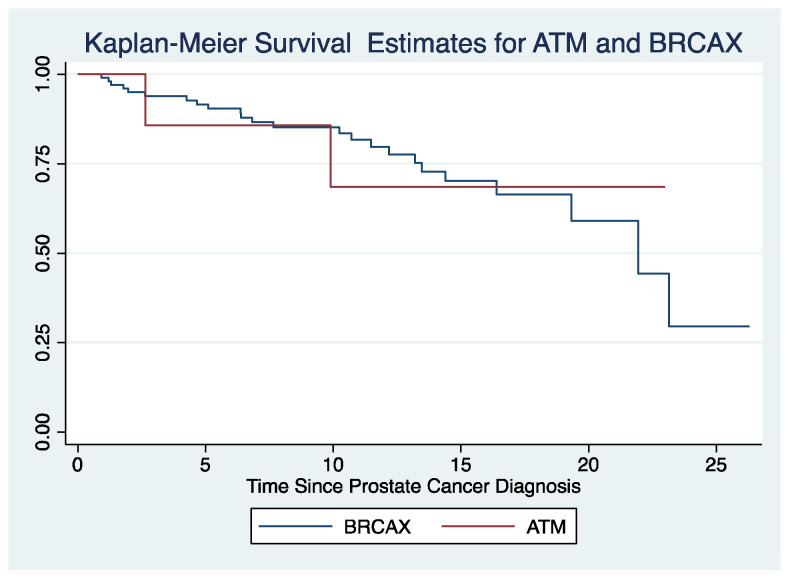
Germline mutations in are associated with aggressive prostate cancer. Additional information regarding the clinical phenotype of germline pathogenic variants in other prostate cancer predisposition genes is required. Clinical testing has been limited by evidence, further restricting knowledge of variants that contribute to prostate cancer development. Prostate cancer patients who were first- and second-degree relatives from multi-case prostate cancer families underwent a gene panel screen to identify novel (non-) germline pathogenic variants in cancer predisposition genes and define clinical phenotypes associated with each gene. The germline genomic DNA (gDNA) of 94 index cases with verified prostate cancer from families with a minimum of two verified prostate cancer cases was screened with an 84-cancer-gene panel. Families were recruited for multi-case breast/ovarian cancer ( = 66), or multi-case prostate cancer ( = 28). Prostate cancer characteristics associated with each gene were compared with prostate cancer cases of confirmed non-mutation carriers (), also from multi-case prostate cancer families ( = 111), and with data from the Prostate Cancer Outcomes Registry (PCOR). Ninety-four prostate cancer index cases underwent gene panel testing; twenty-two index cases (22/94; 23%) were found to carry a class 4-5 (C4/5) variant. Six of twenty-two (27%) variants were not clinically notifiable, and seven of twenty-two (31.8%) variants were in genes. Nine of twenty-two (40.9%) index cases had variants identified in ( = 4), ( = 2) and ( = 3); gDNA for all relatives of these nine cases was screened for the corresponding familial variant. The final cohort comprised 15 confirmed germline mutation carriers with prostate cancer ( = 9, = 2, = 4). and -associated cancers were D'Amico intermediate or high risk, comparable to our previously published and prostate cancer cohort. carriers demonstrated low- to intermediate-risk prostate cancer. In the cohort, 53.2% of subjects demonstrated high-risk disease compared with 25% of the PCOR cohort. and germline mutation carriers and the (confirmed non-mutation carriers) cohort demonstrated high risk disease compared with the general population. Targeted genetic testing will help identify men at greater risk of prostate-cancer-specific mortality. Data correlating rare variants with clinical phenotype and familial predisposition will strengthen the clinical validity and utility of these results and establish these variants as significant in prostate cancer detection and management.
中的种系突变与侵袭性前列腺癌相关。需要有关其他前列腺癌易感基因中种系致病变异临床表型的更多信息。临床检测受到证据的限制,进一步限制了对促成前列腺癌发展的变异的了解。来自多例前列腺癌家族的一级和二级亲属的前列腺癌患者接受了基因panel筛查,以识别癌症易感基因中的新型(非)种系致病变异,并确定与每个基因相关的临床表型。使用84个癌症基因panel对来自至少有两例确诊前列腺癌病例的家族的94例确诊前列腺癌的索引病例的种系基因组DNA(gDNA)进行了筛查。招募了多例乳腺癌/卵巢癌(n = 66)或多例前列腺癌(n = 28)的家族。将与每个基因相关的前列腺癌特征与同样来自多例前列腺癌家族(n = 111)的确诊非突变携带者()的前列腺癌病例以及前列腺癌结果登记处(PCOR)的数据进行了比较。94例前列腺癌索引病例接受了基因panel检测;发现22例索引病例(22/94;23%)携带4-5类(C4/5)变异。22个变异中有6个(27%)在临床上不可报告,22个变异中有7个(31.8%)在基因中。22个索引病例中有9个(40.9%)在(n = 4)、(n = 2)和(n = 3)中发现了变异;对这9例病例的所有亲属的gDNA进行了相应家族变异的筛查。最终队列包括15例确诊的前列腺癌种系突变携带者(n = 9,n = 2,n = 4)。与相关的癌症为达米科中度或高风险,与我们之前发表的和前列腺癌队列相当。携带者表现为低至中度风险的前列腺癌。在队列中,53.2%的受试者表现为高风险疾病,而PCOR队列中这一比例为25%。与种系突变携带者以及(确诊非突变携带者)队列相比,普通人群表现出高风险疾病。靶向基因检测将有助于识别前列腺癌特异性死亡风险更高的男性。将罕见变异与临床表型和家族易感性相关的数据将加强这些结果的临床有效性和实用性,并确定这些变异在前列腺癌检测和管理中的重要性。