Graham Florence, Kane Ros, Gussy Mark, Nelson David
Lincoln Medical School, College of Science, Universities of Nottingham and Lincoln, Lincoln LN6 7TS, UK.
School of Health and Social Care, University of Lincoln, Lincoln LN6 7TS, UK.
Nurs Rep. 2022 Jul 5;12(3):482-497. doi: 10.3390/nursrep12030046.
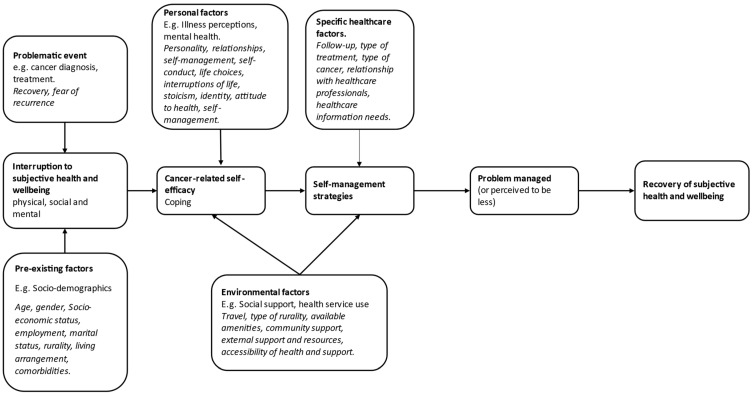
Rural cancer survivors have poorer experiences and health outcomes compared to their urban counterparts. There is limited research on the post-treatment experiences of UK cancer survivors residing in rural areas. This study aimed to provide an understanding of the specific challenges and opportunities faced by rural cancer survivors and to provide insight into how rurality influences experiences post-primary treatment, ultimately to inform service provision. A secondary analysis of in-depth interview transcripts ( = 16) from a wider study on self-management in cancer survivors was conducted. An adapted version of Foster and Fenlon's recovery of health and wellbeing in cancer survivorship framework informed the data coding. Health and wellbeing were interrupted by a variety of problem incidents, and the subsequent steps to recovery were influenced by pre-existing, personal, environmental, and healthcare factors. A prominent theme was support, both from local communities and family as well as from healthcare professionals, with many survivors feeling that their rural setting had a positive influence on their health and wellbeing. Close relationships with local GPs were seen as fundamental to supporting recovery. Access to healthcare was frequently mentioned as a challenge with an emphasis on lengthy travel times and limited bespoke support in rural areas. This study is novel in that it applied a well-established theoretical framework to a rich qualitative dataset on the lived experiences of rural cancer survivors. Rural residency influenced recovery from cancer both positively and negatively. Future practitioners and policy makers should consider working with local communities to tailor interventions to the specific characteristics of the rural environment.
与城市癌症幸存者相比,农村癌症幸存者的经历和健康状况更差。关于居住在英国农村地区的癌症幸存者治疗后的经历,相关研究有限。本研究旨在了解农村癌症幸存者面临的具体挑战和机遇,并深入了解农村地区如何影响初次治疗后的经历,最终为服务提供提供参考。对一项关于癌症幸存者自我管理的更广泛研究中的深度访谈记录(n = 16)进行了二次分析。Foster和Fenlon的癌症幸存者健康与福祉恢复框架的改编版本为数据编码提供了依据。健康和福祉受到各种问题事件的干扰,随后的恢复步骤受到先前存在的、个人的、环境的和医疗保健因素的影响。一个突出的主题是来自当地社区、家庭以及医疗保健专业人员的支持,许多幸存者认为他们的农村环境对他们的健康和福祉有积极影响。与当地全科医生的密切关系被视为支持康复的基础。获得医疗保健经常被提及为一项挑战,重点是农村地区漫长的出行时间和有限的定制支持。这项研究的新颖之处在于,它将一个成熟的理论框架应用于关于农村癌症幸存者生活经历的丰富定性数据集。农村居住对癌症康复既有积极影响也有消极影响。未来的从业者和政策制定者应考虑与当地社区合作,根据农村环境的具体特点量身定制干预措施。