Proboste Tatiana, Clark Nicholas J, Tozer Sarah, Wood Caitlin, Lambert Stephen B, Soares Magalhães Ricardo J
UQ Spatial Epidemiology Laboratory, School of Veterinary Science, University of Queensland, Gatton, QLD 4343, Australia.
Queensland Maternal and Perinatal Quality Council, Queensland Department of Health, Herston, QLD 4029, Australia.
Pathogens. 2022 Jul 25;11(8):830. doi: 10.3390/pathogens11080830.
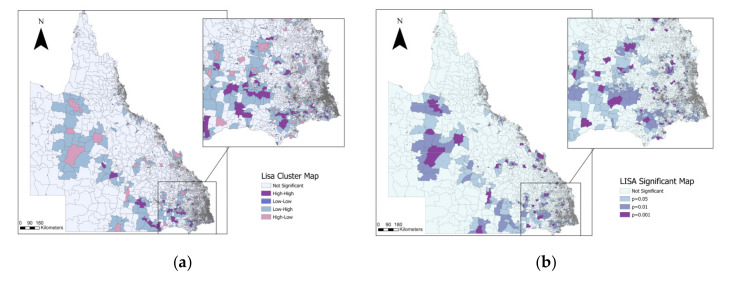
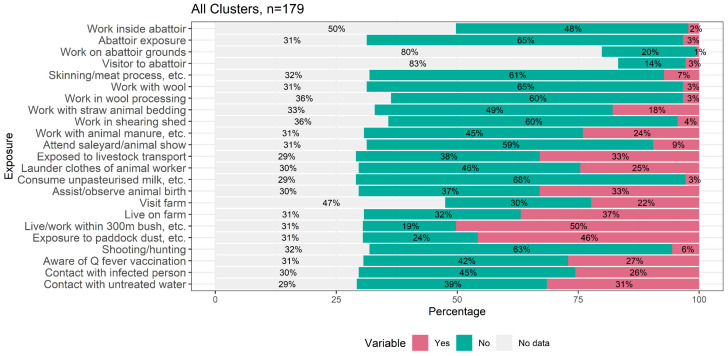
Q fever, caused by the bacterium , is an important zoonotic disease worldwide. Australia has one of the highest reported incidences and seroprevalence of Q fever, and communities in the state of Queensland are at highest risk of exposure. Despite Australia's Q fever vaccination programs, the number of reported Q fever cases has remained stable for the last few years. The extent to which Q fever notifications cluster in circumscribed communities is not well understood. This study aimed to retrospectively explore and identify the spatiotemporal variation in Q fever household and community clusters in Queensland reported during 2002 to 2017, and quantify potential within cluster drivers. We used Q fever notification data held in the Queensland Notifiable Conditions System to explore the geographical clustering patterns of Q fever incidence, and identified and estimated community Q fever spatiotemporal clusters using SatScan, Boston, MA, USA. The association between Q fever household and community clusters, and demographic and socioeconomic characteristics was explored using the chi-squared statistical test and logistic regression analysis. From the total 2175 Q fever notifications included in our analysis, we found 356 Q fever hotspots at a mesh-block level. We identified that 8.2% of Q fever notifications belonged to a spatiotemporal cluster. Within the spatiotemporal Q fever clusters, we found 44 (61%) representing household clusters and 20 (27.8%) were statistically significant with an average cluster size of 3 km radius. Our multivariable model shows statistical differences between cases belonging to clusters in comparison with cases outside clusters based on the type of reported exposure. In conclusion, our results demonstrate that clusters of Q fever notifications are temporally stable and geographically circumscribed, indicating a persistent common exposure. Furthermore, within individuals in household and community clusters, abattoir exposure (a traditional occupational exposure) was rarely reported by individuals.
由 细菌引起的 Q 热是一种在全球范围内重要的人畜共患病。澳大利亚是 Q 热报告发病率和血清阳性率最高的国家之一,昆士兰州的社区面临的暴露风险最高。尽管澳大利亚实施了 Q 热疫苗接种计划,但在过去几年中,Q 热报告病例数一直保持稳定。Q 热报告病例在特定社区中的聚集程度尚不清楚。本研究旨在回顾性探索和识别 2002 年至 2017 年期间昆士兰州报告的 Q 热家庭和社区聚集的时空变化,并量化聚集内的潜在驱动因素。我们使用昆士兰州法定传染病系统中的 Q 热报告数据来探索 Q 热发病率的地理聚集模式,并使用美国马萨诸塞州波士顿的 SatScan 识别和估计社区 Q 热时空聚集。使用卡方统计检验和逻辑回归分析探索 Q 热家庭和社区聚集与人口统计学和社会经济特征之间的关联。在我们分析的总共 2175 例 Q 热报告病例中,我们在网格街区层面发现了 356 个 Q 热热点。我们确定 8.2% 的 Q 热报告病例属于时空聚集。在时空 Q 热聚集中,我们发现 44 个(61%)代表家庭聚集,20 个(27.8%)具有统计学意义,平均聚集半径为 3 公里。我们的多变量模型显示,根据报告的暴露类型,属于聚集的病例与聚集外的病例之间存在统计学差异。总之,我们的结果表明,Q 热报告病例聚集在时间上是稳定的,在地理上是受限的,这表明存在持续的共同暴露。此外,在家庭和社区聚集中的个体中,很少有人报告有屠宰场暴露(一种传统职业暴露)。