Department of Laboratory Medicine, Institute of Biomedicine, Sahlgrenska Academy at the University of Gothenburg, Gothenburg, Sweden.
Neuromuscular Center, Department of Neurology, Sahlgrenska University Hospital, Gothenburg, Sweden.
Neuropathol Appl Neurobiol. 2022 Dec;48(7):e12841. doi: 10.1111/nan.12841. Epub 2022 Aug 6.
Patients with dermatomyositis (DM) suffer from reduced aerobic metabolism contributing to impaired muscle function, which has been linked to cytochrome c oxidase (COX) deficiency in muscle tissue. This mitochondrial respiratory chain dysfunction is typically seen in perifascicular regions, which also show the most intense inflammatory reaction along with capillary loss and muscle fibre atrophy. The objective of this study was to investigate the pathobiology of the oxidative phosphorylation deficiency in DM.
Muscle biopsy specimens with perifascicular COX deficiency from five juveniles and seven adults with DM were investigated. We combined immunohistochemical analyses of subunits in the respiratory chain including complex I (subunit NDUFB8), complex II (succinate dehydrogenase, subunit SDHB) and complex IV (COX, subunit MTCO1) with in situ hybridisation, next generation deep sequencing and quantitative polymerase chain reaction (PCR).
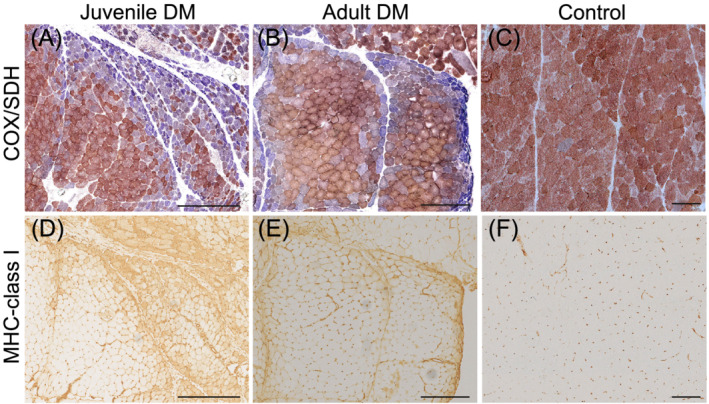
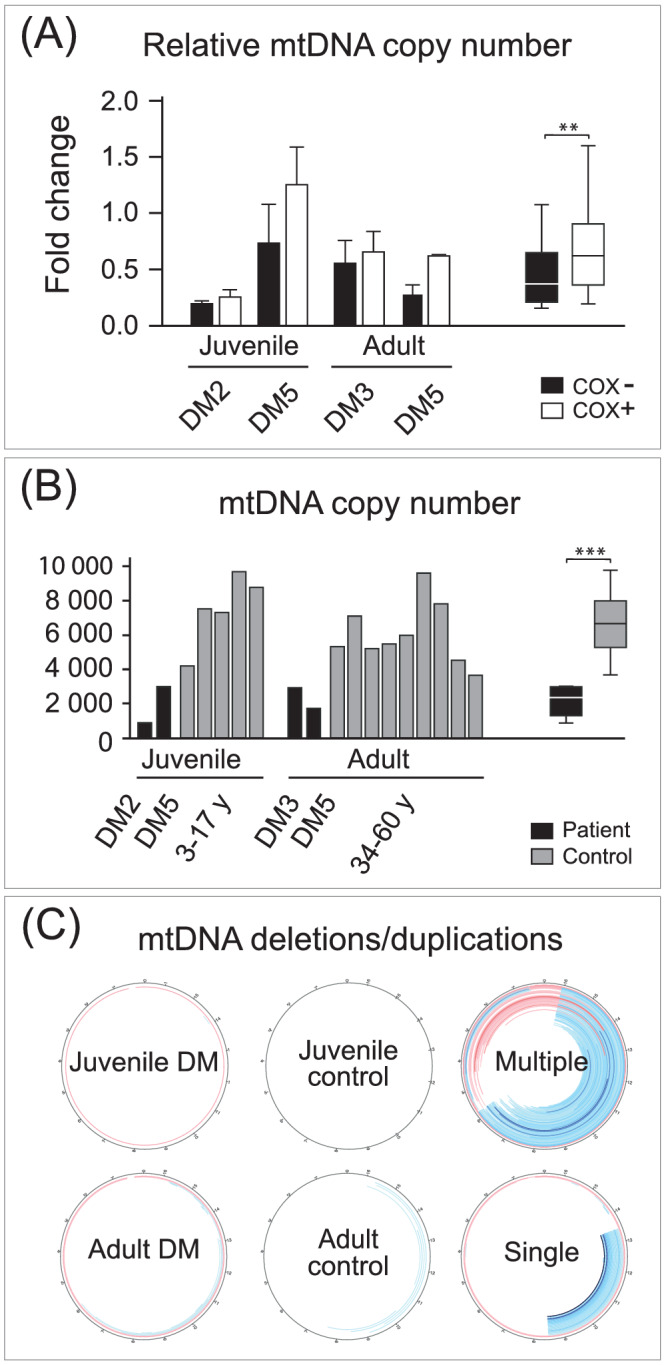
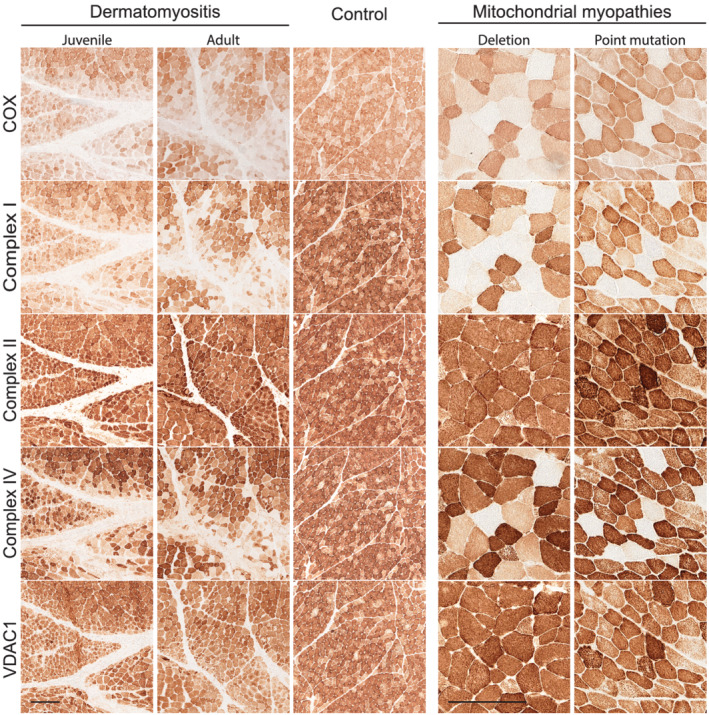
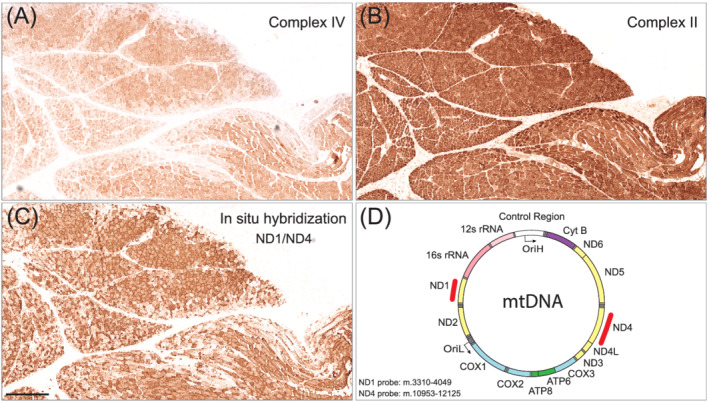
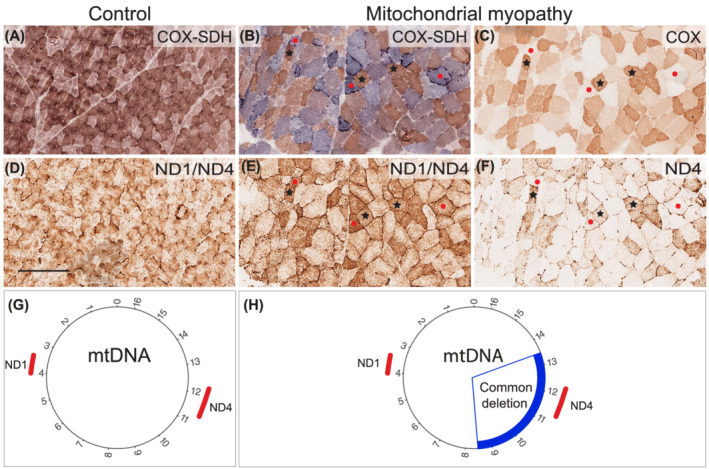
There was a profound deficiency of complexes I and IV in the perifascicular regions with enzyme histochemical COX deficiency, whereas succinate dehydrogenase activity and complex II were preserved. In situ hybridisation of mitochondrial RNA showed depletion of mitochondrial DNA (mtDNA) transcripts in the perifascicular regions. Analysis of mtDNA by next generation deep sequencing and quantitative PCR in affected muscle regions showed an overall reduction of mtDNA copy number particularly in the perifascicular regions.
The respiratory chain dysfunction in DM muscle is associated with mtDNA depletion causing deficiency of complexes I and IV, which are partially encoded by mtDNA, whereas complex II, which is entirely encoded by nuclear DNA, is preserved. The depletion of mtDNA indicates a perturbed replication of mtDNA explaining the muscle pathology and the disturbed aerobic metabolism.
皮肌炎(DM)患者的有氧代谢减少,导致肌肉功能受损,这与肌肉组织中细胞色素 c 氧化酶(COX)缺乏有关。这种线粒体呼吸链功能障碍通常发生在纤维旁区域,该区域还伴有最强烈的炎症反应、毛细血管丧失和肌肉纤维萎缩。本研究旨在探讨 DM 中氧化磷酸化缺陷的病理生物学。
研究了五名青少年和七名成人 DM 患者的伴纤维旁 COX 缺乏的肌肉活检标本。我们将呼吸链亚基的免疫组织化学分析(包括复合物 I(亚基 NDUFB8)、复合物 II(琥珀酸脱氢酶,亚基 SDHB)和复合物 IV(COX,亚基 MTCO1))与原位杂交、下一代深度测序和定量聚合酶链反应(PCR)相结合。
在伴纤维旁 COX 缺陷的酶组织化学 COX 缺陷区域,复合物 I 和 IV 明显缺乏,而琥珀酸脱氢酶活性和复合物 II 保留。线粒体 RNA 的原位杂交显示,线粒体 DNA(mtDNA)转录物在纤维旁区域耗竭。受影响的肌肉区域的 mtDNA 分析通过下一代深度测序和定量 PCR 显示 mtDNA 拷贝数总体减少,特别是在纤维旁区域。
DM 肌肉中的呼吸链功能障碍与 mtDNA 耗竭有关,导致复合物 I 和 IV 缺乏,而复合物 II 完全由核 DNA 编码,因此得以保留。mtDNA 的耗竭表明 mtDNA 的复制受到干扰,解释了肌肉病理学和有氧代谢紊乱。