School of Primary and Allied Health Care, Faculty of Medicine, Nursing and Health Sciences, Monash University, Frankston, Victoria, Australia
Discipline of Podiatry, School of Allied Health, Human Services and Sport, La Trobe University, Bundoora, Victoria, Australia.
BMJ Open. 2022 Jul 27;12(7):e062063. doi: 10.1136/bmjopen-2022-062063.
To explore children's foot, ankle and leg consultation patterns and management practices in Australian primary care.
Cross-sectional, retrospective study.
Australia Bettering the Evaluation and Care of Health program dataset.
Data were extracted for general practitioners (GPs) and patients 18 years from April 2000 to March 2016 inclusive.
Demographic characteristics: sex, GP age groups (ie, <45, 45-54, 55+ years), GP country of training, patient age grouping (0-4, 5-9, 10-14, 15-18 years), postcode, concession card status, indigenous status, up to three patient encounter reasons, up to four encounter problems/diagnoses and the clinical management actioned by the GP.
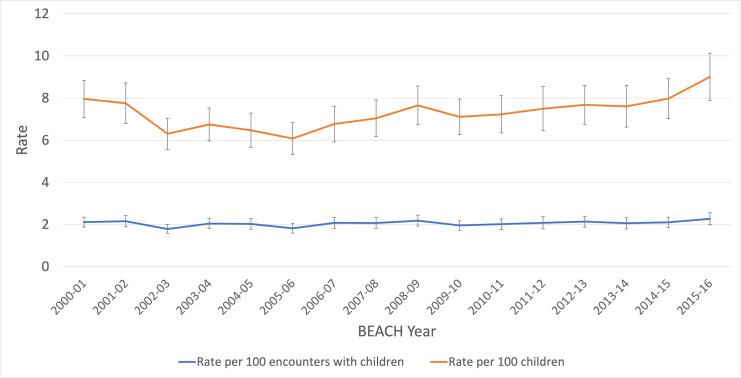
Children's foot, ankle or leg problems were managed at a rate of 2.05 (95% CI 1.99 to 2.11) per 100 encounters during 229 137 GP encounters with children. There was a significant increase in the rate of foot, ankle and leg problems managed per 100 children in the population, from 6.1 (95% CI 5.3 to 6.8) in 2005-2006 to 9.0 (95% CI 7.9 to 10.1) in 2015-2016. Management of children's foot, ankle and leg problems were independently associated with male patients (30% more than female), older children (15-18 years were 7.1 times more than <1 years), male GPs (13% more) and younger GPs (<45 years of age 13% more than 55+). The top four most frequently managed problems were injuries (755.9 per 100 000 encounters), infections (458.2), dermatological conditions (299.4) and unspecified pain (176.3). The most frequently managed problems differed according to age grouping.
Children commonly present to GPs for foot, ankle and leg problems. Presentation frequencies varied according to age. Unexpectedly, conditions presenting commonly in adults, but rarely in children, were also frequently recorded. This data highlights the importance of initiatives supporting contemporary primary care knowledge of diagnoses and management of paediatric lower limb problems to minimise childhood burden of disease.
探索澳大利亚初级保健中儿童足部、踝关节和腿部的咨询模式和管理实践。
横断面、回顾性研究。
澳大利亚改善卫生保健评估和管理计划数据集。
数据提取自全科医生(GP)和 2000 年 4 月至 2016 年 3 月期间 18 岁的患者。
人口统计学特征:性别、GP 年龄组(<45、45-54、55+ 岁)、GP 培训国家、患者年龄组(0-4、5-9、10-14、15-18 岁)、邮政编码、优惠卡状态、土著身份、最多三个患者就诊原因、最多四个就诊问题/诊断和 GP 采取的临床管理措施。
在 229137 次 GP 与儿童的就诊中,儿童足部、踝关节或腿部问题的管理率为每 100 次就诊 2.05(95%CI 1.99-2.11)。在人口中,每 100 名儿童管理足部、踝关节和腿部问题的比例显著增加,从 2005-2006 年的 6.1(95%CI 5.3-6.8)增加到 2015-2016 年的 9.0(95%CI 7.9-10.1)。儿童足部、踝关节和腿部问题的管理与男性患者(比女性多 30%)、年龄较大的儿童(15-18 岁是<1 岁的 7.1 倍)、男性 GP(多 13%)和年轻 GP(<45 岁多 13%)独立相关。管理频率最高的前四个问题是损伤(每 10 万次就诊 755.9 次)、感染(458.2)、皮肤病(299.4)和未特指疼痛(176.3)。最常见的管理问题因年龄分组而异。
儿童通常因足部、踝关节和腿部问题就诊于 GP。就诊频率因年龄而异。出乎意料的是,成年人常见但儿童罕见的疾病也经常被记录。这些数据突出表明,支持当代初级保健对儿童下肢问题的诊断和管理的知识的倡议,对于减轻儿童疾病负担非常重要。