Department of Neuropsychiatry, Division of Neuroscience, Graduate School of Medicine, Mie University, Tsu 514-8507, Japan.
Int J Environ Res Public Health. 2022 Jul 25;19(15):9070. doi: 10.3390/ijerph19159070.
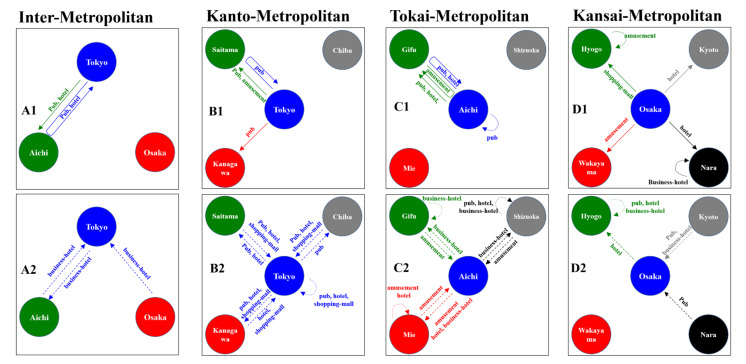
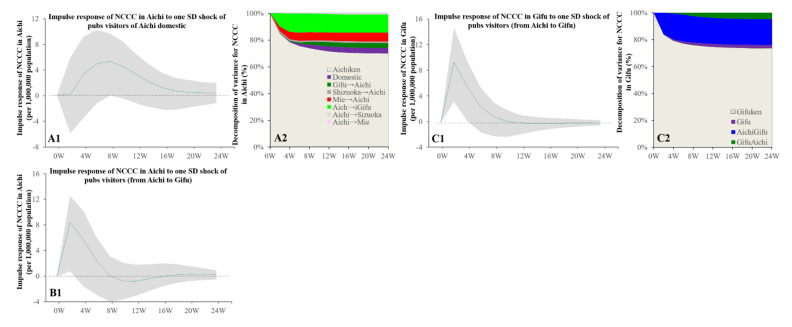
A combination of pharmaceutical and non-pharmaceutical interventions as well as social restrictions has been recommended to prevent the spread of coronavirus disease 2019 (COVID-19). Therefore, social contact surveys play an essential role as the basis for more effective measures. This study attempts to explore the fundamental basis of the expansion of COVID-19. Temporal bidirectional causalities between the numbers of newly confirmed COVID-19 cases (NCCC) and individual mobilisations with consumption motives across prefecture borders in three metropolitan regions in Japan were analysed using vector autoregression models. Mobilisation with consumption in pubs from Kanto to Tokai contributed to the spread of COVID-19 in both regions. Meanwhile, causal mobilisation with consumption motives in Kansai also contributed to the expansion of COVID-19; however, the pattern was dependent on the industrial characteristics of each prefecture in Kansai. Furthermore, the number of pub visitors in Kanto immediately decreased when NCCC increased in Kanto. In contrast, the causal mobilisations for the expansion of COVID-19 in the Tokai and Kansai regions were unaffected by the increasing NCCC. These findings partially proved the validity of the conventional governmental measures to suppress pub visitors across prefectural borders. Nevertheless, the individual causal mobilisations with consumption motives that contributed to the increasing COVID-19 cases are not identical nationwide, and thus, regional characteristics should be considered when devising preventive strategies.
已建议将药物和非药物干预措施以及社会限制相结合,以防止 2019 年冠状病毒病(COVID-19)的传播。因此,社会接触调查作为更有效措施的基础发挥着重要作用。本研究试图探讨 COVID-19 扩张的基本基础。利用向量自回归模型分析了日本三个大都市区县边界个体消费动机移动数量与新确诊 COVID-19 病例(NCCC)之间的时间双向因果关系。从关东到东海的酒吧消费性动员对两个地区的 COVID-19 传播都有贡献。同时,关西的消费动机性动员也促进了 COVID-19 的扩散;然而,这种模式取决于关西每个县的工业特征。此外,当关东的 NCCC 增加时,关东的酒吧访客数量立即减少。相比之下,东海和关西地区 COVID-19 扩张的因果动员不受 NCCC 增加的影响。这些发现部分证明了政府抑制跨县边界酒吧访客的传统措施的有效性。然而,导致 COVID-19 病例增加的个体消费动机因果动员在全国范围内并不相同,因此在制定预防策略时应考虑地区特点。