Ramsell Stuart, Arias Bermudez Carlos, Takem Baiyee Cyril Ayuk Mbeng, Rodgers Brandon, Parikh Samir, Almaani Salem, Sharma Nidhi, LoRusso Samantha, Freimer Miriam, Redder Elyse, Bumma Naresh, Vallkati Ajay, Efebera Yvonne, Kahwash Rami, Campbell Courtney M
College of Medicine, The Ohio State University, Columbus, OH, United States.
Division of Nephrology, The Ohio State University Wexner Medical Center, Columbus, OH, United States.
Front Cardiovasc Med. 2022 Jul 11;9:907597. doi: 10.3389/fcvm.2022.907597. eCollection 2022.
Beta-adrenergic antagonists or blockers (BB) are a cornerstone of cardiac therapy for multiple indications. However, BB are considered relatively contraindicated in amyloid cardiomyopathy due to poor tolerance. This intolerance is hypothesized to be due to concomitant neuropathy and significant restrictive cardiomyopathy. This study analyzes the incidence and characteristics of BB tolerance in patients with amyloid cardiomyopathy.
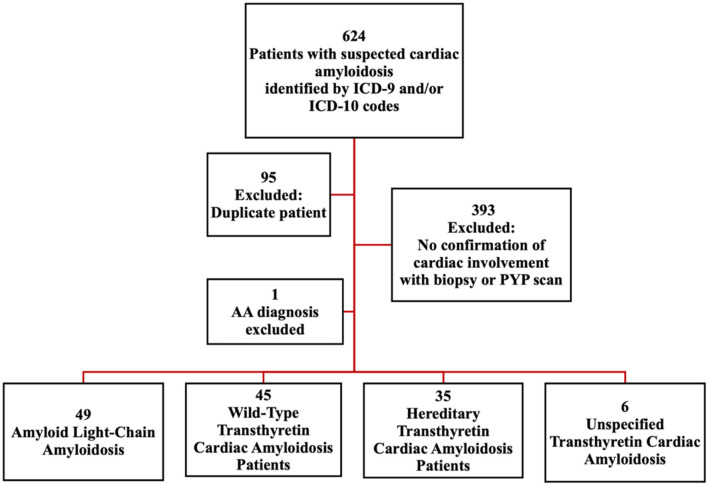
Through a single-center retrospective chart review, patients with amyloid cardiomyopathy, confirmed by endomyocardial biopsy or technetium-99 pyrophosphate scan, were identified and clinical data was collected. Statistical methods included Chi-square test and two sample -tests.
Of 135 cardiac amyloidosis patients, 27 patients (20.0%) had no BB use, 56 patients (41.5%) were current BB users, and 52 patients (38.5%) were prior BB users. The most frequent indications for BB use were heart failure, hypertension, coronary artery disease, and arrhythmia. The most common reason for stopping BB therapy was hypotension (62.8%) followed by fatigue, bradycardia, and orthostasis. Neurologic symptoms at the initial BB prescription or most recent evaluation were not significantly different between current and prior BB users. Their cardiovascular profiles were similar by ejection fraction, wall thickness, troponin I, and brain natriuretic peptide. There was no association for BB discontinuation based on amyloid subtype, sex, or race.
The majority of patients with amyloid cardiomyopathy were prescribed BB, and over half of these patients still tolerated BB therapy. Current and prior BB users had similar profiles from a cardiovascular and neurologic perspective, with no association identified to predict BB discontinuation.
β-肾上腺素能拮抗剂或阻滞剂(BB)是多种适应证心脏治疗的基石。然而,由于耐受性差,BB在淀粉样心肌病中被认为相对禁忌。这种不耐受被认为是由于合并神经病变和显著的限制性心肌病所致。本研究分析了淀粉样心肌病患者中BB耐受性的发生率和特征。
通过单中心回顾性病历审查,识别经心内膜心肌活检或99锝焦磷酸盐扫描确诊的淀粉样心肌病患者,并收集临床数据。统计方法包括卡方检验和两样本检验。
在135例心脏淀粉样变性患者中,27例(20.0%)未使用BB,56例(41.5%)为当前BB使用者,52例(38.5%)为既往BB使用者。使用BB最常见的适应证是心力衰竭、高血压、冠状动脉疾病和心律失常。停止BB治疗最常见的原因是低血压(62.8%),其次是疲劳、心动过缓和直立性低血压。当前和既往BB使用者在初始BB处方或最近评估时的神经症状无显著差异。他们的心血管特征在射血分数、壁厚、肌钙蛋白I和脑钠肽方面相似。基于淀粉样蛋白亚型、性别或种族,BB停药之间无关联。
大多数淀粉样心肌病患者被处方使用BB,其中超过一半的患者仍能耐受BB治疗。从心血管和神经学角度来看,当前和既往BB使用者具有相似的特征,未发现可预测BB停药的关联因素。