Glanzner Werner Giehl, de Macedo Mariana Priotto, Gutierrez Karina, Bordignon Vilceu
Department of Animal Science, McGill University, Sainte Anne de Bellevue, QC, Canada.
Front Cell Dev Biol. 2022 Jul 11;10:940197. doi: 10.3389/fcell.2022.940197. eCollection 2022.
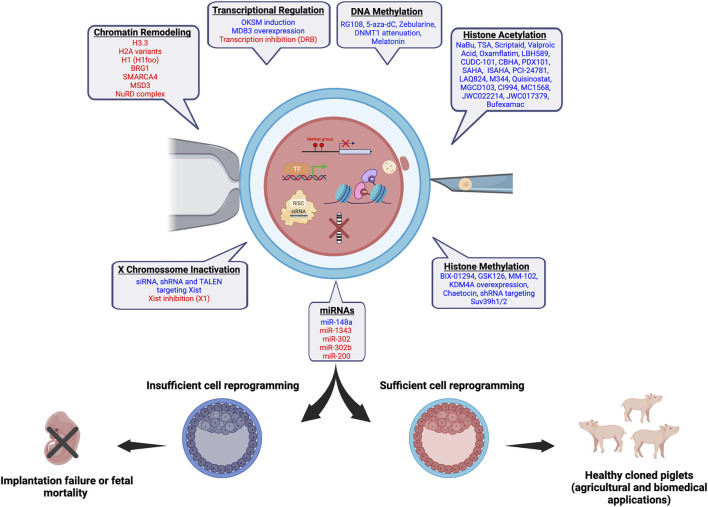
Over the last 25 years, cloned animals have been produced by transferring somatic cell nuclei into enucleated oocytes (SCNT) in more than 20 mammalian species. Among domestic animals, pigs are likely the leading species in the number of clones produced by SCNT. The greater interest in pig cloning has two main reasons, its relevance for food production and as its use as a suitable model in biomedical applications. Recognized progress in animal cloning has been attained over time, but the overall efficiency of SCNT in pigs remains very low, based on the rate of healthy, live born piglets following embryo transfer. Accumulating evidence from studies in mice and other species indicate that new strategies for promoting chromatin and epigenetic reprogramming may represent the beginning of a new era for pig cloning.
在过去25年里,通过将体细胞核移植到去核卵母细胞中(体细胞核移植技术),已在20多种哺乳动物中培育出克隆动物。在家畜中,猪可能是通过体细胞核移植技术产生克隆动物数量最多的物种。对猪克隆更感兴趣主要有两个原因,一是其与食品生产相关,二是它可作为生物医学应用中的合适模型。随着时间的推移,动物克隆已取得公认的进展,但基于胚胎移植后健康活产仔猪的比例,猪体细胞核移植技术的整体效率仍然很低。来自小鼠和其他物种研究的越来越多的证据表明,促进染色质和表观遗传重编程的新策略可能代表着猪克隆新时代的开端。