Center for Autoinflammatory Diseases and Immunodeficiencies, Istituto di Ricovero e cura a carattere scientifico (IRCCS) Istituto Giannina Gaslini, Genoa, Italy.
Department of Neuroscience, Rehabilitation, Ophthalmology, Genetics and Maternal-Child Sciences (DINOGMI), University of Genoa, Genoa, Italy.
Front Immunol. 2022 Jul 11;13:935957. doi: 10.3389/fimmu.2022.935957. eCollection 2022.
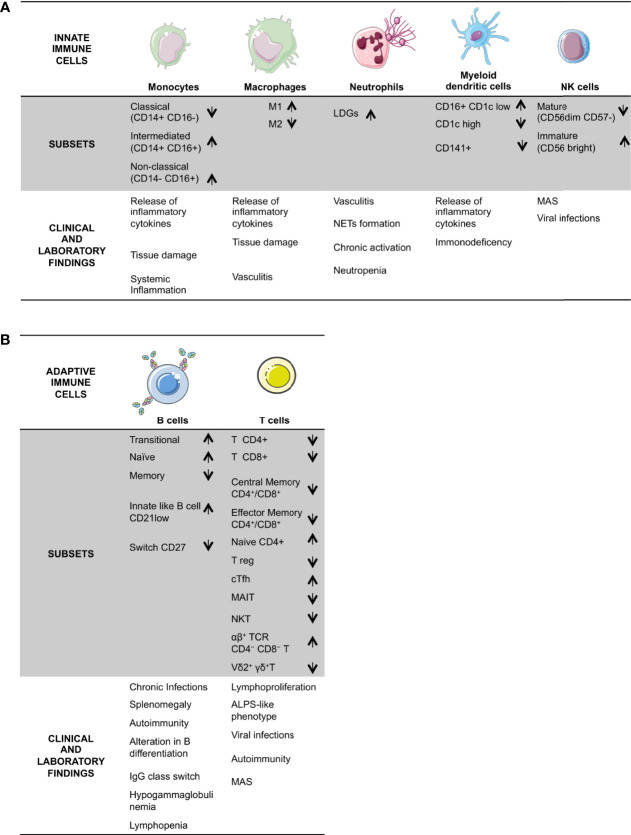
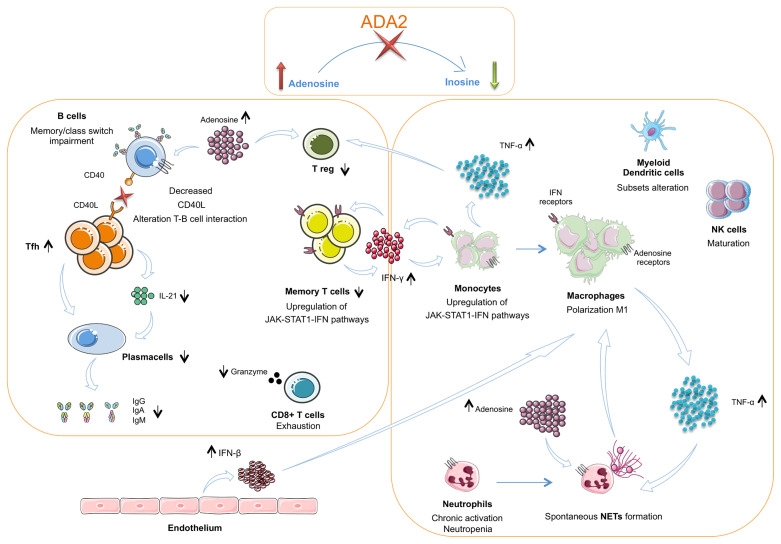
Deficiency of Adenosine deaminase 2 (DADA2) is a monogenic autoinflammatory disorder presenting with a broad spectrum of clinical manifestations, including immunodeficiency, vasculopathy and hematologic disease. Biallelic mutations in ADA2 gene have been associated with a decreased ADA2 activity, leading to reduction in deamination of adenosine and deoxyadenosine into inosine and deoxyinosine and subsequent accumulation of extracellular adenosine. In the early reports, the pivotal role of innate immunity in DADA2 pathogenic mechanism has been underlined, showing a skewed polarization from the M2 macrophage subtype to the proinflammatory M1 subtype, with an increased production of inflammatory cytokines such as TNF-α. Subsequently, a dysregulation of NETosis, triggered by the excess of extracellular Adenosine, has been implicated in the pathogenesis of DADA2. In the last few years, evidence is piling up that adaptive immunity is profoundly altered in DADA2 patients, encompassing both T and B branches, with a disrupted homeostasis in T-cell subsets and a B-cell skewing defect. Type I/type II IFN pathway upregulation has been proposed as a possible core signature in DADA2 T cells and monocytes but also an increased IFN-β secretion directly from endothelial cells has been described. So far, a unifying clear pathophysiological explanation for the coexistence of systemic inflammation, immunedysregulation and hematological defects is lacking. In this review, we will explore thoroughly the latest understanding regarding DADA2 pathophysiological process, with a particular focus on dysregulation of both innate and adaptive immunity and their interacting role in the development of the disease.
腺苷脱氨酶 2 缺乏症(DADA2)是一种单基因自身炎症性疾病,具有广泛的临床表现,包括免疫缺陷、血管病变和血液疾病。ADA2 基因的双等位基因突变与 ADA2 活性降低有关,导致腺苷和脱氧腺苷脱氨成肌苷和脱氧肌苷减少,随后细胞外腺苷积累。在早期的报告中,先天免疫在 DADA2 发病机制中的关键作用得到了强调,显示出从 M2 巨噬细胞亚型向促炎 M1 亚型的偏斜极化,导致 TNF-α等炎症细胞因子的产生增加。随后,细胞外腺苷过量触发的 NETosis 失调被认为是 DADA2 发病机制的一部分。在过去的几年中,越来越多的证据表明,适应性免疫在 DADA2 患者中受到严重改变,包括 T 细胞和 B 细胞分支,T 细胞亚群的平衡失调和 B 细胞偏向缺陷。I 型/II 型 IFN 途径上调被认为是 DADA2 T 细胞和单核细胞的可能核心特征,但也描述了内皮细胞直接分泌增加的 IFN-β。到目前为止,对于系统性炎症、免疫失调和血液学缺陷共存的统一明确的病理生理学解释尚缺乏。在这篇综述中,我们将深入探讨关于 DADA2 病理生理过程的最新理解,特别关注先天和适应性免疫的失调及其在疾病发展中的相互作用作用。