Ka Amy, Taher Amir, D'Souza Stephanie, Barnes Elizabeth H, Gupta Sachin, Troedson Christopher, Wade Fiona, Teo Olga, Dale Russell C, Wong Chong, Bleasel Andrew F, Dexter Mark, Kothur Kavitha, Gill Deepak
TY Nelson Department of Neurology and Neurosurgery, The Children's Hospital at Westmead, Sydney, NSW, Australia.
University of Sydney, The Children's Hospital at Westmead, Westmead, Sydney, NSW, Australia.
Epilepsy Behav Rep. 2022 Jul 8;19:100561. doi: 10.1016/j.ebr.2022.100561. eCollection 2022.
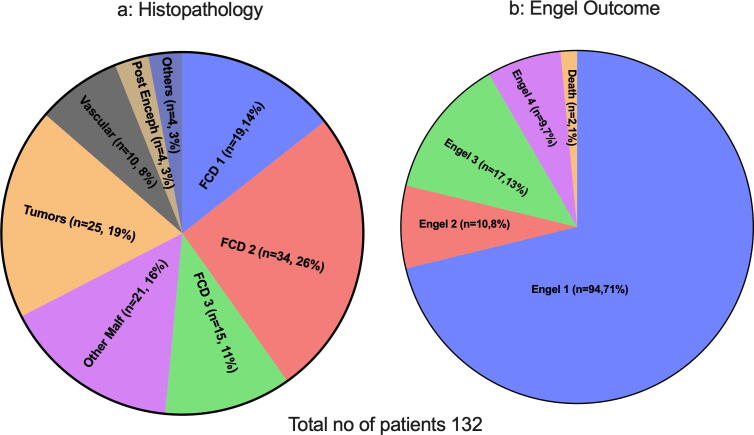
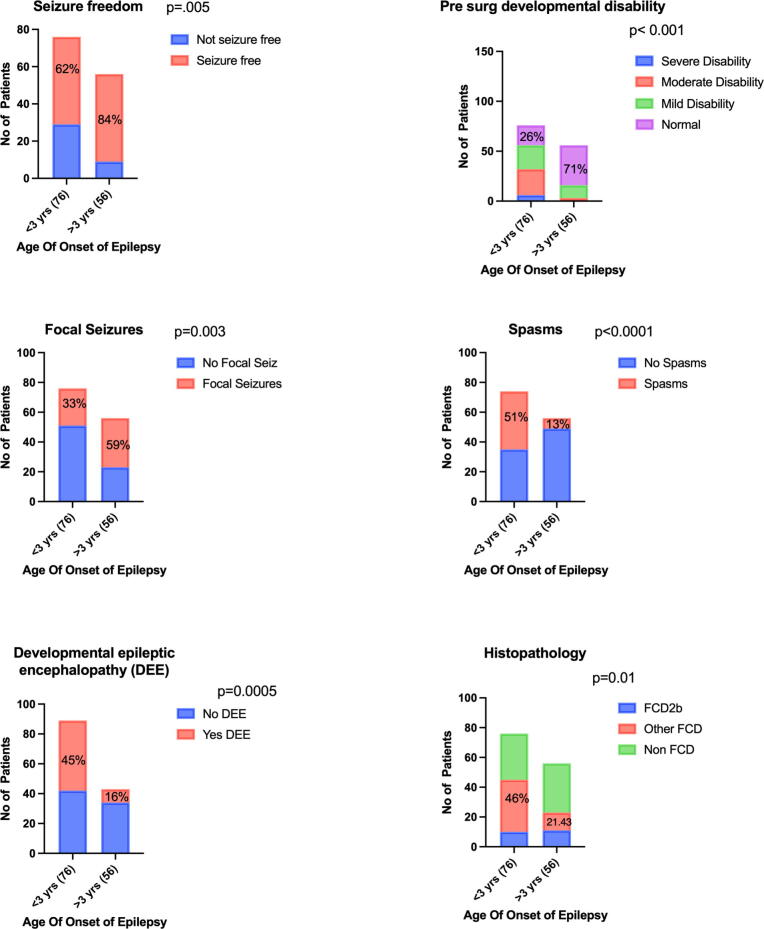
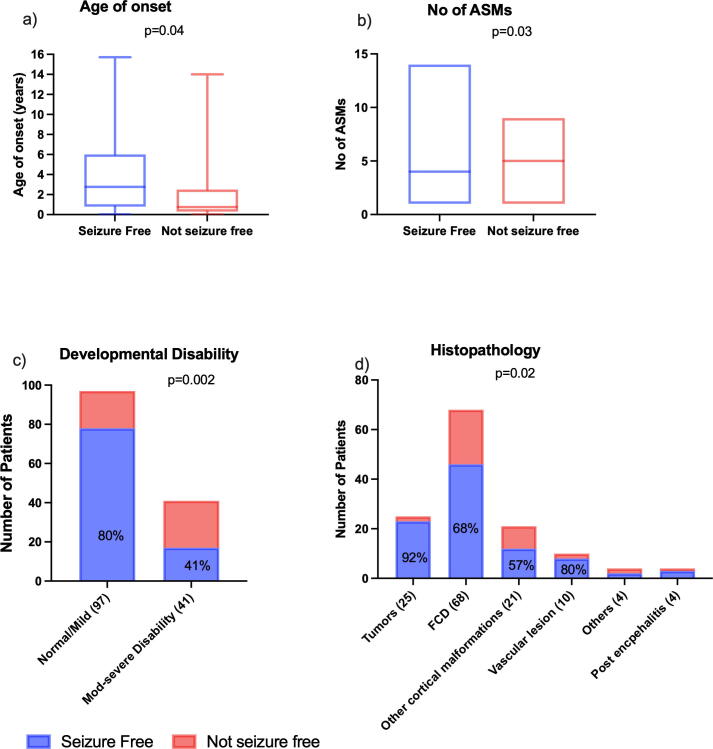
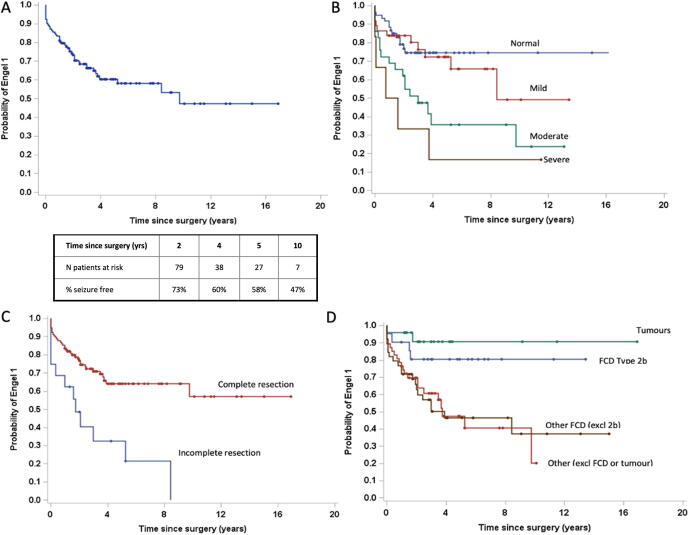
There is a paucity of data on longitudinal seizure outcome of children undergoing epilepsy surgery. All children (n = 132) who underwent resective epilepsy surgery from January 1998 to December 2015 were identified. Relevant clinical, neurophysiological, imaging, surgical and seizure outcome data were extracted. Multivariable logistic regression analysis and Kaplan-Meier survival with Cox proportional hazard modelling were performed. The mean age at surgery was 7.8 years (range 0.2-17.9). 71% were seizure-free at a mean follow up of 5.3 ± 2.7 years. Of those who were seizure-free, 65 patients were able to completely wean off anti- seizure medications successfully. Using survival analysis, the probability of Engel Class I outcome at one year after surgery was 81% (95% confidence interval [CI] 87%-75%). This dropped to 73% at two years (95% CI 81%-65%), 58% at five years (95% CI 67.8%-48%), and 47% at ten years. Proportional hazard modelling showed that the presence of moderate to severe developmental disability (HR 6.5; p = 0.02) and lack of complete resection (HR 0.4; p = 0.02) maintain association as negative predictors of seizure-free outcome. Our study demonstrates favorable long-term seizure control following pediatric epilepsy surgery and highlights important predictors of seizure outcome guiding case selection and counseling of expectations prior to surgery.
关于接受癫痫手术的儿童癫痫发作的纵向结果的数据很少。确定了1998年1月至2015年12月期间接受切除性癫痫手术的所有儿童(n = 132)。提取了相关的临床、神经生理学、影像学、手术和癫痫发作结果数据。进行了多变量逻辑回归分析以及带有Cox比例风险模型的Kaplan-Meier生存分析。手术时的平均年龄为7.8岁(范围0.2 - 17.9岁)。在平均5.3±2.7年的随访中,71%的患者无癫痫发作。在那些无癫痫发作的患者中,65例患者能够成功完全停用抗癫痫药物。使用生存分析,术后一年达到恩格尔I级结果的概率为81%(95%置信区间[CI] 87% - 75%)。两年时降至73%(95% CI 81% - 65%),五年时为58%(95% CI 67.8% - 48%),十年时为47%。比例风险模型显示,中度至重度发育障碍(HR 6.5;p = 0.02)和未完全切除(HR 0.4;p = 0.02)作为无癫痫发作结果的负面预测因素保持相关性。我们的研究表明小儿癫痫手术后长期癫痫控制良好,并突出了癫痫发作结果的重要预测因素,为术前病例选择和预期咨询提供指导。