Pavlenko Egor, Ruengeler Till, Engel Paulina, Poepsel Simon
University of Cologne, Center for Molecular Medicine Cologne (CMMC), Faculty of Medicine and University Hospital, Cologne, Germany.
Cologne Excellence Cluster for Cellular Stress Responses in Ageing-Associated Diseases (CECAD), University of Cologne, Cologne, Germany.
Front Genet. 2022 Jul 11;13:906662. doi: 10.3389/fgene.2022.906662. eCollection 2022.
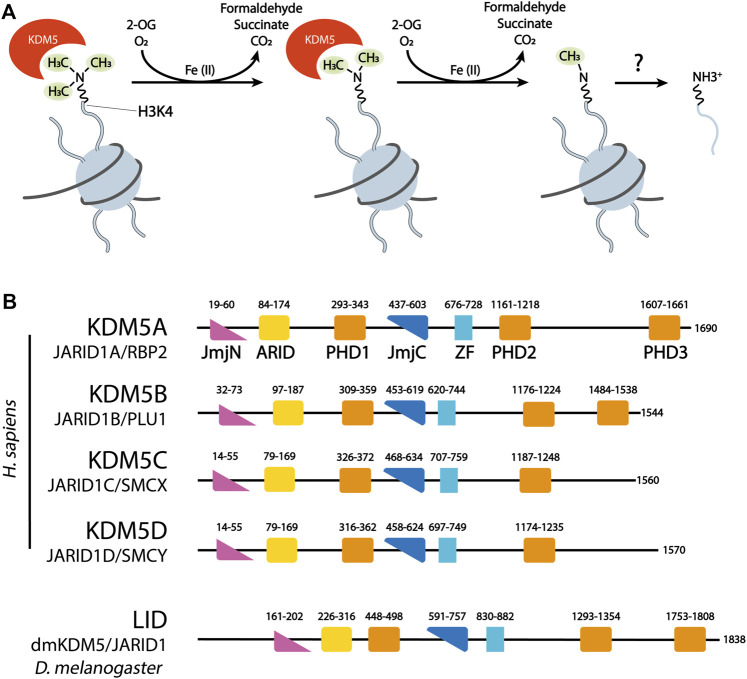
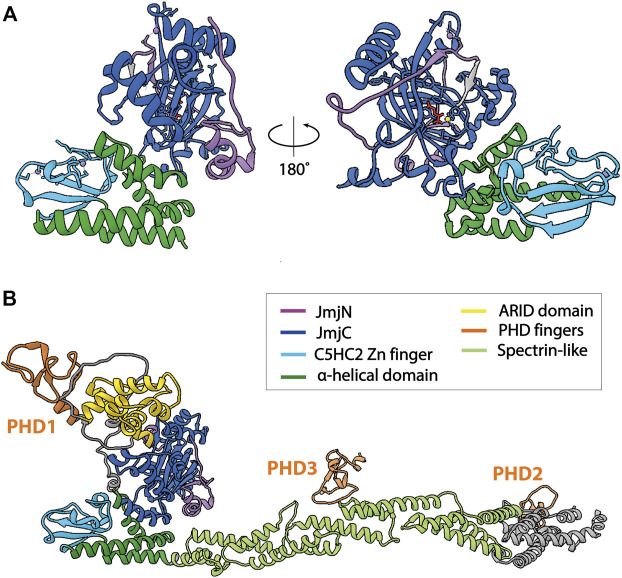
Mammalian histone demethylases of the KDM5 family are mediators of gene expression dynamics during developmental, cellular differentiation, and other nuclear processes. They belong to the large group of JmjC domain containing, 2-oxoglutarate (2-OG) dependent oxygenases and target methylated lysine 4 of histone H3 (H3K4me1/2/3), an epigenetic mark associated with active transcription. In recent years, KDM5 demethylases have gained increasing attention due to their misregulation in many cancer entities and are intensively explored as therapeutic targets. Despite these implications, the molecular basis of KDM5 function has so far remained only poorly understood. Little is known about mechanisms of nucleosome recognition, the recruitment to genomic targets, as well as the local regulation of demethylase activity. Experimental evidence suggests close physical and functional interactions with epigenetic regulators such as histone deacetylase (HDAC) containing complexes, as well as the retinoblastoma protein (RB). To understand the regulation of KDM5 proteins in the context of chromatin, these interactions have to be taken into account. Here, we review the current state of knowledge on KDM5 function, with a particular emphasis on molecular interactions and their potential implications. We will discuss and outline open questions that need to be addressed to better understand histone demethylation and potential demethylation-independent functions of KDM5s. Addressing these questions will increase our understanding of histone demethylation and allow us to develop strategies to target individual KDM5 enzymes in specific biological and disease contexts.
KDM5家族的哺乳动物组蛋白去甲基化酶是发育、细胞分化及其他核过程中基因表达动态变化的调节因子。它们属于包含JmjC结构域的一大类2-氧代戊二酸(2-OG)依赖性加氧酶,作用于组蛋白H3的甲基化赖氨酸4(H3K4me1/2/3),这是一种与活跃转录相关的表观遗传标记。近年来,KDM5去甲基化酶因其在多种癌症中的调控异常而受到越来越多的关注,并被深入研究作为治疗靶点。尽管有这些发现,但迄今为止,KDM5功能的分子基础仍知之甚少。关于核小体识别机制、基因组靶点募集以及去甲基化酶活性的局部调节知之甚少。实验证据表明,它们与表观遗传调节因子如含组蛋白去乙酰化酶(HDAC)的复合物以及视网膜母细胞瘤蛋白(RB)存在密切的物理和功能相互作用。为了在染色质背景下理解KDM5蛋白的调控,必须考虑这些相互作用。在这里,我们综述了关于KDM5功能的当前知识状态,特别强调分子相互作用及其潜在影响。我们将讨论并概述一些有待解决的开放性问题,以便更好地理解组蛋白去甲基化以及KDM5潜在的非去甲基化功能。解决这些问题将增进我们对组蛋白去甲基化的理解,并使我们能够制定策略,在特定的生物学和疾病背景下靶向单个KDM5酶。