Department of Cancer Immunology, Institute for Cancer Research, Oslo University Hospital, Oslo, Norway; K. G. Jebsen Centre for B Cell Malignancies, Institute of Clinical Medicine, University of Oslo, Oslo.
Department of Medical Oncology, Dana-Farber Cancer Institute, Boston, MA, USA; Harvard Medical School, Boston, MA.
Haematologica. 2023 Jan 1;108(1):9-21. doi: 10.3324/haematol.2022.281266.
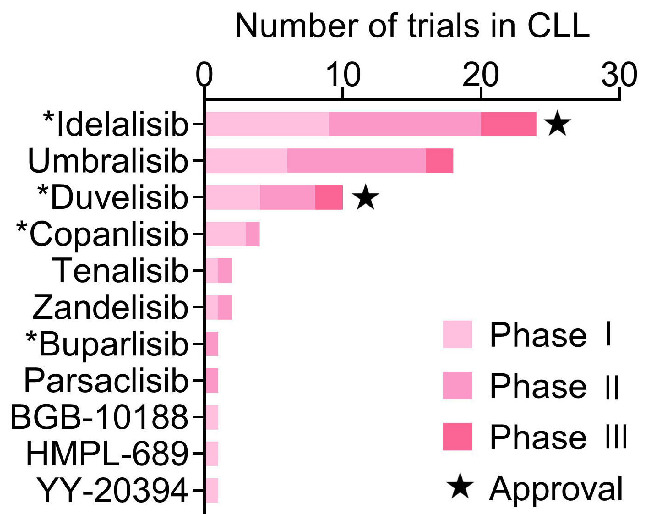
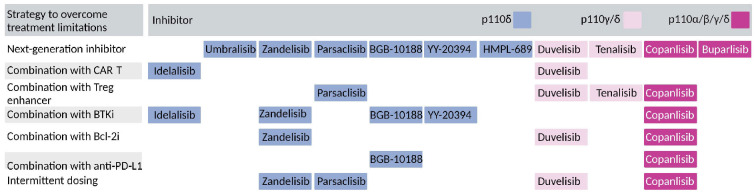
Phosphatidylinositol 3-kinase (PI3K) inhibitors are effective in chronic lymphocytic leukemia (CLL). However, the severe toxicity profile associated with the first-generation inhibitors idelalisib and duvelisib, combined with the availability of other more tolerable agents, have limited their use. CLL is still considered incurable, and relapse after treatment, development of resistance, and treatment intolerance are common. It is therefore of interest to optimize the administration of currently approved PI3K inhibitors and to develop next-generation agents to improve tolerability, so that this class of agents will be considered an effective and safe treatment option when needed. These efforts are reflected in the large number of emerging clinical trials with PI3K inhibitors in CLL. Current strategies to overcome treatment limitations include intermittent dosing, which is established for copanlisib and zandelisib and under investigation for duvelisib and parsaclisib. A second strategy is to combine the PI3K inhibitor with another novel agent, either as a continuous regimen or a fixedduration regimen, to deepen responses. In addition to these approaches, it is of interest to identify higher-resolution actionable biomarkers that can predict treatment responses and toxicity, and inform personalized treatment decisions. Here, we discuss the current status of PI3K inhibitors in CLL, factors limiting the use of currently approved PI3K inhibitors in CLL, current strategies to overcome these limitations, and where to go next.
磷脂酰肌醇 3-激酶 (PI3K) 抑制剂在慢性淋巴细胞白血病 (CLL) 中有效。然而,第一代抑制剂idelalisib 和 duvelisib 与其他更耐受的药物联合使用时,严重的毒性特征限制了它们的使用。CLL 仍然被认为是不可治愈的,治疗后复发、耐药性的发展和治疗不耐受是常见的。因此,优化目前批准的 PI3K 抑制剂的给药方式并开发下一代药物以提高耐受性很有意义,以便在需要时将此类药物视为有效和安全的治疗选择。这些努力反映在大量针对 CLL 的 PI3K 抑制剂的新兴临床试验中。克服治疗局限性的当前策略包括间歇性给药,这已在 copanlisib 和 zandelisib 中确立,并正在研究 duvelisib 和 parsaclisib。第二种策略是将 PI3K 抑制剂与另一种新型药物联合使用,无论是连续疗程还是固定疗程,以加深反应。除了这些方法之外,确定可以预测治疗反应和毒性并为个性化治疗决策提供信息的更高分辨率的可操作生物标志物也很有趣。在这里,我们讨论了 PI3K 抑制剂在 CLL 中的现状、限制目前批准的 PI3K 抑制剂在 CLL 中应用的因素、克服这些限制的当前策略以及下一步的方向。