Centers for Disease Control and Prevention, Maseru, Lesotho.
Division of Global HIV and TB, US Centers for Disease Control and Prevention, Center for Global Health, Atlanta, GA, United States of America.
PLoS One. 2022 Jul 28;17(7):e0271431. doi: 10.1371/journal.pone.0271431. eCollection 2022.
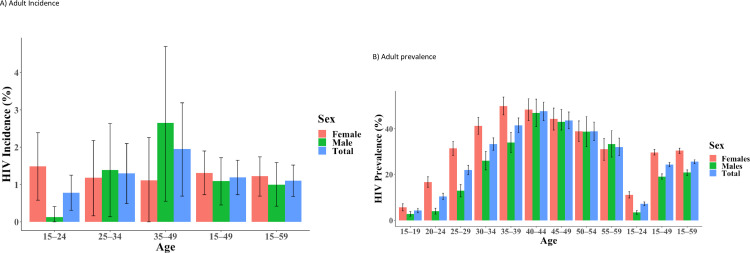
Despite extensive global efforts, sub-Saharan Africa remains disproportionately affected by the HIV epidemic. This generalized epidemic can be seen in Lesotho which in 2014 the HIV prevalence rate of those aged 15-49 years was 24.6%, with and incidence of 1.9 new infections per 100-person-year exposures. To better understand the impact of Lesotho's national HIV response and significant predictors associated with HIV infection, the Lesotho Population-based HIV Impact Assessment was conducted. This survey provided a nationally representative sample of individuals aged 15-59 years old in which participants were tested for HIV and given an individual questionnaire that included socio-demographic and behavioral risk questions. The association of factors between survey questions and HIV incident was assessed using logistic regression. Multivariate logistic regression models for men and women were constructed for each outcome using variables known to be or plausibly associated with recent or chronic infection. Overall annualized incidence among people aged 15-49 was 1.19% (95% CI 0.73-1.65) per year. The overall prevalence of HIV was 25.6% with women having significantly higher prevalence. Multiple variables, including decreased wealth status, lower education levels, marital status, condom use at first sex, and circumcision (men only) were identified as being significantly associated with HIV infection for both men and women. In combination with improving the awareness of HIV status, an increased focus is needed on AGYW and men 35-49 years old to prevent new infections. HIV education and prevention programs should focus heavily on younger age groups prior to and soon after sexual debut to prevent HIV transmission. The findings of the survey showed significant room for improvement in increasing awareness of HIV status and reinforcing the need for continued HIV prevention and treatment efforts in Lesotho to prevent new infections.
尽管全球做出了广泛努力,但撒哈拉以南非洲地区仍受到艾滋病毒流行的不成比例的影响。莱索托就是这种普遍流行的一个例子,在 2014 年,15-49 岁人群的艾滋病毒流行率为 24.6%,每 100 人-年新感染率为 1.9 例。为了更好地了解莱索托国家艾滋病毒应对措施的影响以及与艾滋病毒感染相关的重要预测因素,进行了莱索托基于人群的艾滋病毒影响评估。该调查为年龄在 15-59 岁的个人提供了具有全国代表性的样本,其中对参与者进行了艾滋病毒检测,并对他们进行了个人问卷调查,其中包括社会人口统计学和行为风险问题。使用逻辑回归评估了调查问题与艾滋病毒感染的关联。使用已知或合理地与近期或慢性感染相关的变量,为男性和女性分别构建了针对每个结果的多变量逻辑回归模型。15-49 岁人群的年平均发病率为 1.19%(95%CI 0.73-1.65)。艾滋病毒总体流行率为 25.6%,女性的流行率明显更高。多种变量,包括财富状况下降、教育程度较低、婚姻状况、首次性行为时使用安全套以及割礼(仅男性),被确定为与男性和女性的艾滋病毒感染显著相关。除了提高对艾滋病毒状况的认识外,还需要更加关注年轻女性和 35-49 岁的男性,以防止新的感染。艾滋病毒教育和预防规划应重点关注年轻群体,在开始性行为之前和之后不久,以防止艾滋病毒传播。调查结果表明,在提高艾滋病毒状况的认识和加强莱索托继续开展艾滋病毒预防和治疗工作以防止新的感染方面,仍有很大的改进空间。