State Key Laboratory for Biocontrol, School of Life Sciences, Sun Yat-Sen University, Guangzhou, 510275, China.
School of Agriculture, Sun Yat-Sen University, Guangzhou, 510275, China.
BMC Genomics. 2022 Jul 28;23(1):541. doi: 10.1186/s12864-022-08656-9.
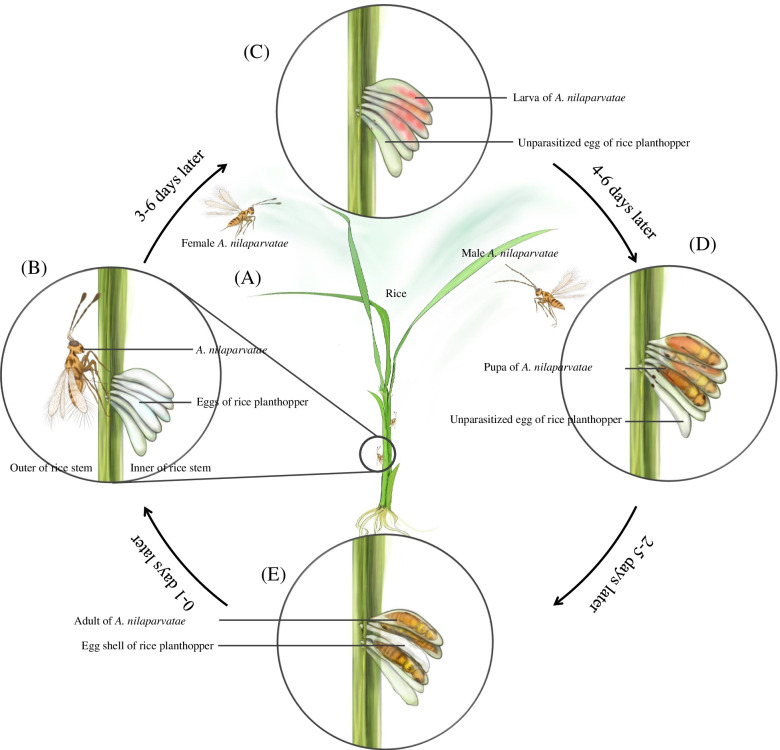
Mymaridae is an ancient insect group and is a basal lineage of the superfamily Chalcidoidea. Species of Mymaridae have great potential for biological control. Anagrus nilaparvatae, a representative species of Mymaridae, is ideal for controlling rice planthopper due to its high rate of parasitism and ability to find hosts efficiently in paddy ridges and fields.
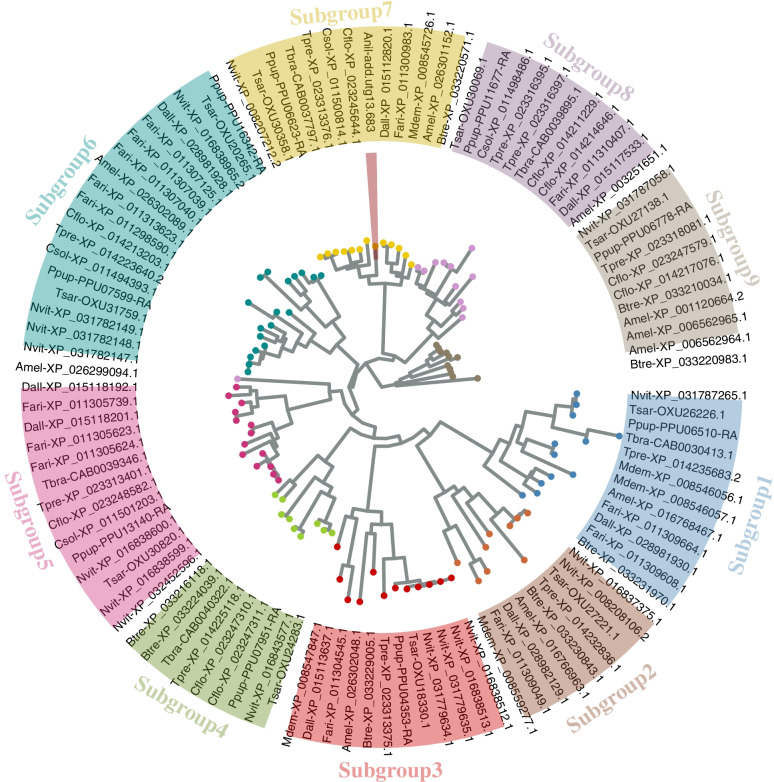
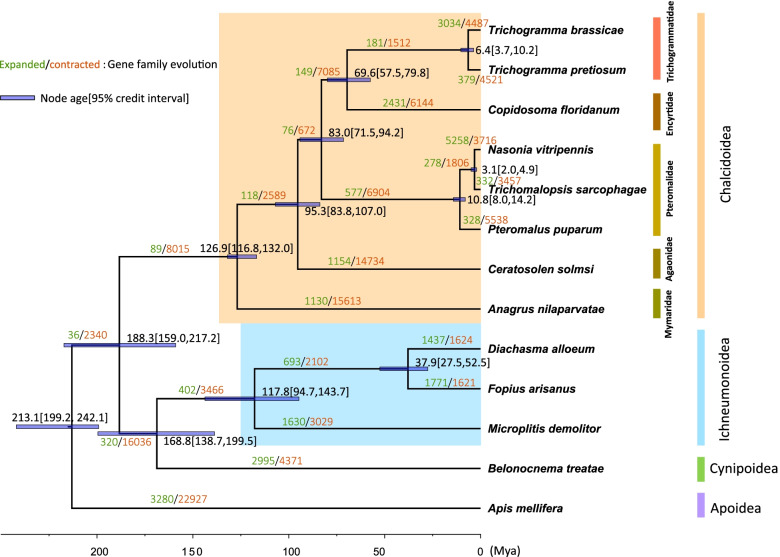
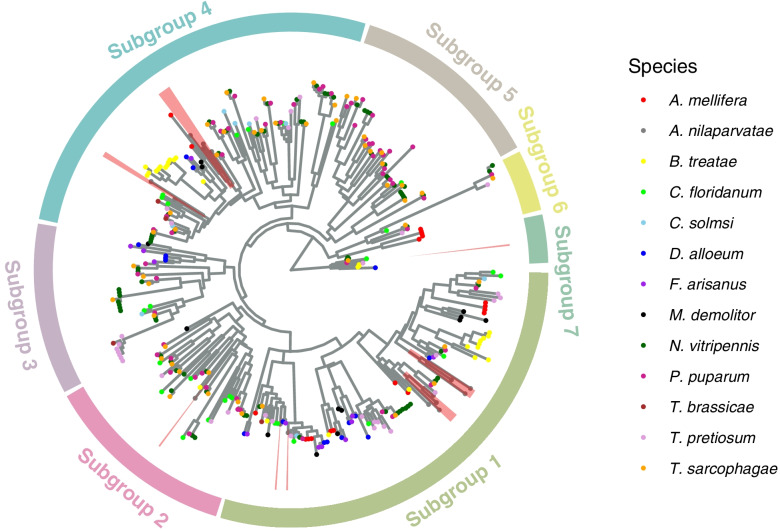
Using both PacBio single-molecule real-time and Illumina sequencing, we sequenced and assembled the whole genome of A. nilaparvatae, a first for the family Mymaridae. The assembly consists of 394 scaffolds, totaling 488.8 Mb. The assembly is of high continuity and completeness, indicated by the N50 value of 25.4 Mb and 98.2% mapping rate of Benchmarking Universal Single-Copy Orthologs. In total, 16,894 protein-coding genes in the genome were annotated. A phylogenomic tree constructed for A. nilaparvatae and other 12 species of Hymenoptera confirmed that the family Mymaridae is sister to all remaining chalcidoids. The divergence time between A. nilaparvatae and the other seven Chalcidoidea species was dated at ~ 126.9 Mya. Chemoreceptor and mechanoreceptor genes are important in explaining parasitic behavior. We identified 17 odorant binding proteins, 11 chemosensory proteins, four Niemann-Pick type C2 proteins, 88 olfactory receptors, 12 gustatory receptors, 22 ionotropic receptors and 13 sensory neuron membrane proteins in the genome of A. nilaparvatae, which are associated with the chemosensory functions. Strikingly, there is only one pickpocket receptors and nine transient receptor potential genes in the genome that have a mechanosensory function.
We obtained a high-quality genome assembly for A. nilaparvatae using PacBio single-molecule real-time sequencing, which provides phylogenomic insights for its evolutionary history. The small numbers of chemo- and mechanosensory genes in A. nilaparvatae indicate the species-specific host detection and oviposition behavior of A. nilaparvatae might be regulated by relatively simple molecular pathways.
缨翅目是一个古老的昆虫群,是缨翅目超科的一个基干谱系。缨翅目物种具有很大的生物防治潜力。缨翅目代表种稻螟赤眼蜂由于其较高的寄生率和在稻田和田间有效寻找宿主的能力,是控制稻飞虱的理想选择。
我们使用 PacBio 单分子实时测序和 Illumina 测序,对稻螟赤眼蜂的全基因组进行了测序和组装,这是缨翅目家族的首次测序。组装由 394 个支架组成,总计 488.8 Mb。组装具有较高的连续性和完整性,N50 值为 25.4 Mb,基准通用单拷贝同源物的映射率为 98.2%。总共注释了基因组中的 16894 个蛋白质编码基因。为稻螟赤眼蜂和其他 12 种膜翅目昆虫构建的系统发育树证实,缨翅目与所有其他缨翅目昆虫是姐妹关系。稻螟赤眼蜂与其他 7 种 Chalcidoidea 物种的分化时间可追溯到约 126.9 Mya。化学感受器和机械感受器基因在解释寄生行为方面很重要。我们在稻螟赤眼蜂基因组中鉴定了 17 个气味结合蛋白、11 个化学感受蛋白、4 个 Niemann-Pick 型 C2 蛋白、88 个嗅觉受体、12 个味觉受体、22 个离子型受体和 13 个感觉神经元膜蛋白,这些蛋白与化学感受功能有关。值得注意的是,在基因组中只有一个偷猎者受体和九个瞬时受体电位基因具有机械感觉功能。
我们使用 PacBio 单分子实时测序获得了稻螟赤眼蜂的高质量基因组组装,为其进化史提供了系统基因组学的见解。稻螟赤眼蜂中化学感觉和机械感觉基因数量较少,表明稻螟赤眼蜂的特定种宿主检测和产卵行为可能受到相对简单的分子途径的调节。