M'Pembele René, Roth Sebastian, Metzger Aljoscha, Nucaro Anthony, Stroda Alexandra, Polzin Amin, Hollmann Markus W, Lurati Buse Giovanna, Huhn Ragnar
Department of Anesthesiology, Medical Faculty and University Hospital Duesseldorf, Heinrich-Heine-University, Duesseldorf, Germany.
Department of Cardiology, Pulmonology and Vascular Medicine, Medical Faculty and University Hospital Duesseldorf, Heinrich-Heine-University, Duesseldorf, Germany.
Thromb J. 2022 Jul 28;20(1):42. doi: 10.1186/s12959-022-00401-2.
The number of patients treated with extracorporeal membrane oxygenation (ECMO) devices is increasing. Anticoagulation therapy is crucial to prevent thrombosis during ECMO therapy. Predominantly, heparin has been used as primary anticoagulant but direct thrombin inhibitors (DTI) have been established as alternatives. The aim of this systematic review and meta-analysis was to evaluate clinical outcomes in patients treated with heparin compared to different DTI during ECMO.
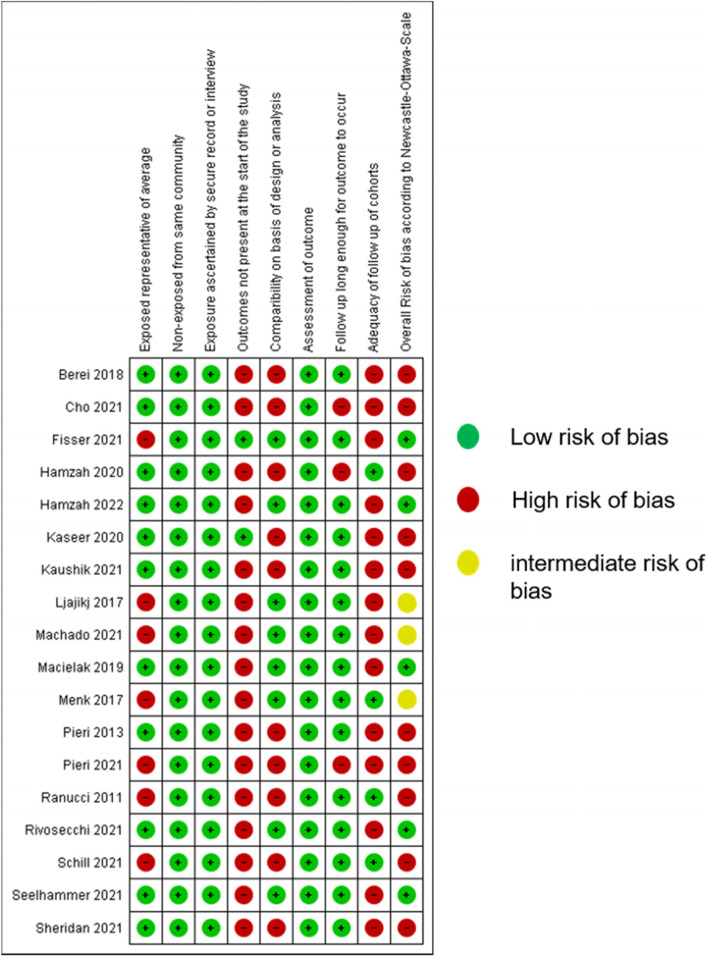
A systematic search was conducted. Full scientific articles were sought for inclusion if heparin anticoagulation was compared to DTI (argatroban/bivalirudin) in ECMO patients. Risk of bias was assessed by Newcastle Ottawa scale. Primary endpoint was in-hospital mortality. Bleeding events, thrombotic events, hours of ECMO support, days of hospital stay, percentage of time within therapeutic range and time to therapeutic range were extracted from full texts as secondary endpoints. Results were presented as Forrest-plots. GRADE was used for confidence assessment in outcomes.
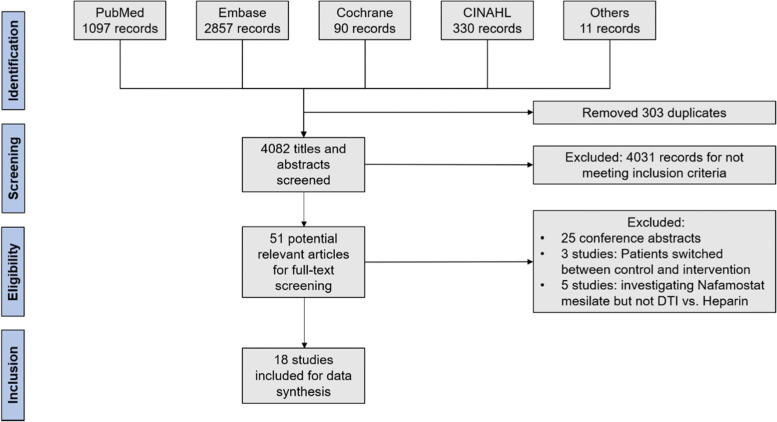
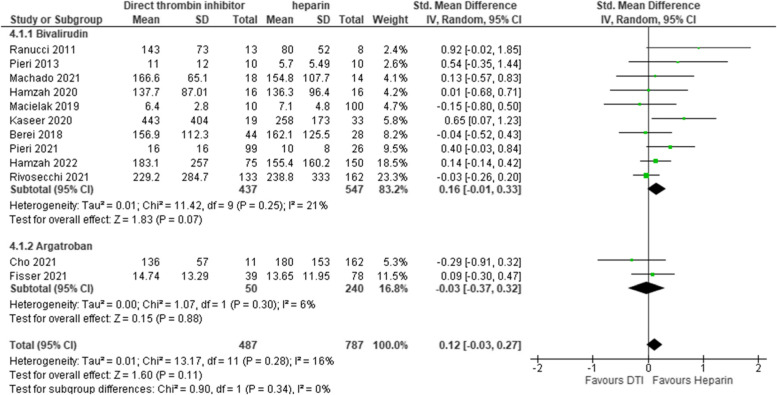
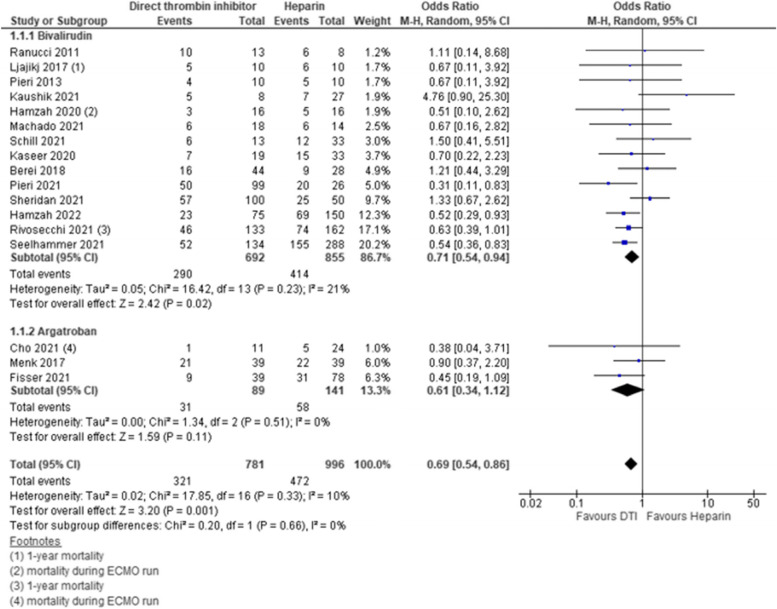
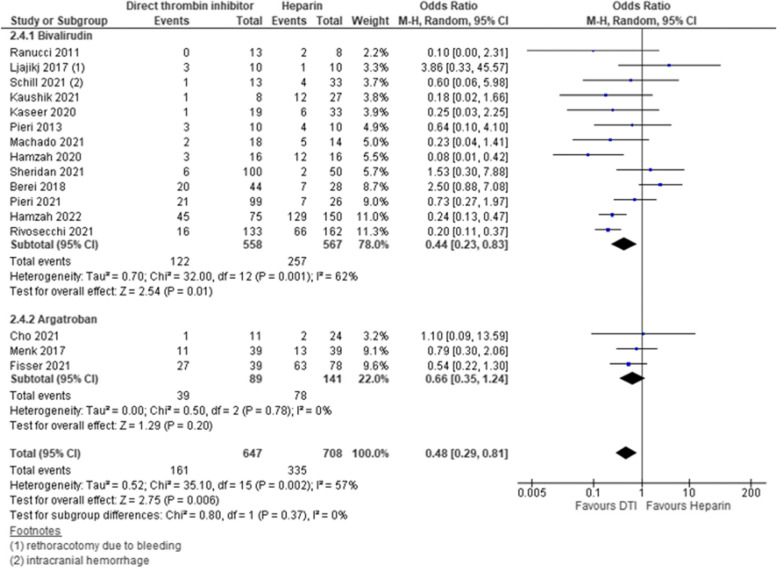
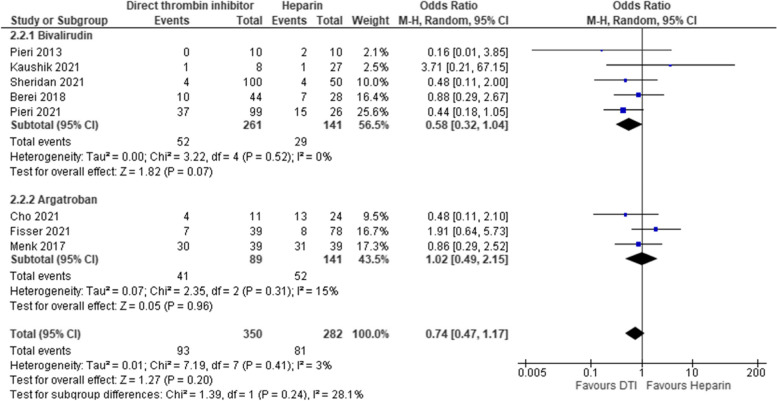
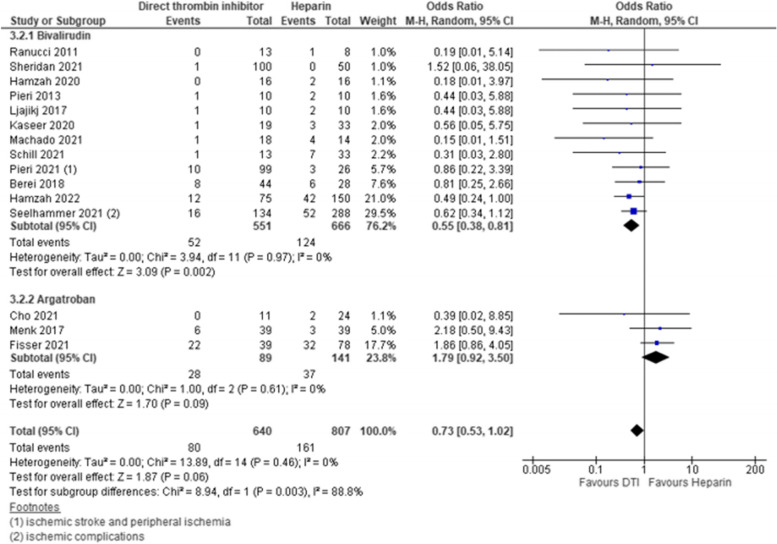
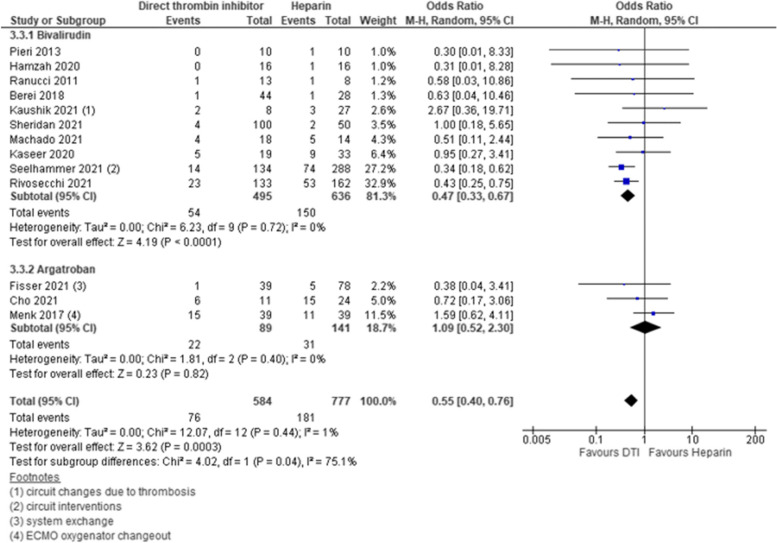
Systematic search identified 4.385 records, thereof 18 retrospective studies for a total of 1942 patients, complied with the predefined eligibility criteria:15 studies investigated bivalirudin and 3 studies investigated argatroban versus heparin. Risk of bias was high for most studies. In-hospital mortality, major bleeding events and pump-related thrombosis were less frequent in DTI group as compared to heparin [mortality-OR 0.69, 95% CI 0.54-0.86; major bleeding-OR 0.48, 95% CI 0.29-0.81; pump thrombosis-OR 0.55, 95% CI 0.40-0.76]. Additionally, percentage of time within therapeutic range was higher for DTI [SMD 0.54, 95% CI 0.14-0.94]. GRADE approach revealed a very low level of certainty for each outcome.
In this meta-analysis, DTI and especially bivalirudin showed beneficial effects on clinical outcomes in ECMO patients as compared to heparin. However, due to the lack of randomized trials, certainty of evidence is low.
This systematic review and meta-analysis was prospectively registered at PROSPERO data base (reference number CRD42021237252 ).
接受体外膜肺氧合(ECMO)设备治疗的患者数量正在增加。抗凝治疗对于预防ECMO治疗期间的血栓形成至关重要。主要使用肝素作为主要抗凝剂,但直接凝血酶抑制剂(DTI)已被确立为替代药物。本系统评价和荟萃分析的目的是评估在ECMO期间接受肝素治疗的患者与不同DTI治疗的患者的临床结局。
进行系统检索。如果在ECMO患者中将肝素抗凝与DTI(阿加曲班/比伐卢定)进行比较,则寻找纳入的完整科学文章。采用纽卡斯尔渥太华量表评估偏倚风险。主要终点是住院死亡率。从全文中提取出血事件、血栓形成事件、ECMO支持时间、住院天数、治疗范围内时间百分比和达到治疗范围的时间作为次要终点。结果以森林图呈现。采用GRADE对结局进行可信度评估。
系统检索确定了4385条记录,其中18项回顾性研究共1942例患者符合预定义的纳入标准:15项研究调查了比伐卢定,3项研究调查了阿加曲班与肝素的比较。大多数研究的偏倚风险较高。与肝素相比,DTI组的住院死亡率、大出血事件和泵相关血栓形成的发生率较低[死亡率-OR 0.69,95% CI 0.54-0.86;大出血-OR 0.48,95% CI 0.29-0.81;泵血栓形成-OR 0.55,95% CI 0.40-0.76]。此外,DTI的治疗范围内时间百分比更高[SMD 0.54,95% CI 0.14-0.94]。GRADE方法显示每个结局的确定性水平非常低。
在这项荟萃分析中,与肝素相比,DTI尤其是比伐卢定对ECMO患者的临床结局显示出有益影响。然而,由于缺乏随机试验,证据的确定性较低。
本系统评价和荟萃分析已在PROSPERO数据库中进行前瞻性注册(注册号CRD42021237252)。