Wu Xiaohui, Zhu Yuncheng, Wu Zhiguo, Huang Jia, Cao Lan, Wang Yun, Su Yousong, Liu Hongmei, Fang Maosheng, Yao Zhijian, Wang Zuowei, Wang Fan, Wang Yong, Peng Daihui, Chen Jun, Fang Yiru
Clinical Research Center and Division of Mood Disorders, Shanghai Mental Health Center, Shanghai Jiao Tong University School of Medicine, Shanghai, China.
Wuhan Mental Health Centre, Wuhan, China.
Front Psychiatry. 2022 Jul 12;13:759334. doi: 10.3389/fpsyt.2022.759334. eCollection 2022.
Two-thirds of major depressive disorder (MDD) patients initially present with somatic symptoms, yet no study has used approaches based on somatic symptoms to subtype MDD. This study aimed to classify MDD somatic symptoms and tracked the prognosis of each subtype.
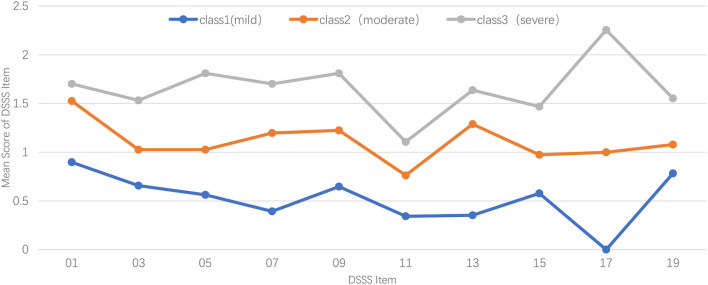
Data were obtained from the study of Algorithm Guided Treatment Strategies for Major Depressive Disorder (AGTs-MDD). We recruited 395 subjects who received monotherapy of mirtazapine or escitalopram and conducted 2-, 4-, 6-, 8-, and 12-week follow-up assessments ( = 311, 278, 251, 199, and 178, respectively). Latent profile analysis (LPA) was performed on somatic symptom items of the depression and somatic symptoms scale (DSSS). Generalized linear mixed models (GLMM) were used to study the longitudinal prognosis of the subtypes classed by LPA. Primary outcome measures were the Hamilton Depression Rating Scale (HAMD), HAMD score reduction rate, as well as somatic and depressive items of DSSS.
Three subtypes of MDD were found, namely, depression with mild somatic symptoms (68.9%), depression with moderate somatic symptoms (19.2%), and depression with severe somatic symptoms (11.9%). Scores of HAMD ( = 3.175, = 0.001), somatic ( = 23.594, < 0.001), and depressive ( = 4.163, < 0.001) DSSS items throughout the 12-week follow-up showed statistical difference among the three subtypes. The moderate group displayed a higher HAMD-17 score and a lower reduction rate at the 6th week, and more severe depressive symptoms both at the 4th and 6th weeks.
The results indicate that somatic symptoms should be emphasized in patients with MDD, and more attention is needed for those with moderate somatic symptoms, which may be relevant to a worse prognosis.
三分之二的重度抑郁症(MDD)患者最初表现为躯体症状,但尚无研究采用基于躯体症状的方法对MDD进行亚型分类。本研究旨在对MDD的躯体症状进行分类,并追踪各亚型的预后情况。
数据来自重度抑郁症算法指导治疗策略(AGTs-MDD)研究。我们招募了395名接受米氮平或艾司西酞普兰单一疗法的受试者,并分别在第2、4、6、8和12周进行随访评估(分别为n = 311、278、251、199和178)。对抑郁与躯体症状量表(DSSS)中的躯体症状项目进行潜在类别分析(LPA)。采用广义线性混合模型(GLMM)研究LPA分类的亚型的纵向预后。主要结局指标为汉密尔顿抑郁量表(HAMD)、HAMD评分降低率以及DSSS的躯体和抑郁项目。
发现了MDD的三种亚型,即轻度躯体症状的抑郁症(68.9%)、中度躯体症状的抑郁症(19.2%)和重度躯体症状的抑郁症(11.9%)。在整个12周的随访中,HAMD(F = 3.175,P = 0.001)、躯体(F = 23.594,P < 0.001)和抑郁(F = 4.163,P < 0.001)DSSS项目得分在三种亚型之间存在统计学差异。中度组在第6周时HAMD-17评分较高且降低率较低,在第4周和第6周时抑郁症状更严重。
结果表明,MDD患者应重视躯体症状,对于中度躯体症状的患者需要给予更多关注,这可能与预后较差有关。