Department of Molecular and Cellular Biology, University of Guelph, Guelph, Ontario, Canada.
Lunenfeld-Tanenbaum Research Institute, Sinai Health System, Toronto, Ontario, Canada.
J Am Soc Nephrol. 2022 Aug;33(8):1546-1567. doi: 10.1681/ASN.2021101343.
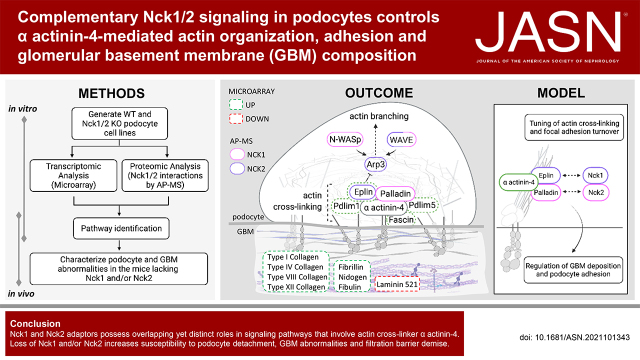
Maintenance of the kidney filtration barrier requires coordinated interactions between podocytes and the underlying glomerular basement membrane (GBM). GBM ligands bind podocyte integrins, which triggers actin-based signaling events critical for adhesion. Nck1/2 adaptors have emerged as essential regulators of podocyte cytoskeletal dynamics. However, the precise signaling mechanisms mediated by Nck1/2 adaptors in podocytes remain to be fully elucidated.
We generated podocytes deficient in Nck1 and Nck2 and used transcriptomic approaches to profile expression differences. Proteomic techniques identified specific binding partners for Nck1 and Nck2 in podocytes. We used cultured podocytes and mice deficient in Nck1 and/or Nck2, along with podocyte injury models, to comprehensively verify our findings.
Compound loss of Nck1/2 altered expression of genes involved in actin binding, cell adhesion, and extracellular matrix composition. Accordingly, Nck1/2-deficient podocytes showed defects in actin organization and cell adhesion , with podocyte detachment and altered GBM morphology present . We identified distinct interactomes for Nck1 and Nck2 and uncovered a mechanism by which Nck1 and Nck2 cooperate to regulate actin bundling at focal adhesions actinin-4. Furthermore, loss of Nck1 or Nck2 resulted in increased matrix deposition , with more prominent defects in Nck2-deficient mice, consistent with enhanced susceptibility to podocyte injury.
These findings reveal distinct, yet complementary, roles for Nck proteins in regulating podocyte adhesion, controlling GBM composition, and sustaining filtration barrier integrity.
维持肾脏滤过屏障需要足细胞和肾小球基底膜(GBM)之间的协调相互作用。GBM 配体结合足细胞整合素,触发肌动蛋白为基础的信号事件,对黏附至关重要。Nck1/2 衔接蛋白已成为足细胞细胞骨架动力学的重要调节因子。然而,Nck1/2 衔接蛋白在足细胞中介导的确切信号机制仍有待充分阐明。
我们生成了缺乏 Nck1 和 Nck2 的足细胞,并使用转录组学方法分析表达差异。蛋白质组学技术鉴定了 Nck1 和 Nck2 在足细胞中的特定结合伴侣。我们使用培养的足细胞和缺乏 Nck1 和/或 Nck2 的小鼠,以及足细胞损伤模型,全面验证了我们的发现。
Nck1/2 的复合缺失改变了与肌动蛋白结合、细胞黏附和细胞外基质组成相关的基因表达。因此,Nck1/2 缺陷的足细胞表现出肌动蛋白组织和细胞黏附缺陷,足细胞脱落和 GBM 形态改变。我们确定了 Nck1 和 Nck2 的独特相互作用组,并揭示了 Nck1 和 Nck2 合作调节粘着斑处肌动蛋白束的机制,肌动蛋白 4。此外,Nck1 或 Nck2 的缺失导致基质沉积增加,Nck2 缺陷小鼠的缺陷更为明显,与对足细胞损伤的敏感性增加一致。
这些发现揭示了 Nck 蛋白在调节足细胞黏附、控制 GBM 组成和维持滤过屏障完整性方面的独特但互补的作用。