• 文献检索
  • 文档翻译
  • 深度研究
  • 学术资讯
  • Suppr Zotero 插件Zotero 插件
  • 邀请有礼
  • 套餐&价格
  • 历史记录
应用&插件
Suppr Zotero 插件Zotero 插件浏览器插件Mac 客户端Windows 客户端微信小程序
定价
高级版会员购买积分包购买API积分包
服务
文献检索文档翻译深度研究API 文档MCP 服务
关于我们
关于 Suppr公司介绍联系我们用户协议隐私条款
关注我们

Suppr 超能文献

核心技术专利:CN118964589B侵权必究
粤ICP备2023148730 号-1Suppr @ 2026

文献检索

告别复杂PubMed语法,用中文像聊天一样搜索,搜遍4000万医学文献。AI智能推荐,让科研检索更轻松。

立即免费搜索

文件翻译

保留排版,准确专业,支持PDF/Word/PPT等文件格式,支持 12+语言互译。

免费翻译文档

深度研究

AI帮你快速写综述,25分钟生成高质量综述,智能提取关键信息,辅助科研写作。

立即免费体验

药物再利用:根源、障碍和促进因素的系统评价。

Drug repurposing: a systematic review on root causes, barriers and facilitators.

机构信息

Internal Medicine Department, Yale University School of Medicine, 367 Cedar Street, 4th Floor, New Haven, CT, 06520, USA.

Cushing/Whitney Medical Library, Yale University, 333 Cedar Street, Box 208014, New Haven, CT, 06520, USA.

出版信息

BMC Health Serv Res. 2022 Jul 29;22(1):970. doi: 10.1186/s12913-022-08272-z.

DOI:10.1186/s12913-022-08272-z
PMID:35906687
原文链接:https://pmc.ncbi.nlm.nih.gov/articles/PMC9336118/
Abstract

BACKGROUND

Repurposing is a drug development strategy receiving heightened attention after the Food and Drug Administration granted emergency use authorization of several repurposed drugs to treat Covid-19. There remain knowledge gaps on the root causes, facilitators and barriers for repurposing.

METHOD

This systematic review used controlled vocabulary and free text terms to search ABI/Informa, Academic Search Premier, Business Source Complete, Cochrane Library, EconLit, Google Scholar, Ovid Embase, Ovid Medline, Pubmed, Scopus, and Web of Science Core Collection databases for the characteristics, reasons and example of companies deprioritizing development of promising drugs and barriers, facilitators and examples of successful re-purposing.

RESULTS

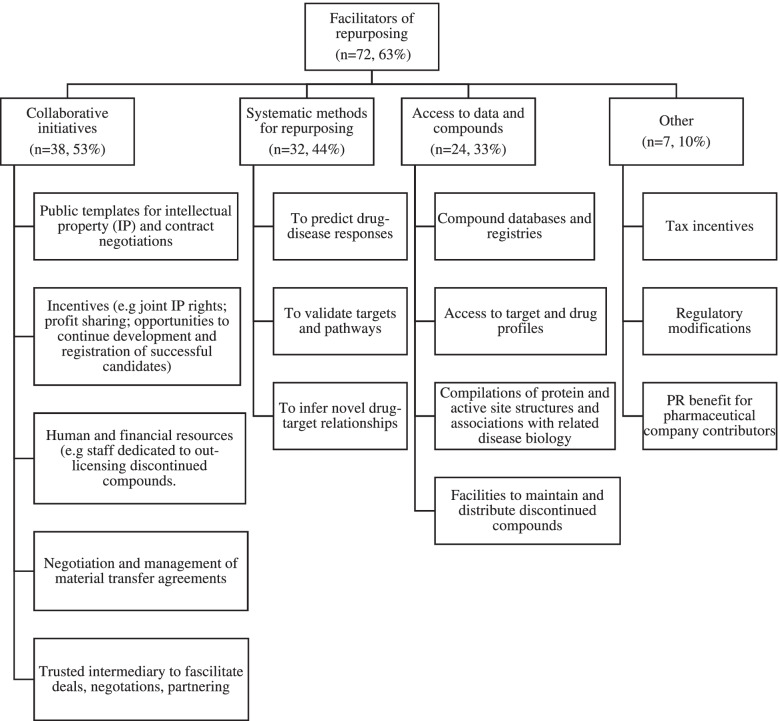
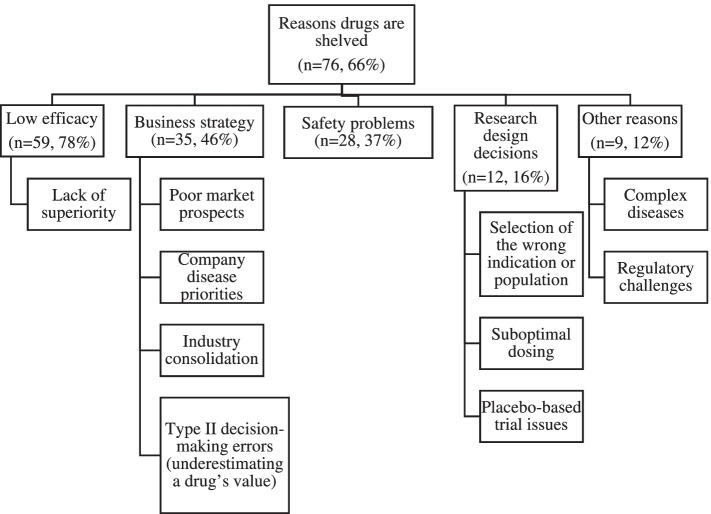
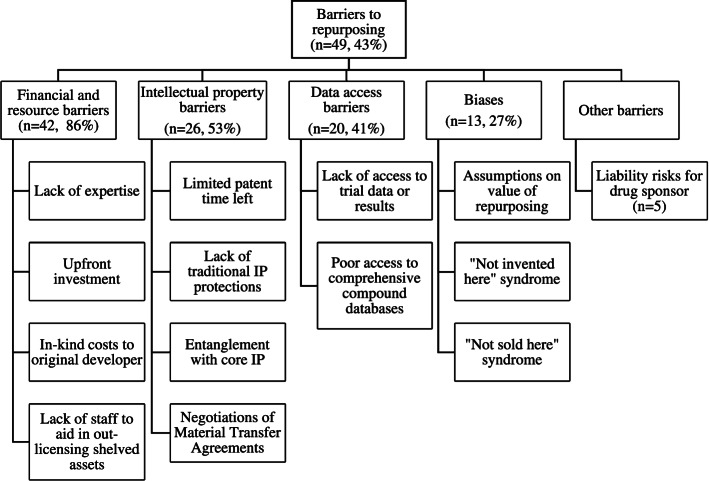
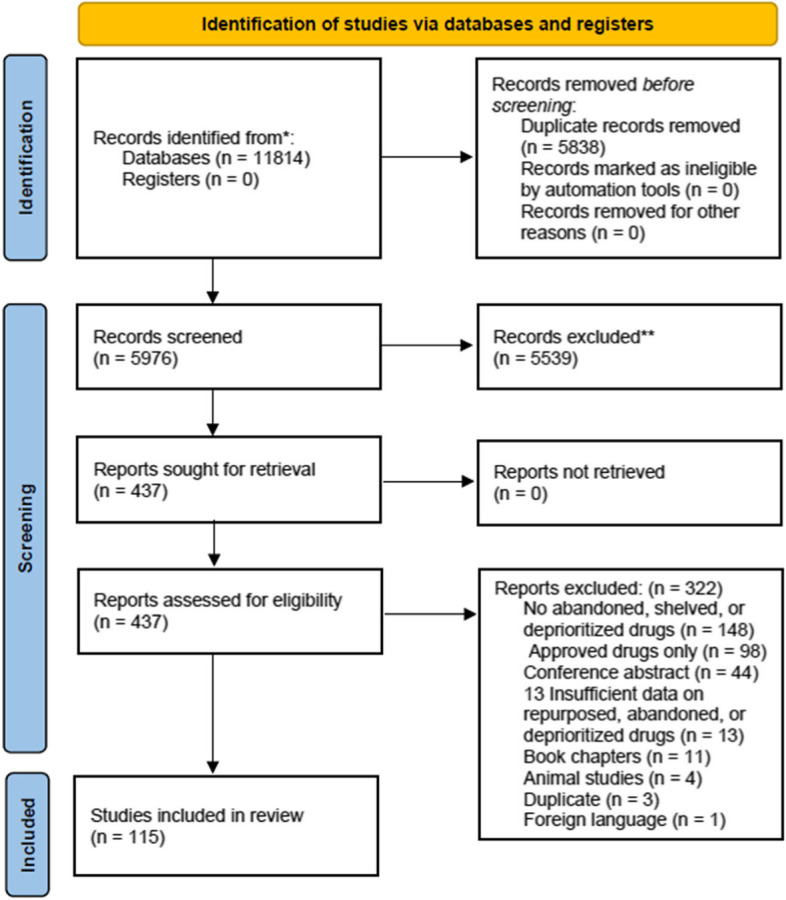
We identified 11,814 articles, screened 5,976 for relevance, found 437 eligible for full text review, 115 of which were included in full analysis. Most articles (66%, 76/115) discussed why promising drugs are abandoned, with lack of efficacy or superiority to other therapies (n = 59), strategic business reasons (n = 35), safety problems (n = 28), research design decisions (n = 12), the complex nature of a studied disease or drug (n = 7) and regulatory bodies requiring more information (n = 2) among top reasons. Key barriers to repurposing include inadequate resources (n = 42), trial data access and transparency around abandoned compounds (n = 20) and expertise (n = 11). Additional barriers include uncertainty about the value of repurposing (n = 13), liability risks (n = 5) and intellectual property (IP) challenges (n = 26). Facilitators include the ability to form multi-partner collaborations (n = 38), access to compound databases and database screening tools (n = 32), regulatory modifications (n = 5) and tax incentives (n = 2).

CONCLUSION

Promising drugs are commonly shelved due to insufficient efficacy or superiority to alternate therapies, poor market prospects, and industry consolidation. Inadequate resources and data access and challenges negotiating IP are key barriers to repurposing reaching its full potential as a core approach in drug development. Multi-partner collaborations and the availability and use of compound databases and tax incentives are key facilitators for repurposing. More research is needed on the current value of repurposing in drug development and how to better facilitate resources to support it, where valuable, especially financial, staffing for out-licensing shelved products, and legal expertise to negotiate IP agreements in multi-partner collaborations.

TRIAL REGISTRATION

The protocol was registered on Open Science Framework ( https://osf.io/f634k/ ) as it was not eligible for registration on PROSPERO as the review did not focus on a health-related outcome.

https://cdn.ncbi.nlm.nih.gov/pmc/blobs/5c9b/9338628/29f1143cc351/12913_2022_8272_Fig5_HTML.jpg
https://cdn.ncbi.nlm.nih.gov/pmc/blobs/5c9b/9338628/4cbc8a39c787/12913_2022_8272_Fig1_HTML.jpg
https://cdn.ncbi.nlm.nih.gov/pmc/blobs/5c9b/9338628/2ece7ea2df00/12913_2022_8272_Fig2_HTML.jpg
https://cdn.ncbi.nlm.nih.gov/pmc/blobs/5c9b/9338628/e4830a8d44ca/12913_2022_8272_Fig3_HTML.jpg
https://cdn.ncbi.nlm.nih.gov/pmc/blobs/5c9b/9338628/8c529385a05e/12913_2022_8272_Fig4_HTML.jpg
https://cdn.ncbi.nlm.nih.gov/pmc/blobs/5c9b/9338628/29f1143cc351/12913_2022_8272_Fig5_HTML.jpg
https://cdn.ncbi.nlm.nih.gov/pmc/blobs/5c9b/9338628/4cbc8a39c787/12913_2022_8272_Fig1_HTML.jpg
https://cdn.ncbi.nlm.nih.gov/pmc/blobs/5c9b/9338628/2ece7ea2df00/12913_2022_8272_Fig2_HTML.jpg
https://cdn.ncbi.nlm.nih.gov/pmc/blobs/5c9b/9338628/e4830a8d44ca/12913_2022_8272_Fig3_HTML.jpg
https://cdn.ncbi.nlm.nih.gov/pmc/blobs/5c9b/9338628/8c529385a05e/12913_2022_8272_Fig4_HTML.jpg
https://cdn.ncbi.nlm.nih.gov/pmc/blobs/5c9b/9338628/29f1143cc351/12913_2022_8272_Fig5_HTML.jpg
摘要

背景

在食品和药物管理局批准几种重新利用的药物紧急用于治疗Covid-19 之后,重新利用作为一种药物开发策略受到了高度关注。对于重新利用的根本原因、促进因素和障碍,仍然存在知识差距。

方法

本系统评价使用受控词汇和自由文本术语,在 ABI/Informa、Academic Search Premier、Business Source Complete、Cochrane Library、 EconLit、Google Scholar、Ovid Embase、Ovid Medline、Pubmed、Scopus 和 Web of Science Core Collection 数据库中搜索了公司优先考虑开发有前途的药物和障碍的特征、原因和示例,以及成功重新利用的障碍、促进因素和示例。

结果

我们确定了 11814 篇文章,筛选了 5976 篇相关文章,发现了 437 篇符合全文审查标准的文章,其中 115 篇进行了全文分析。大多数文章(66%,76/115)讨论了为什么有前途的药物被放弃,原因包括疗效或优于其他疗法不足(n=59)、战略商业原因(n=35)、安全问题(n=28)、研究设计决策(n=12)、研究疾病或药物的复杂性质(n=7)和监管机构要求提供更多信息(n=2)。重新利用的主要障碍包括资源不足(n=42)、试验数据获取和废弃化合物透明度问题(n=20)和专业知识(n=11)。其他障碍包括对重新利用价值的不确定性(n=13)、责任风险(n=5)和知识产权(IP)挑战(n=26)。促进因素包括形成多方合作的能力(n=38)、化合物数据库和数据库筛选工具的获取(n=32)、监管修改(n=5)和税收激励(n=2)。

结论

有前途的药物通常因疗效或优于替代疗法不足、市场前景不佳和行业整合而被搁置。资源不足、数据获取和谈判 IP 方面的挑战是重新利用充分发挥潜力作为药物开发核心方法的主要障碍。多方合作以及化合物数据库的可用性和使用以及税收激励是重新利用的关键促进因素。需要更多研究来了解重新利用在药物开发中的当前价值,以及如何更好地为支持它提供资源,特别是在有价值的情况下,特别是为放弃许可的搁置产品提供财务、人员配备和法律专业知识,以进行多方合作中的 IP 协议谈判。

试验注册

该方案在开放科学框架(https://osf.io/f634k/)上进行了注册,因为它不符合 PROSPERO 的注册资格,因为该审查不侧重于健康相关结果。
相似文献

1
Drug repurposing: a systematic review on root causes, barriers and facilitators.药物再利用:根源、障碍和促进因素的系统评价。
BMC Health Serv Res. 2022 Jul 29;22(1):970. doi: 10.1186/s12913-022-08272-z.
2
Folic acid supplementation and malaria susceptibility and severity among people taking antifolate antimalarial drugs in endemic areas.在流行地区,服用抗叶酸抗疟药物的人群中,叶酸补充剂与疟疾易感性和严重程度的关系。
Cochrane Database Syst Rev. 2022 Feb 1;2(2022):CD014217. doi: 10.1002/14651858.CD014217.
3
Beyond the black stump: rapid reviews of health research issues affecting regional, rural and remote Australia.超越黑木树:影响澳大利亚地区、农村和偏远地区的健康研究问题的快速综述。
Med J Aust. 2020 Dec;213 Suppl 11:S3-S32.e1. doi: 10.5694/mja2.50881.
4
The future of Cochrane Neonatal.考克兰新生儿协作网的未来。
Early Hum Dev. 2020 Nov;150:105191. doi: 10.1016/j.earlhumdev.2020.105191. Epub 2020 Sep 12.
5
Repurposed Drugs as Potential Therapeutic Candidates for the Management of Alzheimer's Disease.重新利用的药物作为治疗阿尔茨海默病的潜在候选疗法
Curr Drug Metab. 2017;18(9):842-852. doi: 10.2174/1389200218666170607101622.
6
Regulatory considerations and intellectual property rights of repurposed drugs.重新定位药物的监管考虑因素和知识产权。
Prog Mol Biol Transl Sci. 2024;205:357-375. doi: 10.1016/bs.pmbts.2024.03.019. Epub 2024 Apr 4.
7
[Early achievements of the Danish pharmaceutical industry--8. Lundbeck].[丹麦制药行业的早期成就——8. 灵北公司]
Theriaca. 2016(43):9-61.
8
Unlocking hidden potential: advancements, approaches, and obstacles in repurposing drugs for cancer therapy.挖掘潜在可能:药物重用于癌症治疗的进展、方法和障碍。
Br J Cancer. 2024 Mar;130(5):703-715. doi: 10.1038/s41416-023-02502-9. Epub 2023 Nov 27.
9
Drug repurposing from the perspective of pharmaceutical companies.从制药公司的角度看药物再利用。
Br J Pharmacol. 2018 Jan;175(2):168-180. doi: 10.1111/bph.13798. Epub 2017 May 18.
10
An assessment of the factors affecting the commercialization of cell-based therapeutics: a systematic review protocol.评估影响基于细胞的治疗药物商业化的因素:系统评价方案。
Syst Rev. 2017 Jun 26;6(1):120. doi: 10.1186/s13643-017-0517-4.

引用本文的文献

1
Multi-Trait Polygenic Scores for COPD and COPD Exacerbations Implicate Druggable Proteins.慢性阻塞性肺疾病(COPD)和COPD急性加重的多性状多基因评分涉及可成药蛋白。
medRxiv. 2025 Aug 26:2025.08.22.25334001. doi: 10.1101/2025.08.22.25334001.
2
Drug Repurposing for Kala-Azar.用于治疗黑热病的药物重新利用
Pharmaceutics. 2025 Aug 6;17(8):1021. doi: 10.3390/pharmaceutics17081021.
3
Exploring a Therapeutic Gold Mine: The Antifungal Potential of the Gold-Based Antirheumatic Drug Auranofin.探索一座治疗金矿:金基抗风湿药物金诺芬的抗真菌潜力。

本文引用的文献

1
Repurposing medications.药物再利用。
Ocul Surf. 2021 Jan;19:336-340. doi: 10.1016/j.jtos.2020.11.012. Epub 2020 Nov 26.
2
Freedom of Information Act Access to an Investigational New Drug Application.《信息自由法》对研究性新药申请的获取。
ACS Pharmacol Transl Sci. 2019 Aug 20;2(6):497-500. doi: 10.1021/acsptsci.9b00056. eCollection 2019 Dec 13.
3
Drug repurposing in rare diseases: Myths and reality.药物重用于罕见病:神话与现实。
Int J Mol Sci. 2025 Aug 16;26(16):7909. doi: 10.3390/ijms26167909.
4
Motivations and experiences of patients with respiratory disease and their caregivers in a multinational trial of mirtazapine for severe breathlessness: a qualitative study (BETTER-B).米氮平治疗严重呼吸困难的多国试验中呼吸系统疾病患者及其照护者的动机和经历:一项定性研究(BETTER-B)
BMC Pulm Med. 2025 Aug 14;25(1):390. doi: 10.1186/s12890-025-03862-z.
5
A Critical Appraisal of Off-Label Use and Repurposing of Statins for Non-Cardiovascular Indications: A Systematic Mini-Update and Regulatory Analysis.他汀类药物用于非心血管适应症的超说明书使用和重新利用的批判性评估:系统的小型更新与监管分析
J Clin Med. 2025 Aug 1;14(15):5436. doi: 10.3390/jcm14155436.
6
Developing treatments for cerebral small vessel disease: a scoping review of licensed interventions for potential repurposing.开发脑小血管疾病的治疗方法:对潜在重新利用的已获许可干预措施的范围审查。
F1000Res. 2024 Dec 20;13:1546. doi: 10.12688/f1000research.157890.1. eCollection 2024.
7
Repurposing the hypoglycaemic agents for neuroinflammation, a comprehensive review.将降血糖药物用于神经炎症的研究综述
3 Biotech. 2025 Sep;15(9):281. doi: 10.1007/s13205-025-04455-7. Epub 2025 Aug 5.
8
Efficacy of tenofovir on clinical outcomes of COVID-19 patients: a systematic review.替诺福韦对COVID-19患者临床结局的疗效:一项系统评价。
BMC Infect Dis. 2025 Jul 31;25(1):965. doi: 10.1186/s12879-025-11359-7.
9
Reconciling multiple connectivity-based systems biology methods for drug repurposing.协调多种基于连通性的系统生物学方法用于药物再利用。
Brief Bioinform. 2025 Jul 2;26(4). doi: 10.1093/bib/bbaf387.
10
Translational Success and Pharmacoeconomic Lessons of Pandemic-Driven Drug Repurposing.大流行驱动的药物重新利用的转化成功与药物经济学经验教训。
Cureus. 2025 May 29;17(5):e85033. doi: 10.7759/cureus.85033. eCollection 2025 May.
Therapie. 2020 Apr;75(2):157-160. doi: 10.1016/j.therap.2020.02.006. Epub 2020 Feb 13.
4
Involving Patient Groups in Drug Research: A Systematic Review of Reasons.让患者群体参与药物研究:原因的系统综述
Patient Prefer Adherence. 2020 Mar 12;14:587-597. doi: 10.2147/PPA.S232499. eCollection 2020.
5
Phosphonopeptides Revisited, in an Era of Increasing Antimicrobial Resistance.重新审视膦肽类药物,应对日益严重的抗菌药物耐药性挑战。
Molecules. 2020 Mar 23;25(6):1445. doi: 10.3390/molecules25061445.
6
Key indicators of phase transition for clinical trials through machine learning.通过机器学习实现临床试验的相变关键指标。
Drug Discov Today. 2020 Feb;25(2):414-421. doi: 10.1016/j.drudis.2019.12.014. Epub 2020 Jan 8.
7
Challenges and opportunities with drug repurposing: finding strategies to find alternative uses of therapeutics.药物重新利用的挑战与机遇:寻找治疗药物替代用途的策略。
Expert Opin Drug Discov. 2020 Apr;15(4):397-401. doi: 10.1080/17460441.2020.1704729. Epub 2019 Dec 17.
8
In Silico Drug Repositioning for Chagas Disease.计算机辅助药物重定位用于恰加斯病。
Curr Med Chem. 2020;27(5):662-675. doi: 10.2174/0929867326666191016114839.
9
Compound asset sharing initiatives between pharmaceutical companies, funding bodies, and academia: Learnings and successes.制药公司、资助机构和学术界之间的复合资产共享计划:经验教训和成功案例。
Pharmacol Res Perspect. 2019 Jul 30;7(4):e00510. doi: 10.1002/prp2.510. eCollection 2019 Aug.
10
Using What We Already Have: Uncovering New Drug Repurposing Strategies in Existing Omics Data.利用已有资源:从现有组学数据中挖掘新药再利用策略。
Annu Rev Pharmacol Toxicol. 2020 Jan 6;60:333-352. doi: 10.1146/annurev-pharmtox-010919-023537. Epub 2019 Jul 23.