LiRen College, Yanshan University, Qinhuangdao, Hebei, China.
School of Information Technology and Design (SITD) Mongolian National University (MNU), Ulan Bator, Mongolia.
Comput Intell Neurosci. 2022 Jul 22;2022:3484268. doi: 10.1155/2022/3484268. eCollection 2022.
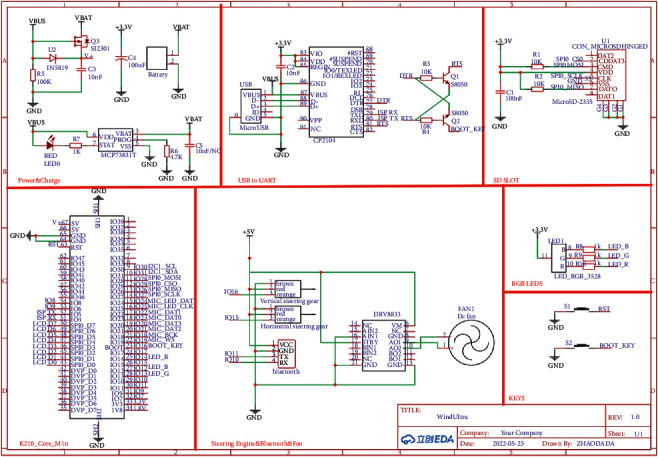
With the development of artificial intelligence, the application of intelligent algorithms to low-power embedded chips has become a new research topic today. Based on this, this study optimizes the YOLOv2 algorithm by tailoring and successfully deploys it on the K210 chip to train the face object detection algorithm model separately. The intelligent fan with YOLOv2 model deployed in K210 chip can detect the target of the character and obtain the position and size of the character in the machine coordinates. Based on the obtained information of character coordinate position and size, the fan's turning Angle and the size of air supply are intelligently perceived. The experimental results show that the intelligent fan design method proposed here is a new embedded chip intelligent method of cutting and improving the YOLOv2 algorithm. It innovatively designed solo tracking, crowd tracking, and intelligent ranging algorithms, which perform well in human perception of solo tracking and crowd tracking and automatic air volume adjustment, improve the accuracy of air delivery and user comfort, and also provide good theoretical and practical support for the combination of AI and embedded in other fields.
随着人工智能的发展,将智能算法应用于低功耗嵌入式芯片已成为当今的一个新研究课题。基于此,本研究通过裁剪对 YOLOv2 算法进行了优化,并成功将其部署在 K210 芯片上,分别对人脸目标检测算法模型进行训练。部署在 K210 芯片上的带有 YOLOv2 模型的智能风扇可以检测字符目标,并获取机器坐标中字符的位置和大小。基于所获得的字符坐标位置和大小信息,智能感知风扇的转向角度和送风大小。实验结果表明,这里提出的智能风扇设计方法是一种新的嵌入式芯片智能方法,用于裁剪和改进 YOLOv2 算法。它创新性地设计了单人跟踪、人群跟踪和智能测距算法,在单人跟踪和人群跟踪的人体感知以及自动风量调节方面表现良好,提高了送风精度和用户舒适度,也为人工智能与嵌入式技术在其他领域的结合提供了良好的理论和实践支持。