Lombardi Yannis, François Hélène
Soins Intensifs Néphrologiques et Rein Aigu, Hôpital Tenon, Assistance Publique-Hôpitaux de Paris, 4 rue de la Chine, Paris, France.
Sorbonne Université, Paris, France.
Front Med (Lausanne). 2022 Jul 14;9:942665. doi: 10.3389/fmed.2022.942665. eCollection 2022.
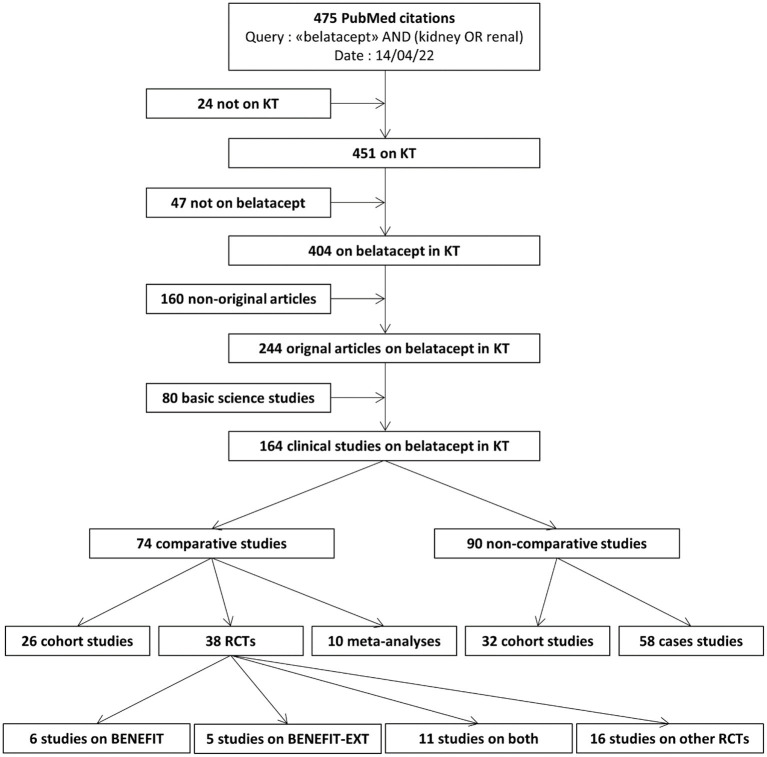
The current gold standard to prevent allograft rejection for maintenance immunosuppression in kidney transplantation currently consists in glucocorticoids, an antiproliferative agent and a calcineurin inhibitor (CNI), with better outcome for tacrolimus than cyclosporin. Although, CNI drastically improved early graft survival, so far, CNI have failed to significantly improve long-term survival mainly because of nephrotoxicity. In addition, CNI carry several other side effects such as an increased risk for cardiovascular events and for diabetes mellitus. Therefore, seeking alternatives to CNI remains of paramount importance in kidney transplantation. Belatacept is a fusion protein composed of the human IgG1 Fc fragment linked to the modified extracellular domain of cytotoxic T lymphocyte-associated antigen 4. In kidney transplant recipients, pivotal phase III randomized studies suggested clinical benefits of belatacept as an initial maintenance regimen, as compared with cyclosporine, mainly on kidney function. Recently, a randomized study also suggested a clinical benefit on renal function of a conversion from a CNI-based to a belatacept-based maintenance regimen in patients. However, conversion from CNIs to belatacept is probably associated with an increased risk of biopsy-proven acute rejection and should prompt close clinical surveillance. On the other hand, other studies suggest a decrease in humoral transplant immunization. Belatacept is probably associated with an increase in both risk and severity of some infectious diseases, including EBV-linked post-transplantation lymphoproliferative disorders, and with a decreased response to vaccines. Most studies on belatacept are observational, retrospective, and non-comparative. Consequently, high-quality data about the safety and efficacy profile of belatacept, as compared with the current gold standard for maintenance regimens (tacrolimus-based), is uncertain. Our review will therefore focus on the most recent published data aiming at evaluating the evidence-based or the "true" benefits and risks of belatacept-based regimens in kidney transplantation.
目前,肾移植中用于维持免疫抑制以防止同种异体移植物排斥的金标准方案是使用糖皮质激素、一种抗增殖药物和一种钙调神经磷酸酶抑制剂(CNI),他克莫司的效果优于环孢素。尽管CNI显著提高了早期移植物存活率,但到目前为止,CNI未能显著提高长期存活率,主要原因是其肾毒性。此外,CNI还会带来其他一些副作用,如心血管事件和糖尿病风险增加。因此,寻找CNI的替代药物在肾移植中仍然至关重要。贝拉西普是一种融合蛋白,由与细胞毒性T淋巴细胞相关抗原4的修饰细胞外结构域相连的人IgG1 Fc片段组成。在肾移植受者中,关键的III期随机研究表明,与环孢素相比,贝拉西普作为初始维持方案具有临床益处,主要体现在肾功能方面。最近,一项随机研究还表明,在患者中从基于CNI的维持方案转换为基于贝拉西普的维持方案对肾功能有临床益处。然而,从CNI转换为贝拉西普可能会增加活检证实的急性排斥反应风险,因此需要密切的临床监测。另一方面,其他研究表明体液移植免疫反应有所降低。贝拉西普可能与某些传染病的风险和严重程度增加有关,包括与EB病毒相关的移植后淋巴细胞增生性疾病,并且与疫苗反应降低有关。大多数关于贝拉西普的研究都是观察性、回顾性和非对比性的。因此,与目前维持方案的金标准(基于他克莫司)相比,关于贝拉西普安全性和有效性的高质量数据尚不确定。因此,我们的综述将聚焦于最近发表的数据,旨在评估基于贝拉西普的方案在肾移植中的循证或“真实”益处和风险。