Loke Yue-Hin, Capuano Francesco, Kollar Sarah, Cibis Merih, Kitslaar Pieter, Balaras Elias, Reiber Johan H C, Pedrizzetti Gianni, Olivieri Laura
Department of Cardiology, Children's National Hospital, Washington, DC, United States.
3D Cardiac Visualization Laboratory, Sheikh Zayed Institute for Pediatric Surgical Innovation, Children's National Hospital, Washington, DC, United States.
Front Cardiovasc Med. 2022 Jul 14;9:929470. doi: 10.3389/fcvm.2022.929470. eCollection 2022.
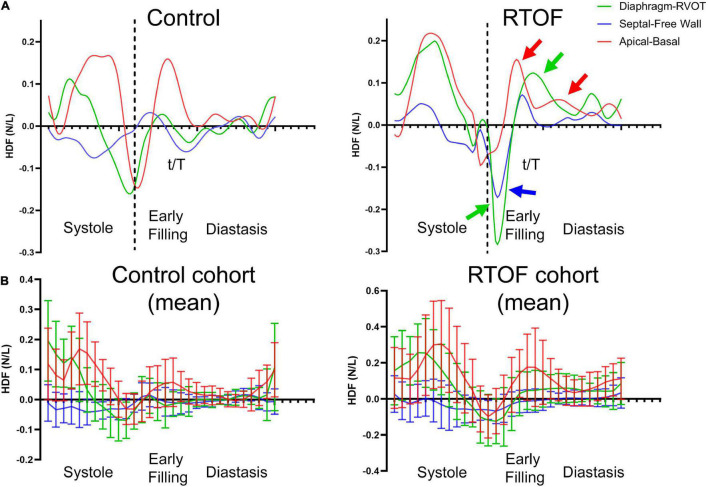
The effect of chronic pulmonary regurgitation (PR) on right ventricular (RV) dysfunction in repaired Tetralogy of Fallot (RTOF) patients is well recognized by cardiac magnetic resonance (CMR). However, the link between RV wall motion, intracardiac flow and PR has not been established. Hemodynamic force (HDF) represents the global force exchanged between intracardiac blood volume and endocardium, measurable by 4D flow or by a novel mathematical model of wall motion. In our study, we used this novel methodology to derive HDF in a cohort of RTOF patients, exclusively using routine CMR imaging.
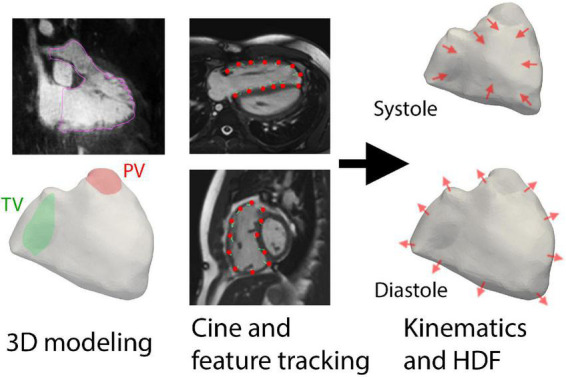
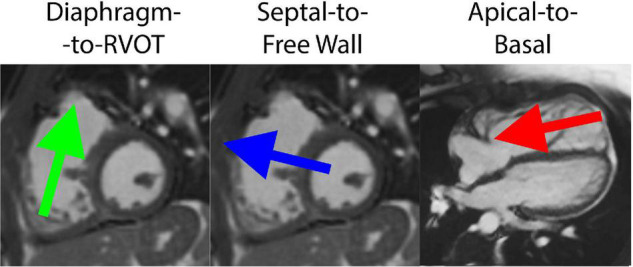
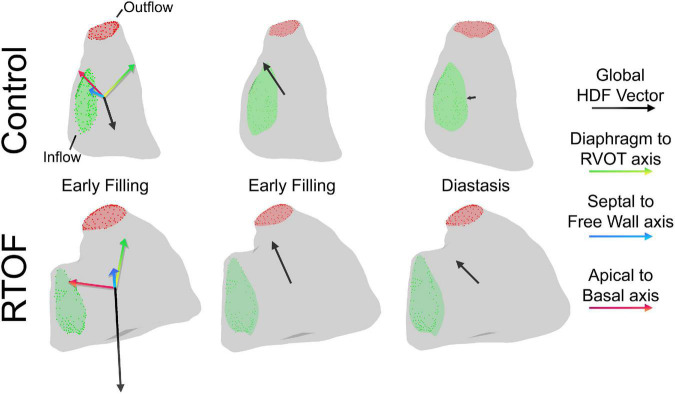
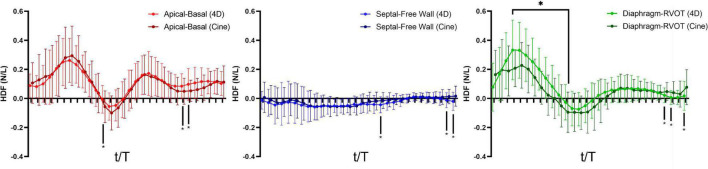
RTOF patients and controls with CMR imaging were retrospectively included. Three-dimensional (3D) models of RV were segmented, including RV outflow tract (RVOT). Feature-tracking software (QStrain 2.0, Medis Medical Imaging Systems, Leiden, Netherlands) captured endocardial contours from long/short-axis cine and used to reconstruct RV wall motion. A global HDF vector was computed from the moving surface, then decomposed into amplitude/impulse of three directional components based on reference (Apical-to-Basal, Septal-to-Free Wall and Diaphragm-to-RVOT direction). HDF were compared and correlated against CMR and exercise stress test parameters. A subset of RTOF patients had 4D flow that was used to derive vorticity (for correlation) and HDF (for comparison against cine method).
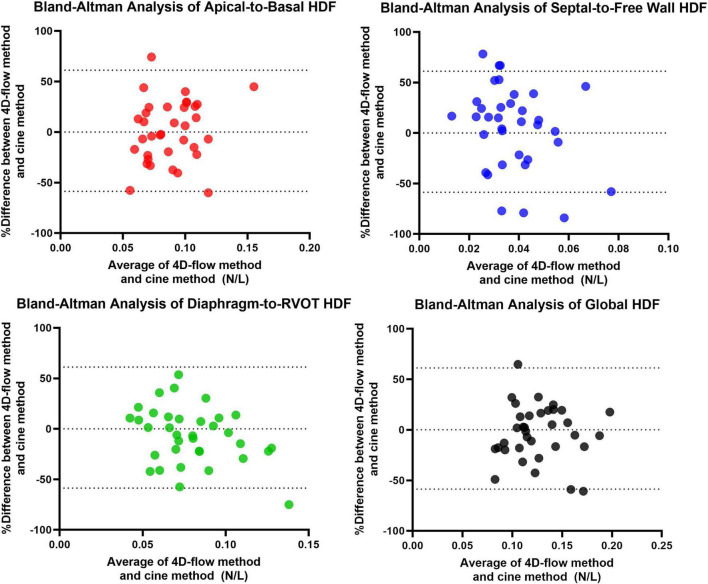
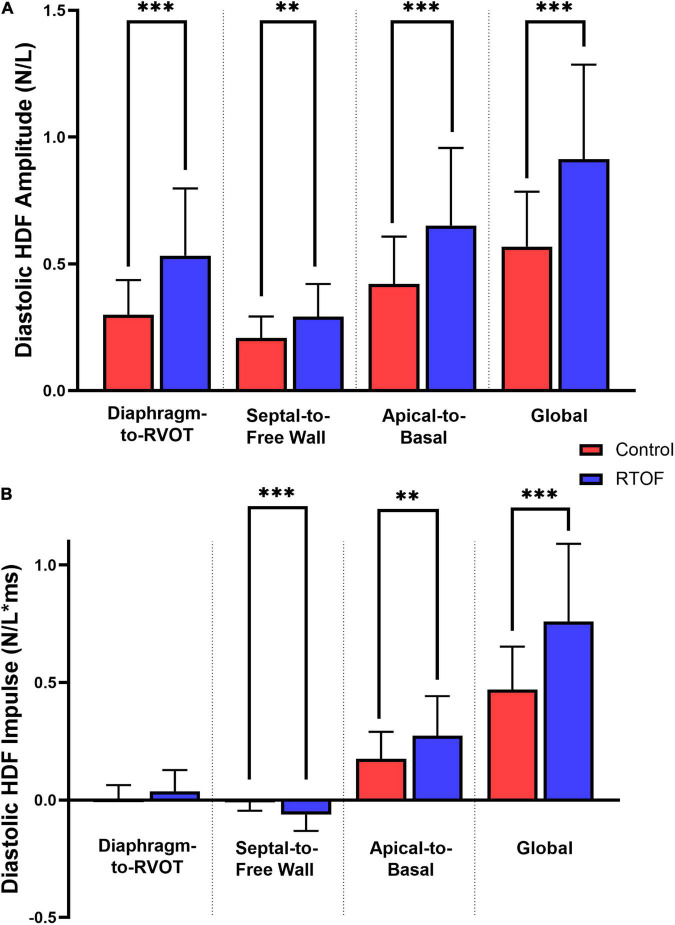
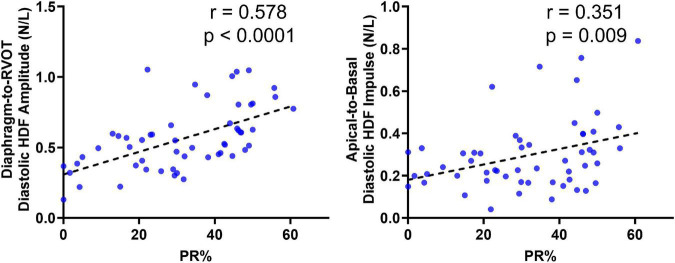
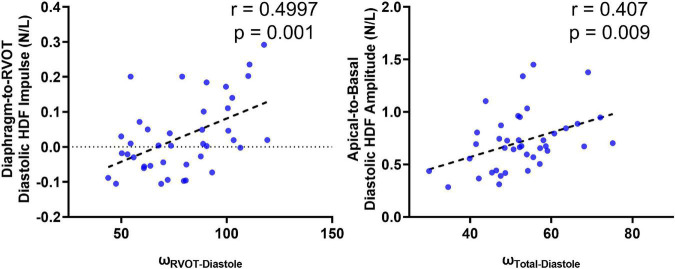
68 RTOF patients and 20 controls were included. RTOF patients had increased diastolic HDF amplitude in all three directions (<0.05). PR% correlated with Diaphragm-RVOT HDF amplitude/impulse ( = 0.578, <0.0001, = 0.508, < 0.0001, respectively). RV ejection fraction modestly correlated with global HDF amplitude ( = 0.2916, = 0.031). VO correlated with Septal-to-Free Wall HDF impulse ( = 0.536, = 0.007). Diaphragm-to-RVOT HDF correlated with RVOT vorticity ( = 0.4997, = 0.001). There was no significant measurement bias between Cine-derived HDF and 4D flow-derived HDF by Bland-Altman analysis.
RTOF patients have abnormal diastolic HDF that is correlated to PR, RV function, exercise capacity and vorticity. HDF can be derived from conventional cine, and is a potential link between RV wall motion and intracardiac flow from PR in RTOF patients.
心脏磁共振成像(CMR)已充分认识到慢性肺反流(PR)对法洛四联症修复术后(RTOF)患者右心室(RV)功能障碍的影响。然而,RV壁运动、心内血流与PR之间的联系尚未确立。血流动力学力(HDF)代表心内血容量与心内膜之间交换的整体力,可通过四维血流或一种新的壁运动数学模型进行测量。在我们的研究中,我们使用这种新方法,仅通过常规CMR成像来推导一组RTOF患者的HDF。
回顾性纳入接受CMR成像的RTOF患者和对照组。对RV的三维(3D)模型进行分割,包括RV流出道(RVOT)。特征跟踪软件(QStrain 2.0,Medis Medical Imaging Systems,荷兰莱顿)从长轴/短轴电影图像中捕捉心内膜轮廓,并用于重建RV壁运动。根据运动表面计算全局HDF向量,然后根据参考方向(心尖到心底、室间隔到游离壁和膈肌到RVOT方向)将其分解为三个方向分量的幅度/冲量。将HDF与CMR和运动应激试验参数进行比较并进行相关性分析。一部分RTOF患者进行了四维血流检查,用于推导涡度(进行相关性分析)和HDF(与电影图像法进行比较)。
纳入68例RTOF患者和20例对照组。RTOF患者在所有三个方向上舒张期HDF幅度均增加(P<0.05)。PR百分比与膈肌-RVOT HDF幅度/冲量相关(分别为r = 0.578,P<0.0001;r = 0.508,P<0.0001)。RV射血分数与全局HDF幅度适度相关(r = 0.2916,P = 0.031)。VO与室间隔到游离壁HDF冲量相关(r = 0.536,P = 0.007)。膈肌到RVOT HDF与RVOT涡度相关(r = 0.4997,P = 0.001)。通过Bland-Altman分析,电影图像法推导的HDF与四维血流法推导的HDF之间无显著测量偏差。
RTOF患者舒张期HDF异常,与PR、RV功能、运动能力及涡度相关。HDF可从传统电影图像中推导得出,是RTOF患者RV壁运动与PR引起的心内血流之间的潜在联系。