Gerstner Rebekka M, Narváez Freddy, Leske Stuart, Troya M Isabela, Analuisa-Aguilar Pablo, Spittal Matthew J, Gunnell David
Monitoring and Evaluation, German Institute for Medical Mission, Tübingen, Germany.
Ministry of Public Health, Undersecretary of Health Services, Quito, Ecuador.
Lancet Reg Health Am. 2022 Oct;14:100324. doi: 10.1016/j.lana.2022.100324. Epub 2022 Jul 25.
There are widespread concerns that the COVID-19 pandemic may increase suicides. Few studies have analysed effects beyond the pandemic's early months or examined changes in known suicide risk factors.
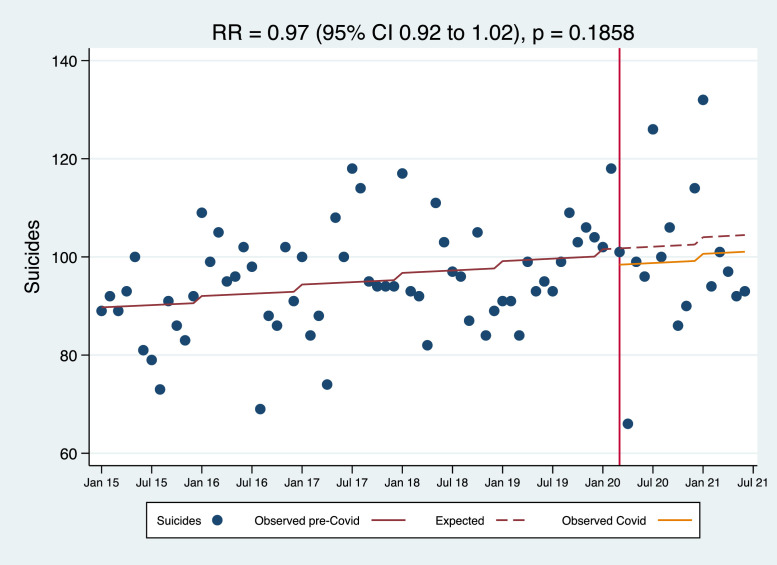
Using time series models fit with Poisson regression, we analysed monthly police-reported suicides in Ecuador from January 2015 to June 2021. Treating March 2020 as the start of the pandemic, we calculated rate ratios (RRs) comparing the observed to the expected number of suicides for the total population and by age and sex groups. We investigated changes in risk factors, precipitants, geographic distribution, and suicide methods.
There was no evidence that suicide rates were higher than expected during the pandemic (RR 0·97 [95% CI 0·92-1·02]). There was some evidence of fewer than expected male suicides (RR 0·95 [95% CI 0·90-1·00]). The proportion of suicides occurring in urban and coastal areas increased but decreased amongst indigenous and other minorities. The proportions of suicides with evidence of alcohol consumption, disability, and amongst married and cohabiting individuals decreased, whereas suicides where mental health problems were considered contributory increased. There were relative increases in the proportion of suicides by hanging but decreases in self-poisoning and other suicide methods.
The pandemic did not appear to adversely impact overall suicide numbers nationwide during the first 16 months of the pandemic. Reduced alcohol consumption may have contributed to the decline in male suicides.
None.
人们普遍担心新冠疫情可能会增加自杀率。很少有研究分析疫情最初几个月之后的影响,或研究已知自杀风险因素的变化。
我们使用泊松回归拟合的时间序列模型,分析了2015年1月至2021年6月厄瓜多尔警方每月报告的自杀事件。将2020年3月视为疫情开始,我们计算了总人群以及按年龄和性别分组的观察到的自杀人数与预期自杀人数的比率(RR)。我们调查了风险因素、诱发因素、地理分布和自杀方式的变化。
没有证据表明疫情期间自杀率高于预期(RR 0.97 [95% CI 0.92 - 1.02])。有一些证据表明男性自杀人数低于预期(RR 0.95 [95% CI 0.90 - 1.00])。城市和沿海地区自杀事件的比例有所增加,但在土著和其他少数群体中有所下降。有饮酒证据、残疾以及已婚和同居者中的自杀比例下降,而认为心理健康问题有促成作用的自杀比例上升。上吊自杀的比例相对增加,但自我中毒和其他自杀方式的比例下降。
在疫情的前16个月里,疫情似乎并未对全国总体自杀人数产生不利影响。酒精消费的减少可能导致了男性自杀人数的下降。
无。