Beijing Tongren Eye Center, Beijing Tongren Hospital, Capital Medical University, Beijing, China.
Beijing Ophthalmology and Visual Science Key Laboratory, Beijing, China.
BMC Ophthalmol. 2022 Aug 2;22(1):329. doi: 10.1186/s12886-022-02522-8.
To describe and analyze the clinical prognosis of infants diagnosed of familial exudative vitreoretinopathy (FEVR) with single gene mutation in long-term follow-up.
A retrospective case study was conducted on 355 FEVR infants with single positive gene.
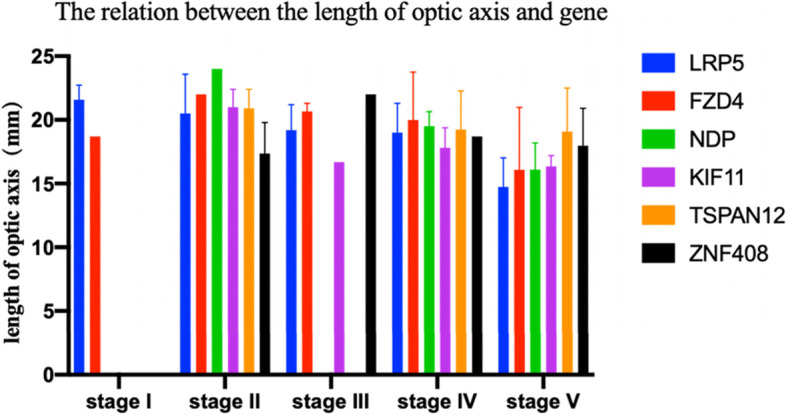
Of the 335 single-gene positive infant FEVR cases (under 3 years old), 20% (n = 67) was diagnosed of strabismus at first visit. Staging of various genotypes was different (P < 0.001). Patients with NDP mutations presented the most severe clinical phenotypes and patients with ZNF408 mutations presented the mildest clinical phenotypes. Most infants underwent surgery under 1 year old (5 stage 75 of 108 [69.44%]). The axial length of different genotypes showed no significant difference (P = 0.2891). The 1 to 3 stage cases were given intravitreal injection and/or retina photocoagulation with the last follow-up vision above 20/67. The 4 to 5 stage cases received the transcorneal vitrectomy with lensectomy or lens sparing vitrectomy (LSV), whose lens maintained transparent after LSV (11/14[78.58%]). After 2 to 10 years of follow-up, 37.96% (41/108) of post-surgery cases showed retinal funnel-like unfold and posterior pole unfold, 69.57% (16/ 23) of which received second surgery for closure of pupil with good prognosis. At the last follow-up, 20% (60/300) were with vision above 20/200.
LRP5 gene mutation was the most common mutation in FEVR patients. The severity of the clinical phenotype varied with different gene mutations. The main surgical methods for cases at Stage 4-5 were transcorneal vitrectomy with lensectomy or LSV. The earlier FEVR occurred, the worse prognosis would be. Active surgical intervention and lens sparing were necessary for cases at Stage 4-5.
描述和分析在长期随访中,经基因检测确诊为家族性渗出性玻璃体视网膜病变(FEVR)的单基因突变婴儿的临床预后。
对 355 例经基因检测确诊为 FEVR 的单基因阳性婴儿进行回顾性病例研究。
335 例单基因阳性婴儿 FEVR 病例(<3 岁)中,首次就诊时斜视发生率为 20%(n=67)。不同基因型的分期不同(P<0.001)。NDP 突变患者的临床表现最严重,ZNF408 突变患者的临床表现最轻微。大多数婴儿在 1 岁以下接受手术(108 例中有 5 期 75 例[69.44%])。不同基因型的眼轴长度无显著差异(P=0.2891)。1-3 期病例行玻璃体腔注药和/或视网膜光凝,末次随访视力>20/67。4-5 期病例行经角膜玻璃体切除术联合晶状体切除术或晶状体保留玻璃体切除术(LSV),LSV 后晶状体保持透明(14 例中有 11 例[78.58%])。2-10 年随访后,60 例(41/108)术后病例出现视网膜漏斗状展开和后极展开,23 例中有 16 例(69.57%)行瞳孔封闭二次手术,预后良好。末次随访时,20%(60/300)视力>20/200。
LRP5 基因突变是 FEVR 患者最常见的突变。不同基因突变的临床表型严重程度不同。4-5 期病例的主要手术方法为经角膜玻璃体切除术联合晶状体切除术或 LSV。FEVR 发生越早,预后越差。4-5 期病例需积极手术干预和晶状体保留。