Newborn Research, Department of Neonatology, University Hospital Zurich, University of Zurich, Zurich, Switzerland.
Department of Forensic Medicine and Imaging, Institute of Forensic Medicine, University of Zurich, Zurich, Switzerland.
BMC Pediatr. 2022 Aug 3;22(1):464. doi: 10.1186/s12887-022-03519-4.
Post-mortem imaging has been suggested as an alternative to conventional autopsy in the prenatal and postnatal periods. Noninvasive autopsies do not provide tissue for histological examination, which may limit their clinical value, especially when infection-related morbidity and mortality are suspected.
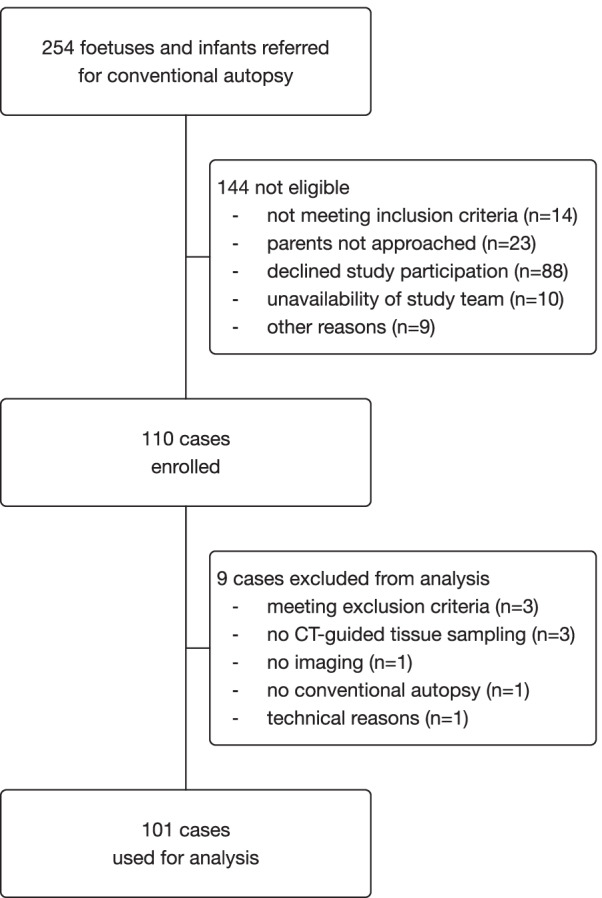
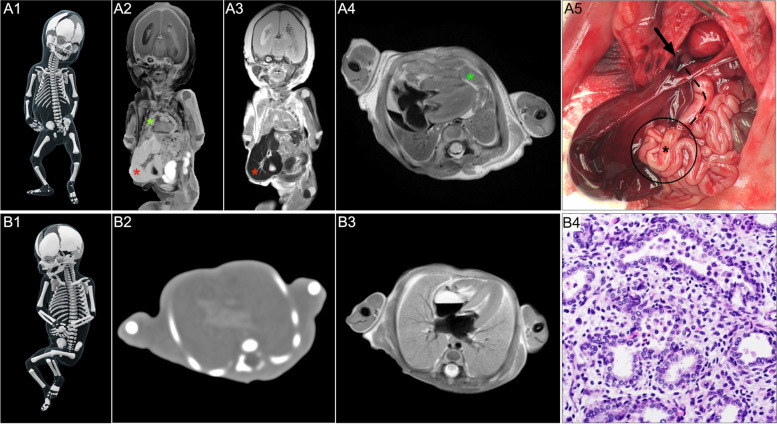
We performed a prospective, multicentre, cross-sectional study to compare the diagnostic performance of post-mortem magnetic resonance imaging with computed tomography-guided biopsy (Virtopsy®) with that of conventional autopsy in foetuses and infants. Cases referred for conventional autopsy were eligible for enrolment. After post-mortem imaging using a computed tomography scanner and a magnetic resonance imaging unit, computed tomography-guided tissue sampling was performed. Virtopsy results were compared with conventional autopsy in determining the likely final cause of death and major pathologies. The primary outcome was the proportion of cases for which the same cause of death was determined by both methods. Secondary outcomes included the proportion of false positive and false negative major pathological lesions detected by virtopsy and the proportion of computed tomography-guided biopsies that were adequate for histological examination.
Overall, 101 cases (84 fetuses, 17 infants) were included. Virtopsy and autopsy identified the same cause of death in 91 cases (90.1%, 95% CI 82.7 to 94.5). The sensitivity and specificity of virtopsy for determining the cause of death were 96.6% (95% CI 90.6 to 98.8) and 41.7% (95% CI 19.3 to 68.0), respectively. In 32 cases (31.7%, 95% CI 23.4 to 41.3), major pathological findings remained undetected by virtopsy, and in 45 cases (44.6%, 95% CI 35.2 to 54.3), abnormalities were diagnosed by virtopsy but not confirmed by autopsy. Computed tomography-guided tissue sampling was adequate for pathological comments in 506 of 956 biopsies (52.7%) and added important diagnostic value in five of 30 cases (16.1%) with an unclear cause of death before autopsy compared with postmortem imaging alone. In 19 of 20 infective deaths (95%), biopsies revealed infection-related tissue changes. Infection was confirmed by placental examination in all fetal cases.
Virtopsy demonstrated a high concordance with conventional autopsy for the detection of cause of death but was less accurate for the evaluation of major pathologies. Computed tomography-guided biopsy had limited additional diagnostic value.
ClinicalTrials.gov (NCT01888380).
在产前和产后阶段,尸检后成像已被提议作为传统尸检的替代方法。非侵入性尸检不能提供用于组织学检查的组织,这可能限制了其临床价值,尤其是当怀疑与感染有关的发病率和死亡率时。
我们进行了一项前瞻性、多中心、横断面研究,比较了死后磁共振成像与计算机断层扫描引导活检(Virtopsy®)在胎儿和婴儿中的诊断性能与传统尸检的诊断性能。符合条件的病例为常规尸检病例。在使用计算机断层扫描仪和磁共振成像设备进行死后成像后,进行计算机断层扫描引导组织取样。Virtopsy 结果与传统尸检结果进行比较,以确定死亡的可能最终原因和主要病理学。主要结局是两种方法确定相同死因的病例比例。次要结局包括通过 Virtopsy 检测到的假阳性和假阴性主要病理病变的比例,以及用于组织学检查的计算机断层扫描引导活检的比例。
总共纳入了 101 例病例(84 例胎儿,17 例婴儿)。Virtopsy 和尸检确定了 91 例(90.1%,95%CI82.7-94.5)相同的死亡原因。Virtopsy 确定死因的灵敏度和特异性分别为 96.6%(95%CI90.6-98.8)和 41.7%(95%CI19.3-68.0)。在 32 例(31.7%,95%CI23.4-41.3)中,Virtopsy 未能检测到主要病理学发现,在 45 例(44.6%,95%CI35.2-54.3)中,Virtopsy 诊断出异常,但尸检未证实。在 956 次活检中的 506 次(52.7%)中,计算机断层扫描引导组织取样足以进行病理评价,在与单独死后成像相比,在 30 例死因不明的病例中,有 5 例(16.1%)增加了重要的诊断价值。在 19 例感染性死亡(95%)中,活检显示与感染有关的组织变化。所有胎儿病例均通过胎盘检查证实感染。
Virtopsy 在检测死因方面与传统尸检具有很高的一致性,但在评估主要病理学方面准确性较低。计算机断层扫描引导活检的附加诊断价值有限。
ClinicalTrials.gov(NCT01888380)。