Addala Taki Eddine, Greffier Joël, Hamard Aymeric, Snene Fehmi, Bobbia Xavier, Bastide Sophie, Belaouni Asmaa, de Forges Hélène, Larbi Ahmed, de la Coussaye Jean-Emmanuel, Beregi Jean-Paul, Claret Pierre-Géraud, Frandon Julien
IMAGINE Research Unit 103, Department of Medical Imaging, Nîmes University Hospital, Montpellier University, Nîmes, France.
IMAGINE Research Unit 103, Emergency Department, Nîmes University Hospital, Montpellier University, Nîmes, France.
Quant Imaging Med Surg. 2022 Aug;12(8):4248-4258. doi: 10.21037/qims-21-848.
Ultra-low dose computed tomography (ULD-CT) was shown to be a good alternative to digital radiographs in various locations. This study aimed to assess the diagnostic sensitivity and specificity of ULD-CT versus digital radiographs in patients consulting for extremity traumas in emergency room.
Digital radiography and ULD-CT scan were performed in patients consulting at the emergency department (February-August 2018) for extremity traumas. Fracture detection was evaluated retrospectively by two blinded independent radiologists. Sensitivity and specificity were evaluated using best value comparator (BVC) and a Bayesian latent class model (LCM) approaches and clinical follow-up. Image quality, quality diagnostic and diagnostic confidence level were evaluated (Likert scale). The effective dose received was calculated.
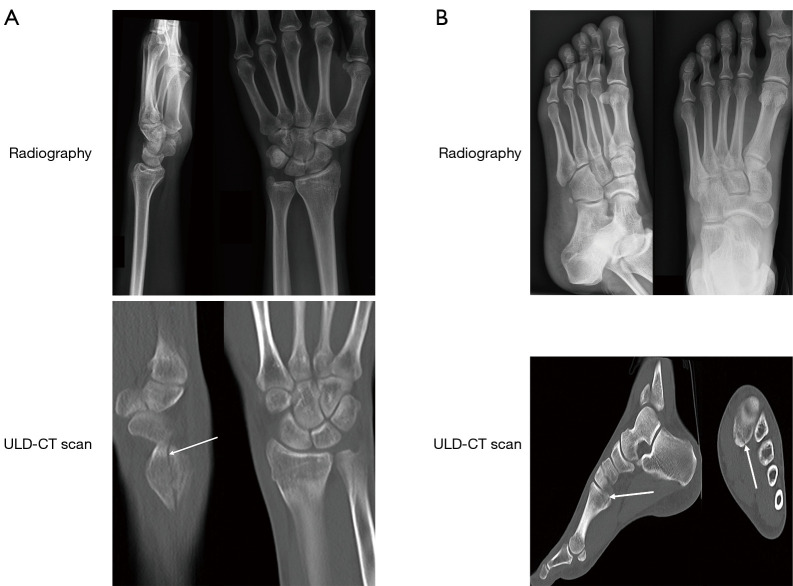
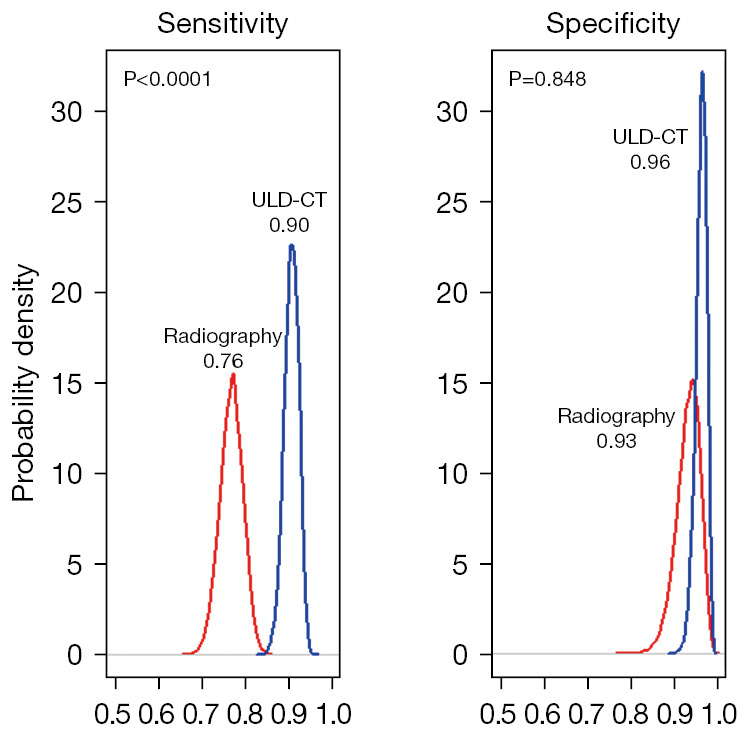
Seventy-six consecutive patients (41 men, mean age: 35.2±13.2 years), with 31 wrists/hands and 45 ankles/feet traumas were managed by emergency physicians. According to clinical data, radiography had 3 false positive and 10 false negative examinations, and ULD-CT, 2 of each. Radiography and ULD-CT specificities were similar; sensitivities were lower for radiography, with BVC and Bayesian. With Bayesian, ULD-CT and radiography sensitivities were 90% (95% CI: 87-93%) and 76% (95% CI: 71-81%, P<0.0001) and specificities 96% (95% CI: 93-98%) and 93% (95% CI: 87-97%, P=0.84). The inter-observer agreement was higher for ULD-CT for all subjective indexes. The effective dose for ULD-CT and radiography was 0.84±0.14 and 0.58±0.27 µSv (P=0.002) for hand/wrist, and 1.50±0.32 and 1.44±0.78 µSv (P=NS) for foot/ankle.
With an effective dose level close to radiography, ULD-CT showed better detection of extremities fractures in the emergency room and may allow treatment adaptation. Further studies need to be performed to assess impact of such examination in everyday practice.
ClinicalTrials.gov Identifier: NCT04832490.
超低剂量计算机断层扫描(ULD-CT)在多个部位已被证明是数字X线摄影的良好替代方法。本研究旨在评估在急诊室因肢体创伤就诊的患者中,ULD-CT与数字X线摄影相比的诊断敏感性和特异性。
对2018年2月至8月在急诊科因肢体创伤就诊的患者进行数字X线摄影和ULD-CT扫描。由两名独立的盲法放射科医生对骨折检测进行回顾性评估。使用最佳值比较器(BVC)和贝叶斯潜在类别模型(LCM)方法以及临床随访来评估敏感性和特异性。对图像质量、诊断质量和诊断置信水平进行评估(李克特量表)。计算所接受的有效剂量。
76例连续患者(41名男性,平均年龄:35.2±13.2岁),其中31例为手腕/手部创伤,45例为脚踝/足部创伤,由急诊医生进行处理。根据临床数据,X线摄影有3例假阳性和10例假阴性检查,ULD-CT各有2例。X线摄影和ULD-CT的特异性相似;X线摄影的敏感性较低,采用BVC和贝叶斯方法时均如此。采用贝叶斯方法时,ULD-CT和X线摄影的敏感性分别为90%(95%CI:87-93%)和76%(95%CI:71-81%,P<0.0001),特异性分别为96%(95%CI:93-98%)和93%(95%CI:87-97%,P=0.84)。对于所有主观指标,ULD-CT的观察者间一致性更高。手部/腕部的ULD-CT和X线摄影的有效剂量分别为0.84±0.14和0.58±0.27µSv(P=0.002),足部/踝部分别为1.50±0.32和1.44±0.78µSv(P=无显著性差异)。
ULD-CT的有效剂量水平与X线摄影相近,在急诊室对肢体骨折的检测表现更好,可能有助于调整治疗方案。需要进行进一步研究以评估这种检查在日常实践中的影响。
ClinicalTrials.gov标识符:NCT04832490。