Department of Palliative Medicine, Uniklinik RWTH Aachen, Faculty of Medicine, RWTH Aachen University, Pauwelsstr. 57, 52074, Aachen, Germany.
Department of Anaesthesia / Pain and Palliative Care Unit, College of Medicine, University of Nigeria, Ituku-Ozalla Campus, Enugu, Nigeria.
BMC Palliat Care. 2022 Aug 4;21(1):141. doi: 10.1186/s12904-022-01028-w.
Dealing with life-limiting illnesses, death, dying and grief, is uncharted territory for medical graduates. It is a field that is heavily influenced by cultural, religio-spiritual and social factors. This adds complexity to palliative and end-of-life-care, which challenges newly qualified physicians and requires the formation of appropriate knowledge, skills, and attitudes in junior doctors. This study aimed to obtain insight into the perspectives, perceived self-efficacy, and preparedness of newly qualified Nigerian physicians in practising palliative care and identify potential variables influencing them.
The study was a cross-sectional, multi-centre survey of newly qualified Nigerian physicians, using semi-structured, in-depth qualitative interviews. The data were analysed by applying content-structuring qualitative content analysis.
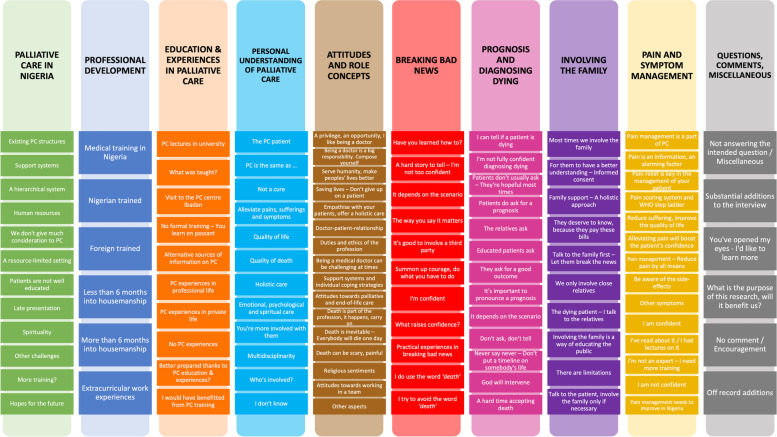
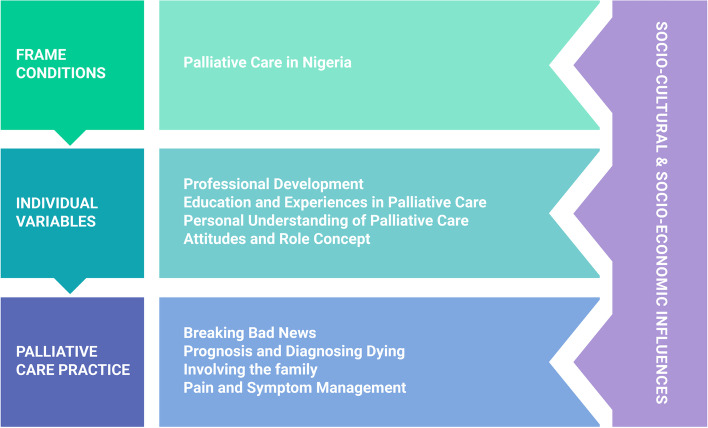
Forty semi-structured interviews were conducted with medical house officers at two tertiary institutions in Nigeria. The perceived self-efficacy and preparedness of newly qualified Nigerian physicians in practising palliative care were reported to be higher in areas of family involvement, and pain and symptom management than in areas of breaking bad news, prognosis, and diagnosing dying. Major influences on the young physicians' perceived self-efficacy and preparedness in practising palliative care were socio-economic circumstances of a resource-limited setting and cultural-religious considerations. In addition, the perceived impact of palliative care education and experience was documented.
This study offers valuable insights into the perceived self-efficacy and preparedness of newly qualified physicians and reveals the influence of socio-cultural and socio-economic variables in Nigeria. Evidence of the social, cultural, and religio-spiritual dimensions of palliative care is indispensable for culturally sensitive care. These results could aid in the development of appropriate knowledge, skills, and attitudes in newly qualified physicians through culturally and contextually appropriate palliative care training measures. The results may be applicable to other sub-Saharan African settings and may be used to improve future palliative care education, training, and practice.
处理绝症、死亡、濒死和悲伤是医学毕业生未知的领域。这个领域深受文化、宗教-精神和社会因素的影响。这给姑息治疗和临终关怀带来了复杂性,这对新合格的医生提出了挑战,需要在年轻医生中形成适当的知识、技能和态度。本研究旨在了解新合格的尼日利亚医生在实践姑息治疗方面的观点、自我效能感和准备情况,并确定影响他们的潜在变量。
这项研究是对尼日利亚两家三级医疗机构的新合格尼日利亚医生进行的横断面、多中心调查,采用半结构式深入定性访谈。通过应用内容结构定性内容分析对数据进行分析。
在尼日利亚的两家三级医疗机构对 40 名住院医师进行了半结构式深入定性访谈。新合格的尼日利亚医生在实践姑息治疗方面的自我效能感和准备情况报告在家庭参与以及疼痛和症状管理方面较高,而在告知坏消息、预后和诊断临终方面则较低。影响年轻医生在实践姑息治疗方面自我效能感和准备情况的主要因素是资源有限环境的社会经济情况和文化宗教考虑。此外,还记录了对姑息治疗教育和经验的感知影响。
本研究深入了解了新合格医生的自我效能感和准备情况,并揭示了尼日利亚社会文化变量的影响。姑息治疗的社会、文化和宗教精神维度的证据对于文化敏感的护理是必不可少的。这些结果可以通过文化和背景适当的姑息治疗培训措施,帮助在新合格医生中发展适当的知识、技能和态度。这些结果可能适用于其他撒哈拉以南非洲国家,并可用于改善未来的姑息治疗教育、培训和实践。