School of Materials and Chemistry & Institute of Bismuth and Rhenium, University of Shanghai for Science and Technology, Shanghai, China.
Department of Cardio-Pulmonary Circulation, School of Medicine, Shanghai Pulmonary Hospital, Tongji University, Shanghai, China.
Animal Model Exp Med. 2023 Apr;6(2):81-91. doi: 10.1002/ame2.12264. Epub 2022 Aug 3.
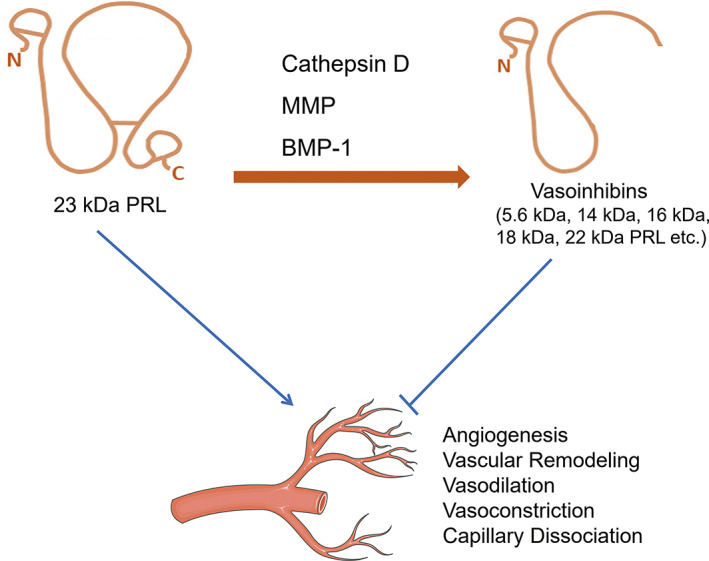
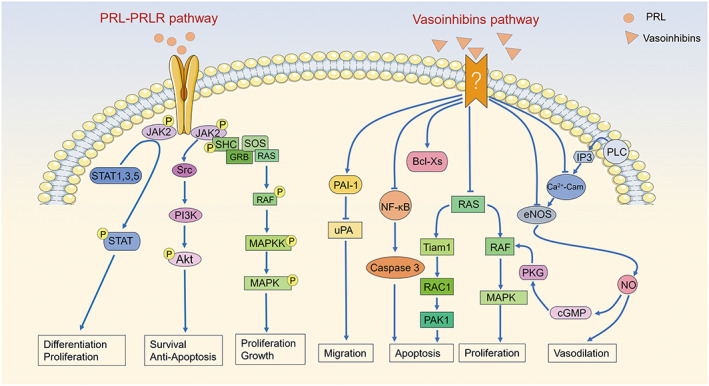
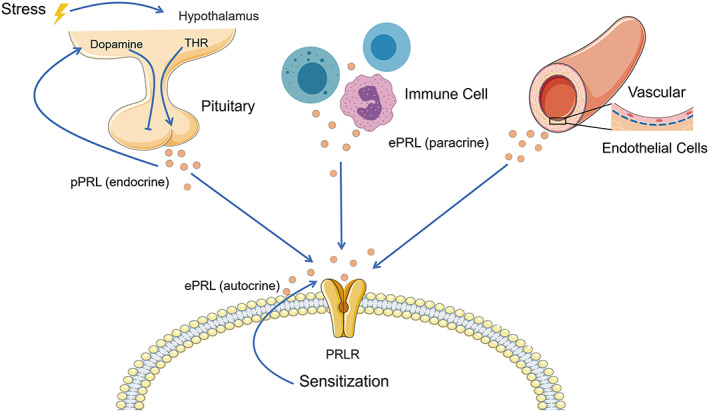
Prolactin (PRL) is a polypeptide hormone that is mainly synthesized and secreted by the lactotroph cells of the pituitary. There are two main isoforms of PRL: 23-kDa PRL (named full-length PRL) and vasoinhibins (including 5.6-18 kDa fragments). Both act as circulating hormones and cytokines to stimulate or inhibit vascular formation at different stages and neovascularization, including endothelial cell proliferation and migration, protease production, and apoptosis. However, their effects on vascular function and cardiovascular diseases are different or even contrary. In addition to the structure, secretion regulation, and signal transduction of PRL/vasoinhibins, this review focuses on the pathological mechanism and clinical significance of PRL/vasoinhibins in cardiovascular diseases.
催乳素(PRL)是一种主要由垂体的泌乳细胞合成和分泌的多肽激素。PRL 有两种主要的同工型:23kDa PRL(命名为全长 PRL)和血管抑制素(包括 5.6-18kDa 片段)。它们都作为循环激素和细胞因子,在不同阶段刺激或抑制血管形成和新血管生成,包括内皮细胞增殖和迁移、蛋白酶产生和细胞凋亡。然而,它们对血管功能和心血管疾病的影响是不同的,甚至是相反的。除了 PRL/血管抑制素的结构、分泌调节和信号转导外,本综述还重点介绍了 PRL/血管抑制素在心血管疾病中的病理机制和临床意义。