Hospital of Stomatology, Sun Yat-sen University, Guangzhou 51055, China; Guangdong Provincial Key Laboratory of Stomatology, Guangzhou 510080, China; Guanghua School of Stomatology, Sun Yat-sen University, Guangzhou 51055, China.
Department of Urology, Zhujiang Hospital, Southern Medical University, Guangzhou 510000, China.
Mol Ther. 2022 Nov 2;30(11):3394-3413. doi: 10.1016/j.ymthe.2022.07.022. Epub 2022 Aug 3.
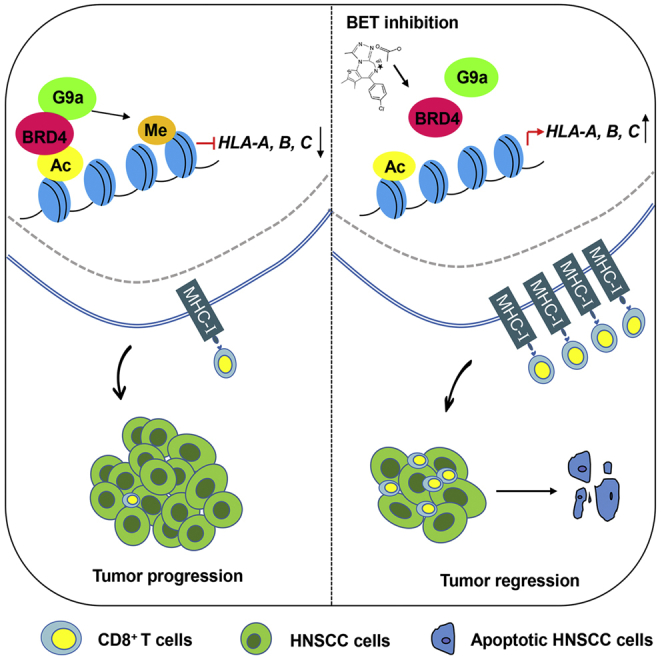
BET inhibition has been shown to have a promising antitumor effect in multiple tumors. However, the impact of BET inhibition on antitumor immunity was still not well documented in HNSCC. In this study, we aim to assess the functional role of BET inhibition in antitumor immunity and clarify its mechanism. We show that BRD4 is highly expressed in HNSCC and inversely correlated with the infiltration of CD8 T cells. BET inhibition potentiates CD8 T cell-based antitumor immunity in vitro and in vivo. Mechanistically, BRD4 acts as a transcriptional suppressor and represses the expression of MHC class I molecules by recruiting G9a. Pharmacological inhibition or genetic depletion of BRD4 potently increases the expression of MHC class I molecules in the absence and presence of IFN-γ. Moreover, compared to PD-1 blocking antibody treatment or JQ1 treatment individually, the combination of BET inhibition with anti-PD-1 antibody treatment significantly enhances the antitumor response in HNSCC. Taken together, our data unveil a novel mechanism by which BET inhibition potentiates antitumor immunity via promoting the expression of MHC class I molecules and provides a rationale for the combination of ICBs with BET inhibitors for HNSCC treatment.
BET 抑制已被证明在多种肿瘤中具有有前景的抗肿瘤作用。然而,BET 抑制对 HNSCC 中的抗肿瘤免疫的影响仍未得到充分记录。在这项研究中,我们旨在评估 BET 抑制在抗肿瘤免疫中的功能作用,并阐明其机制。我们表明,BRD4 在 HNSCC 中高度表达,并且与 CD8 T 细胞的浸润呈负相关。BET 抑制在体外和体内增强了基于 CD8 T 细胞的抗肿瘤免疫。从机制上讲,BRD4 作为转录抑制剂发挥作用,并通过招募 G9a 来抑制 MHC I 类分子的表达。BRD4 的药理学抑制或基因耗竭在没有 IFN-γ的情况下强烈增加 MHC I 类分子的表达,并且在存在 IFN-γ的情况下也增加。此外,与 PD-1 阻断抗体治疗或 JQ1 治疗单独相比,BET 抑制与抗 PD-1 抗体治疗联合使用可显著增强 HNSCC 的抗肿瘤反应。总之,我们的数据揭示了 BET 抑制通过促进 MHC I 类分子的表达来增强抗肿瘤免疫的新机制,并为将 ICB 与 BET 抑制剂联合用于 HNSCC 治疗提供了依据。