Luu Thi Thanh Huong, Eichner Adina, Wohlrab Johannes
Universitätsklinik für Dermatologie und Venerologie, Martin-Luther-Universität Halle-Wittenberg, Ernst-Grube-Str. 40, 06097, Halle (Saale), Deutschland.
Institut für angewandte Dermatopharmazie, Martin-Luther-Universität Halle-Wittenberg, Halle (Saale), Deutschland.
Dermatologie (Heidelb). 2022 Nov;73(11):873-879. doi: 10.1007/s00105-022-05031-3. Epub 2022 Jul 11.
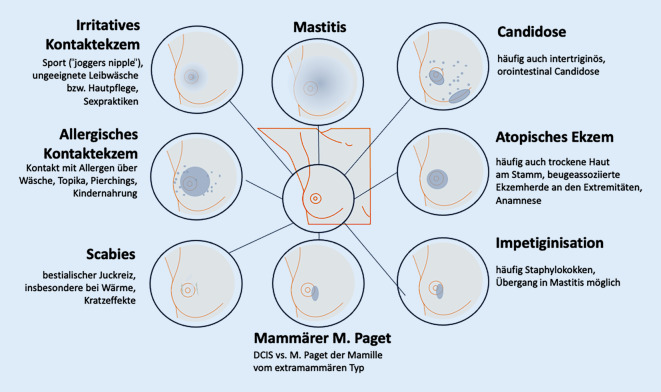
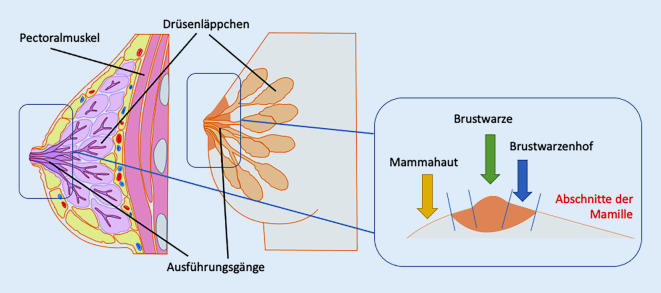
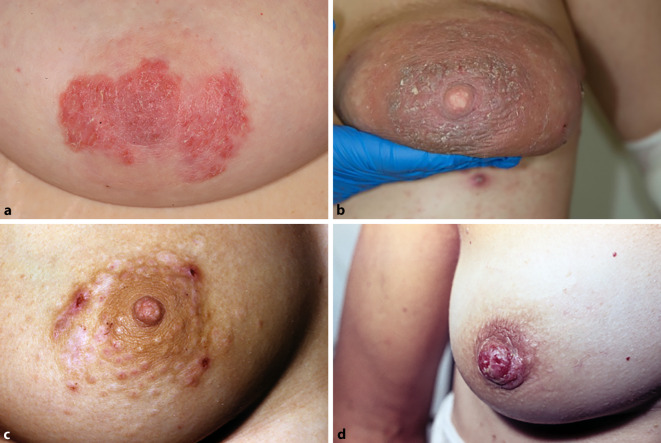
The nipple region is characterized by special anatomical conditions and from a dermatological perspective can be divided into breast skin, skin of the areola and the skin of the nipple. In a clinical context the nipples are often altered during lactation by mechanical alteration, changes in the environment with maceration by the milk flow and by microbial pathogens. In addition, there is a risk of developing puerperal mastitis. Outside of pregnancy and lactation, eczema diseases are occasionally found on the mammary skin, often with atopic disposition (atopic nipple eczema) or as irritant contact eczema ("joggers nipple"). More rarely, allergic contact eczema is observed from preservatives in topical preparations or metals (piercings). Also, in the context of a scabies infestation involvement of the nipples, especially in women, is regularly observed. Of great clinical importance are rare preinvasive lesions of breast cancer or Paget's disease of the mamilla of the extramammary type. Due to the special anatomical conditions, it is obvious that specific penetration conditions are also derived from the application of topical substances. Experimental studies on human skin ex vivo suggest that depending on the molecular weight and solubility of the drug as well as the vehicle system used, a significant increase in cutaneous bioavailability, especially on the nipple itself through the transpapillary diffusion pathway, may occur. This should be considered in particular in the topical application of drugs with known potential of dose-dependent side effects (e.g. glucocorticoids); however, there is still no clinical evidence for this.
乳头区域具有特殊的解剖学条件,从皮肤病学角度可分为乳房皮肤、乳晕皮肤和乳头皮肤。在临床情况下,乳头在哺乳期常因机械性改变、乳汁流动浸渍导致的环境变化以及微生物病原体而发生改变。此外,还有发生产褥期乳腺炎的风险。在妊娠和哺乳期之外,乳腺皮肤偶尔会出现湿疹疾病,通常具有特应性倾向(特应性乳头湿疹)或为刺激性接触性湿疹(“跑步者乳头”)。更罕见的是,从局部制剂中的防腐剂或金属(穿孔)观察到过敏性接触性湿疹。此外,在疥疮感染的情况下,乳头受累,尤其是在女性中,经常可以观察到。具有重要临床意义的是罕见的乳腺癌侵袭前病变或乳腺外乳头派杰氏病。由于特殊的解剖学条件,显然局部用药也会产生特定的渗透情况。人体皮肤离体实验研究表明,根据药物的分子量和溶解度以及所用的载体系统,皮肤生物利用度可能会显著增加,尤其是通过经乳头扩散途径在乳头本身。对于具有已知剂量依赖性副作用潜力的药物(如糖皮质激素)的局部应用,应特别考虑这一点;然而,目前仍没有这方面的临床证据。