Department of Surgery, Flevoziekenhuis, Hospitaalweg 1, 1315 RA, Almere, The Netherlands.
Department of Surgery, Amsterdam UMC, Location AMC, Amsterdam, The Netherlands.
Hernia. 2023 Feb;27(1):119-125. doi: 10.1007/s10029-022-02651-5. Epub 2022 Aug 4.
The Lichtenstein hernioplasty has long been seen as the gold standard for inguinal hernia repair. Unfortunately, this repair is often associated with chronic pain, up to 10-35%. Therefore, several new techniques have been developed, such as the transinguinal preperitoneal patch (TIPP) and the endoscopic total extraperitoneal (TEP) technique. Several studies showed beneficial results of the TIPP and TEP compared to the Lichtenstein hernioplasty; however, little is published on the outcome when comparing the TIPP and TEP procedures. This study aimed to evaluate outcomes after the TIPP vs the TEP technique for inguinal hernia repair.
A single-center randomized controlled trial was carried out between 2015 and 2020. A total of 300 patients with unilateral inguinal hernia were enrolled and randomized to the TIPP- or TEP technique. Primary outcome was chronic pain (defined as any pain following the last 3 months) and quality of life, assessed with Carolinas comfort scale (CCS) at 12 months. Secondary outcomes were: wound infection, wound hypoesthesia, recurrence, readmission within 30 days, and reoperation.
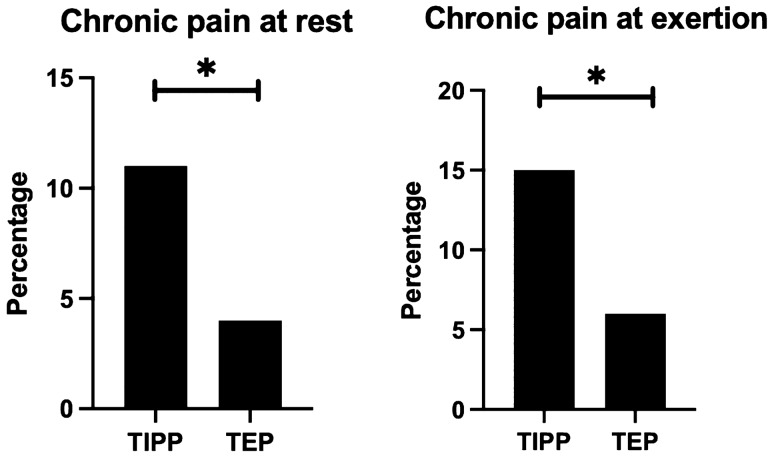
A total of 300 patients were randomized (150 per group). After a follow-up of 12 months, we observed significantly less postoperative chronic groin pain, chronic pain at exertion, wound hypoesthesia, and wound infections after the TEP when compared to the TIPP procedure. No significant differences in quality of life, reoperations, recurrence rate, and readmission within 30 days were observed.
We showed that the TEP has a favorable outcome compared to the TIPP procedure, leading to less postoperative pain and wound complications, whereas recurrence rates and reoperations were equal in both the groups.
Lichtenstein 疝修补术长期以来一直被视为腹股沟疝修补的金标准。不幸的是,这种修复常常与慢性疼痛相关,发生率为 10-35%。因此,已经开发出几种新技术,例如经腹股沟腹膜前补片(TIPP)和内镜完全腹膜外(TEP)技术。几项研究表明,TIPP 和 TEP 与 Lichtenstein 疝修补术相比具有更好的效果;然而,关于比较 TIPP 和 TEP 手术结果的报道很少。本研究旨在评估 TIPP 与 TEP 技术治疗腹股沟疝的结果。
这是一项在 2015 年至 2020 年期间进行的单中心随机对照试验。共纳入 300 例单侧腹股沟疝患者,并随机分为 TIPP 或 TEP 组。主要结局是慢性疼痛(定义为最后 3 个月内的任何疼痛)和生活质量,采用卡罗来纳舒适度量表(CCS)在 12 个月时进行评估。次要结局包括:伤口感染、伤口感觉减退、复发、30 天内再入院和再次手术。
共随机分配了 300 例患者(每组 150 例)。随访 12 个月后,与 TIPP 组相比,TEP 组术后慢性腹股沟疼痛、运动时疼痛、伤口感觉减退和伤口感染明显减少。在生活质量、再次手术、复发率和 30 天内再入院方面无显著差异。
我们表明,TEP 与 TIPP 手术相比具有更好的结果,导致术后疼痛和伤口并发症减少,而复发率和再次手术在两组中相等。